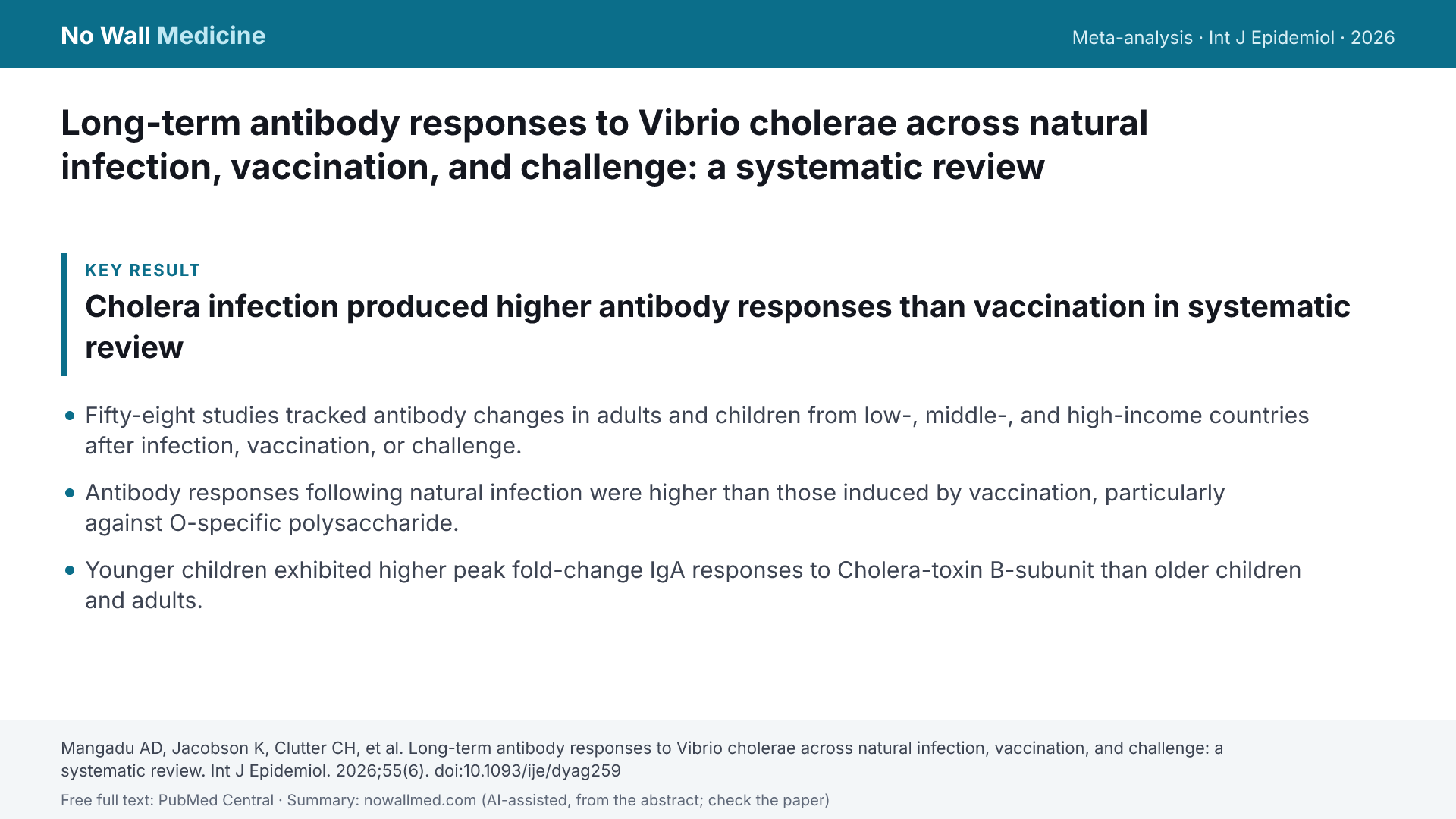
Cholera infection produced higher antibody responses than vaccination in systematic review
Long-term antibody responses to Vibrio cholerae across natural infection, vaccination, and challenge: a systematic review
Why it matters: Applies to interpreting cholera seroepidemiology; highlights how age, geography, and exposure type influence antibody trajectories.
Key points
- Fifty-eight studies tracked antibody changes in adults and children from low-, middle-, and high-income countries after infection, vaccination, or challenge.
- Antibody responses following natural infection were higher than those induced by vaccination, particularly against O-specific polysaccharide.
- Younger children exhibited higher peak fold-change IgA responses to Cholera-toxin B-subunit than older children and adults.
Limitation the authors note: Limited data from challenge studies revealed slower decay of IgG compared to IgA and IgM.
Headline and key points written with AI from the paper’s abstract, with every number checked against it. Read the paper before relying on them.
Was this summary helpful?
Subject terms
Headline, design, result, key points, caveat and citation as plain text.
Cite this article
Mangadu AD, Jacobson K, Clutter CH, et al. Long-term antibody responses to Vibrio cholerae across natural infection, vaccination, and challenge: a systematic review. Int J Epidemiol. 2026;55(6). doi:10.1093/ije/dyag259
Spotted a mistake? Suggest a correction