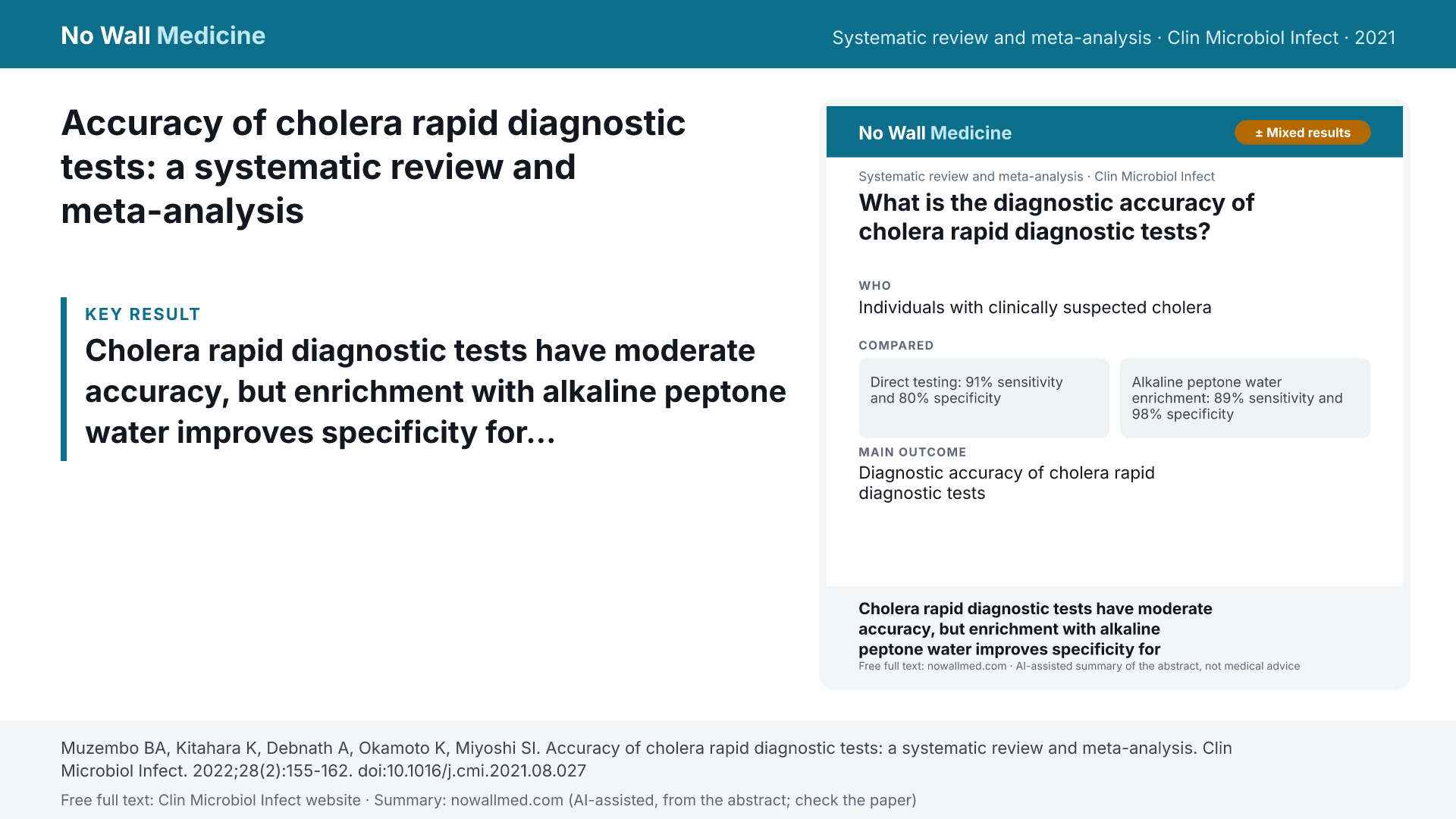
Accuracy of cholera rapid diagnostic tests: a systematic review and meta-analysis
Systematic review and meta-analysisMixed results
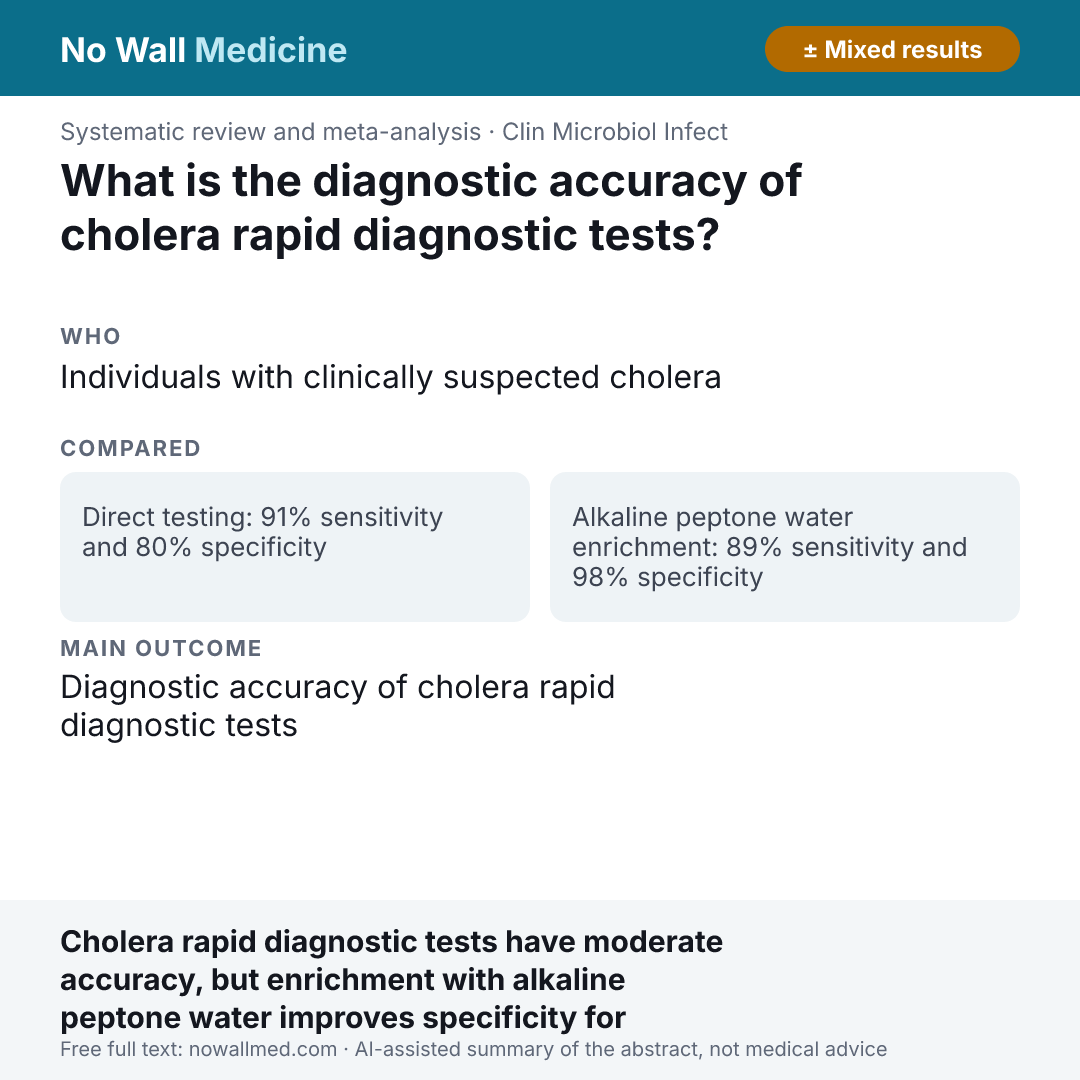
What is the diagnostic accuracy of cholera rapid diagnostic tests?
Who
Individuals with clinically suspected cholera
Compared
Direct testing: 91% sensitivity and 80% specificity
Alkaline peptone water enrichment: 89% sensitivity and 98% specificity
Main outcome
Diagnostic accuracy of cholera rapid diagnostic tests
Bottom line: Cholera rapid diagnostic tests have moderate accuracy, but enrichment with alkaline peptone water improves specificity for surveillance efforts.
Limitation: Alkaline peptone water enriched tests are not necessarily rapid tests.
Clin Microbiol Infect · 2021-09-15 · PROSPERO CRD42021233124
Abstract
Background
Cholera is an acute diarrheal disease caused by Vibrio cholerae O1 or O139. Cholera rapid diagnostic tests (RDTs) are widely used to screen for cholera cases. However, their accuracy has not been systematically reviewed. Objectives
To evaluate the diagnostic accuracy of cholera RDTs. Methods
Systematic review and meta-analysis. Data sources
Medline, EMBASE and Web of science through to November 2020; references of included studies and a technical guidance on cholera RDTs. This review is registered with PROSPERO (CRD42021233124). Study eligibility criteria
Cross-sectional studies comparing the performance of cholera RDTs either to stool culture or PCR. Participants
Individuals with clinically suspected cholera. Data extraction
Two authors independently extracted data and assessed the quality using Quality Assessment of Diagnostic Accuracy Studies 2 (QUADAS-2) criteria. Results
Eighteen studies were included in the systematic review of which 17 were used for meta-analysis. Crystal VC was the most frequently used RDT (13 studies), followed by Cholkit and Institut Pasteur cholera dipstick (three studies each), SD Bioline (two studies), Artron (one study) and Smart (one study). Using direct testing (n = 12 627 specimens), the bivariate random-effects model yielded a pooled sensitivity and specificity of 91% (95% CI 87%-94%) and 80% (95% CI 74%-84%), respectively. However, through alkaline peptone water (APW) enrichment (n = 3403 specimens), the pooled sensitivity and specificity were 89% (95% CI 79%-95%) and 98% (95% CI 95%-99%), respectively. Conclusion
Cholera RDTs, especially when enriched with APW, have moderate sensitivity and specificity. Although less useful for clinical management, the current generation of RDTs have clear utility for surveillance efforts if used in a principled manner. Enrichment of stool specimens in APW before using cholera RDTs reduces the possibility of obtaining false-positive results, despite the few cholera cases that go undetected. It is noteworthy that APW-enriched cholera RDTs are not necessarily rapid tests, and are not listed in the Global Task Force on Cholera Control/WHO target product profile.
Subject terms
Cite this article
Muzembo BA, Kitahara K, Debnath A, Okamoto K, Miyoshi SI. Accuracy of cholera rapid diagnostic tests: a systematic review and meta-analysis. Clin Microbiol Infect. 2022;28(2):155-162. doi:10.1016/j.cmi.2021.08.027
Spotted a mistake? Suggest a correction