Proteomic protein signatures were linked to mortality in patients with heart failure
Proteomics for heart failure risk stratification: a systematic review
Systematic reviewUnclear result
Can high-throughput proteomics identify protein signatures associated with heart failure mortality?
Who
Patients with heart failure
Compared
Aptamer platform studies
Antibody platform studies
Main outcome
All-cause or cardiovascular death
Bottom line: Proteomics can identify common proteins associated with mortality, but high heterogeneity prevents broad clinical inferences.
Limitation: Considerable heterogeneity in measurement panels, heart failure definitions, and follow-up duration.
BMC Med · 2024-01-25Download image
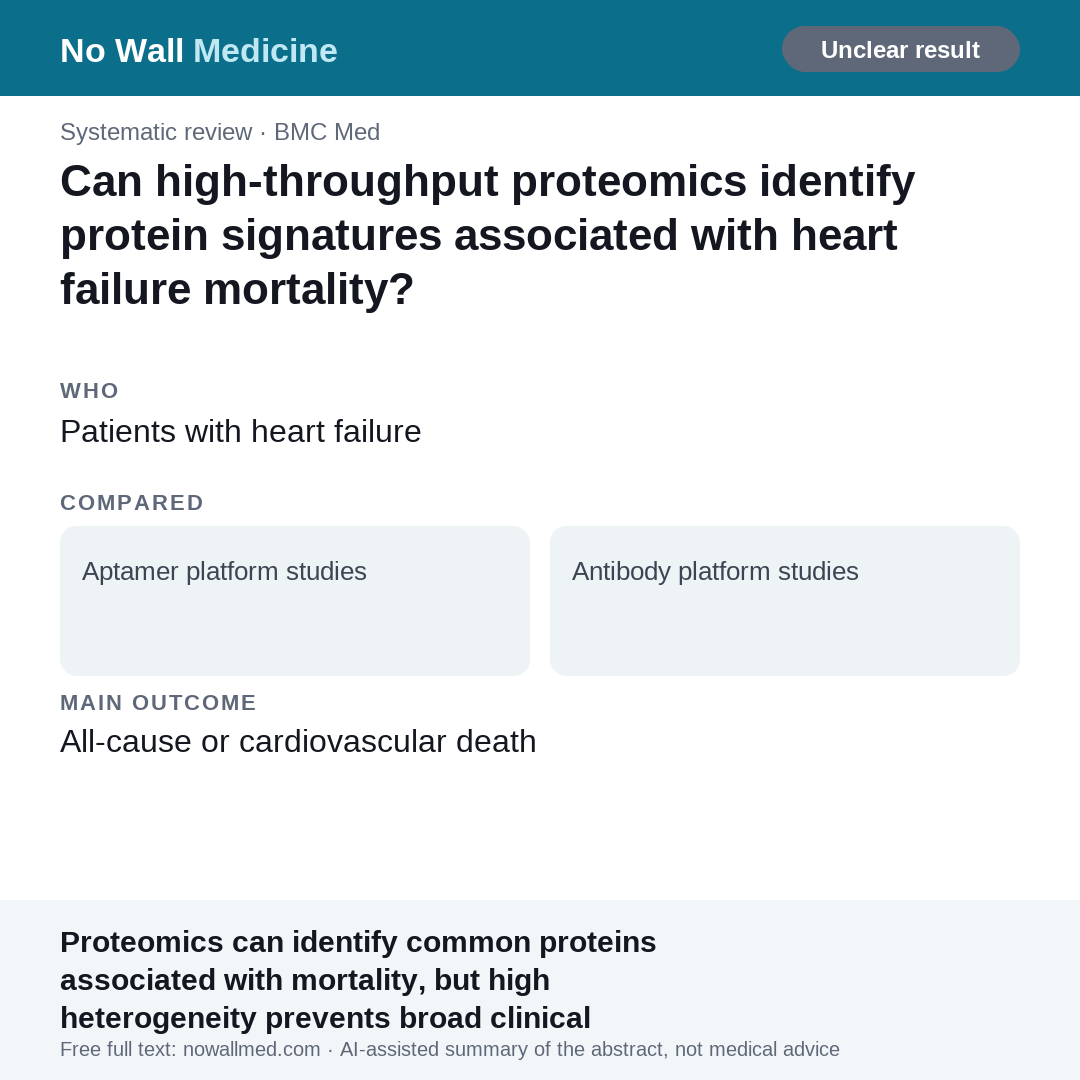
Clinical question: Can high-throughput proteomics identify protein signatures associated with heart failure mortality?
Why it matters: The contribution of high-throughput proteomics to identifying protein signatures associated with heart failure mortality remains to be clearly defined.
Key points
- Researchers reviewed nine observational studies published between 2012 and 2023 that used high-throughput proteomics to measure proteins in human blood.
- In two similar studies of patients with heart failure and reduced ejection fraction, 21 proteins were commonly associated with all-cause death.
- One specific protein, WAP four-disulfide core domain protein 2, was associated with both all-cause death and cardiovascular death across different studies.
Limitation the authors note: Considerable heterogeneity across studies in measurement panels, heart failure definitions, ejection fraction categorization, follow-up duration, and outcome definitions compromised drawing broad inferences.
Headline and key points written with AI from the paper’s abstract, with every number checked against it. Read the paper before relying on them.
Topics
Cite this article
Kuku KO, Oyetoro R, Hashemian M, Livinski AA, Shearer JJ, Joo J. Proteomics for heart failure risk stratification: a systematic review. BMC Med. 2024. doi:10.1186/s12916-024-03249-7
Spotted a mistake? Suggest a correction
Top studies every Monday
The week’s key trials and guidelines in your specialties, plus any topics you follow. By email, free.
Get the weekly digest