Natriuresis-guided diuretic therapy increased urine output and sodium excretion in acute heart failure patients
Protocolized natriuresis-guided diuretic therapy in acute heart failure: a systematic review and meta-analysis
Systematic review and meta-analysisBenefit found
Is natriuresis-guided diuretic therapy effective and safe in acute heart failure?
Who
933
Patients with acute heart failure
Compared
Natriuresis-guided therapy: GMR 1.30 for natriuresis; GMR 1.21 for diuresis
Standard management
Main outcome
Natriuresis, diuresis, and safety outcomes
Result: GMR 1.30 (95% CI 1.14 to 1.49) for natriuresis
Bottom line: Protocolized natriuresis-guided therapy improves diuresis and natriuresis and reduces doubling serum creatinine risk in acute heart failure.
Limitation: Further large randomized controlled trials are needed to evaluate clinical endpoints in diverse settings.
Crit Care · 2025-11-05Download image
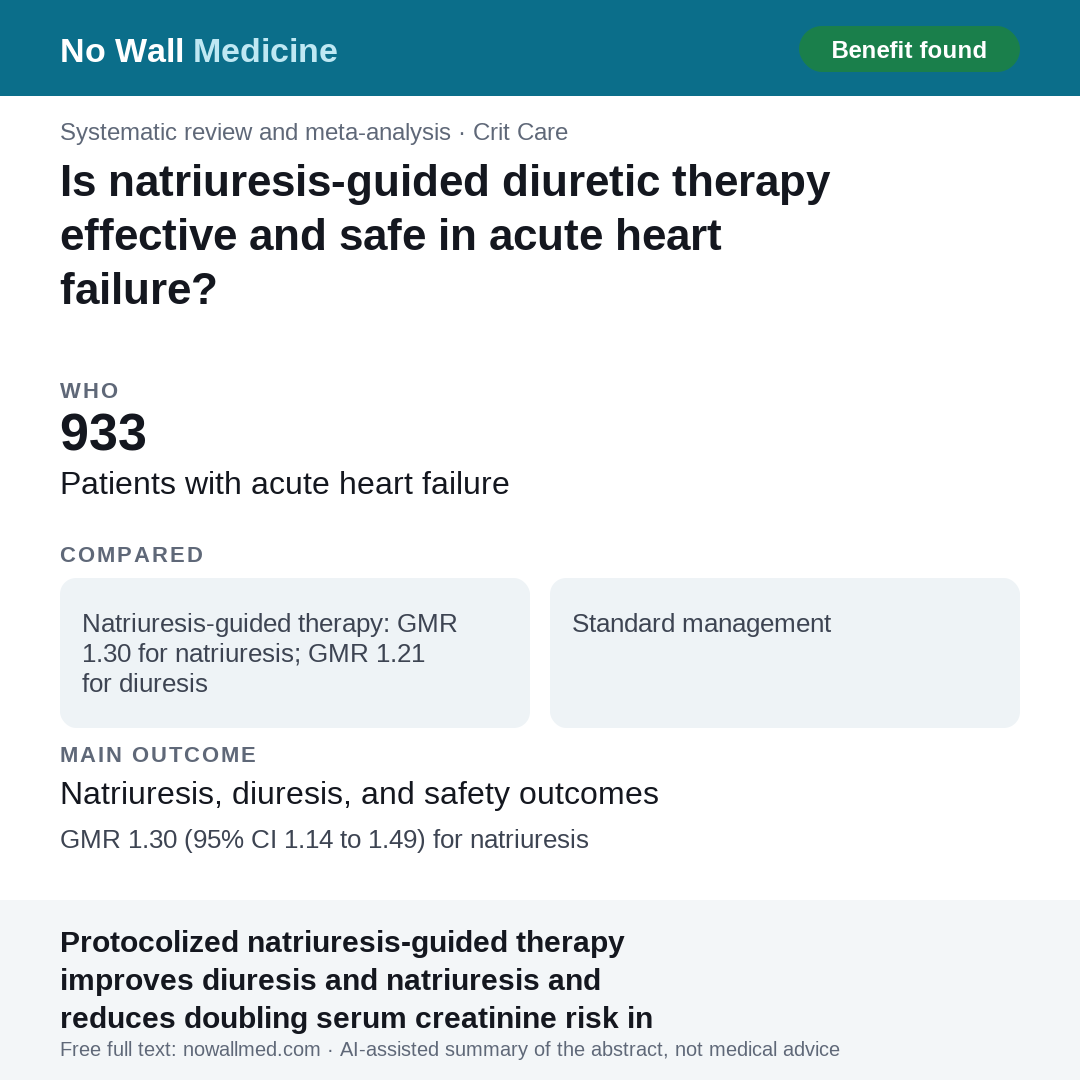
Clinical question: Is natriuresis-guided diuretic therapy effective and safe in acute heart failure?
Why it matters: Evidence-based strategies for optimal loop diuretic dosing and monitoring in acute heart failure remain limited.
Key points
- Researchers analyzed five studies involving 933 patients with acute heart failure to compare protocolized natriuresis-guided diuretic therapy against standard management.
- Protocolized therapy was associated with higher natriuresis (GMR: 1.30; 95% CI: 1.14 to 1.49) and diuresis (GMR: 1.21; 95% CI: 1.09 to 1.35) after 48 h.
- The approach was associated with a lower risk of doubling serum creatinine (RR: 0.52; 95% CI: 0.28 to 0.98) without increasing hypokalemia or hypotension.
Limitation the authors note: The authors state that further large randomized controlled trials are needed to evaluate effects on clinical endpoints in diverse healthcare settings and patients worldwide.
Headline and key points written with AI from the paper’s abstract, with every number checked against it. Read the paper before relying on them.
Topics
Cite this article
Prata AA, Prata AA, Coan ACC, Scardini PG, Fernandes JM, Neto WF. Protocolized natriuresis-guided diuretic therapy in acute heart failure: a systematic review and meta-analysis. Crit Care. 2025. doi:10.1186/s13054-025-05707-x
Spotted a mistake? Suggest a correction