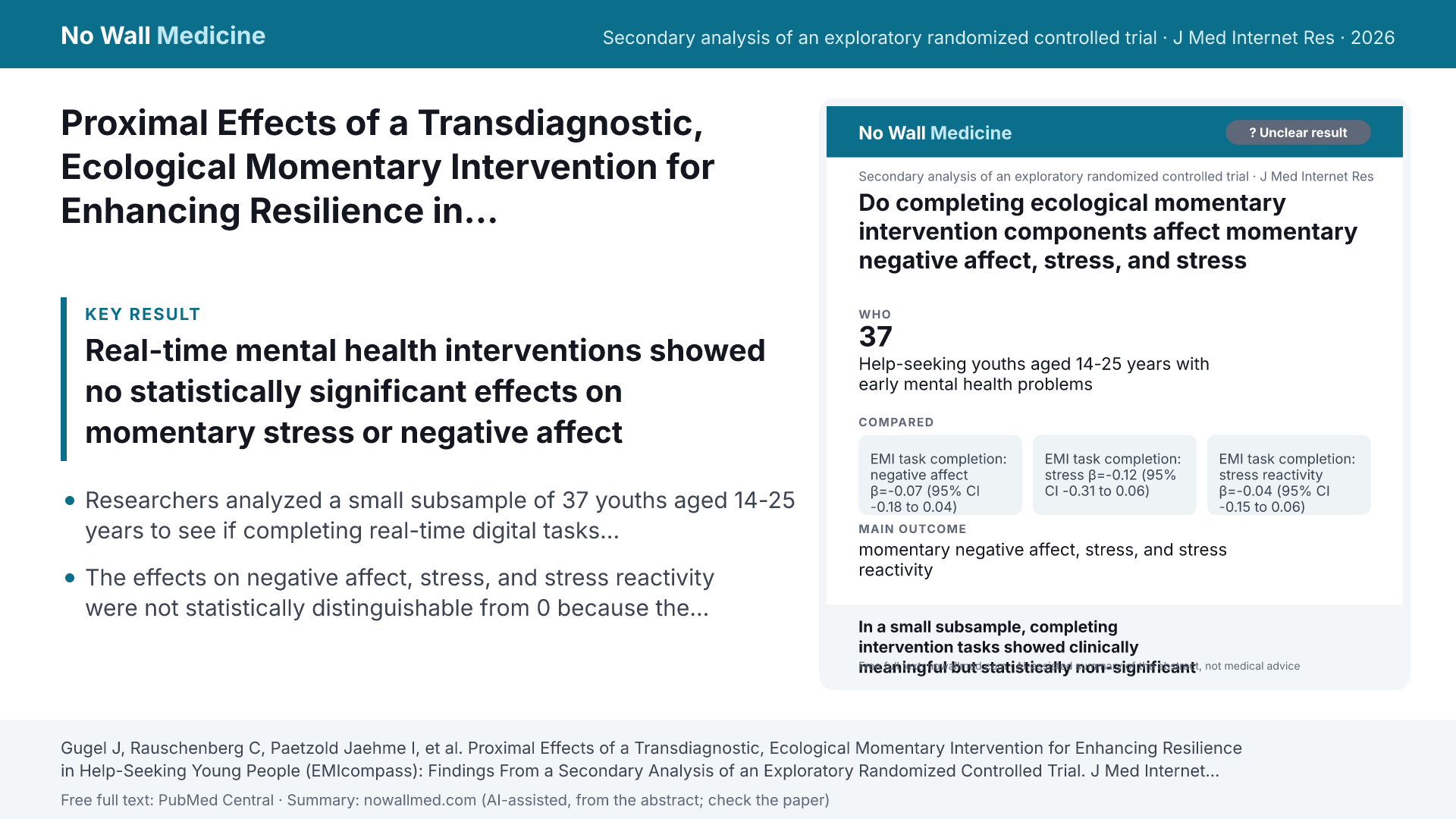
Real-time mental health interventions showed no statistically significant effects on momentary stress or negative affect
Proximal Effects of a Transdiagnostic, Ecological Momentary Intervention for Enhancing Resilience in Help-Seeking Young People (EMIcompass): Findings From a Secondary Analysis of an Exploratory Randomized Controlled Trial
Secondary analysis of an exploratory randomized controlled trialUnclear result
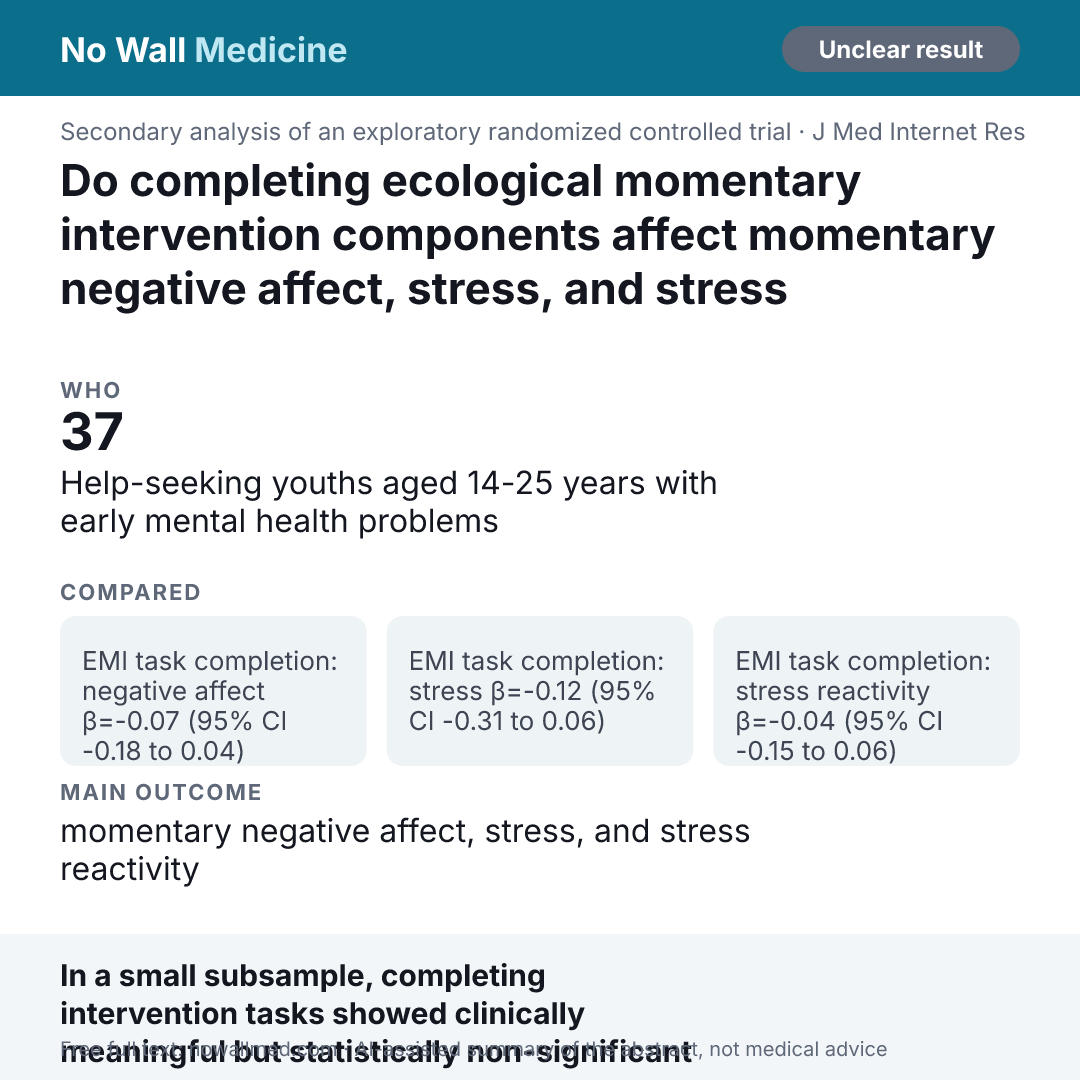
Do completing ecological momentary intervention components affect momentary negative affect, stress, and stress reactivity?
Who
37
Help-seeking youths aged 14-25 years with early mental health problems
Compared
EMI task completion: negative affect β=-0.07 (95% CI -0.18 to 0.04)
EMI task completion: stress β=-0.12 (95% CI -0.31 to 0.06)
EMI task completion: stress reactivity β=-0.04 (95% CI -0.15 to 0.06)
Main outcome
momentary negative affect, stress, and stress reactivity
Bottom line: In a small subsample, completing intervention tasks showed clinically meaningful but statistically non-significant effects on momentary mental health.
Limitation: Limited power due to a small subsample of 37 participants.
J Med Internet Res · 2026-09-03 · Save PNG
Clinical question: Do completing ecological momentary intervention components affect momentary negative affect, stress, and stress reactivity?
Why it matters: Most research on real-time digital interventions focuses on long-term person-level outcomes rather than immediate, moment-to-moment changes in mental health mechanisms.
Key points
- Researchers analyzed a small subsample of 37 youths aged 14-25 years to see if completing real-time digital tasks changed their immediate mental health states.
- The effects on negative affect, stress, and stress reactivity were not statistically distinguishable from 0 because the 95% confidence intervals included 0.
- In an even smaller subsample of 27 participants, the effects of individual task types were also not statistically significant.
Limitation the authors note: The findings remain equivocal due to limited power in this small sample.
Headline and key points written with AI from the paper’s abstract, with every number checked against it. Read the paper before relying on them.
Was this summary helpful?
Subject terms
Headline, design, result, key points, caveat and citation as plain text.
Cite this article
Gugel J, Rauschenberg C, Paetzold Jaehme I, et al. Proximal Effects of a Transdiagnostic, Ecological Momentary Intervention for Enhancing Resilience in Help-Seeking Young People (EMIcompass): Findings From a Secondary Analysis of an Exploratory Randomized Controlled Trial. J Med Internet Res. 2026;28:e77150. doi:10.2196/77150
Spotted a mistake? Suggest a correction