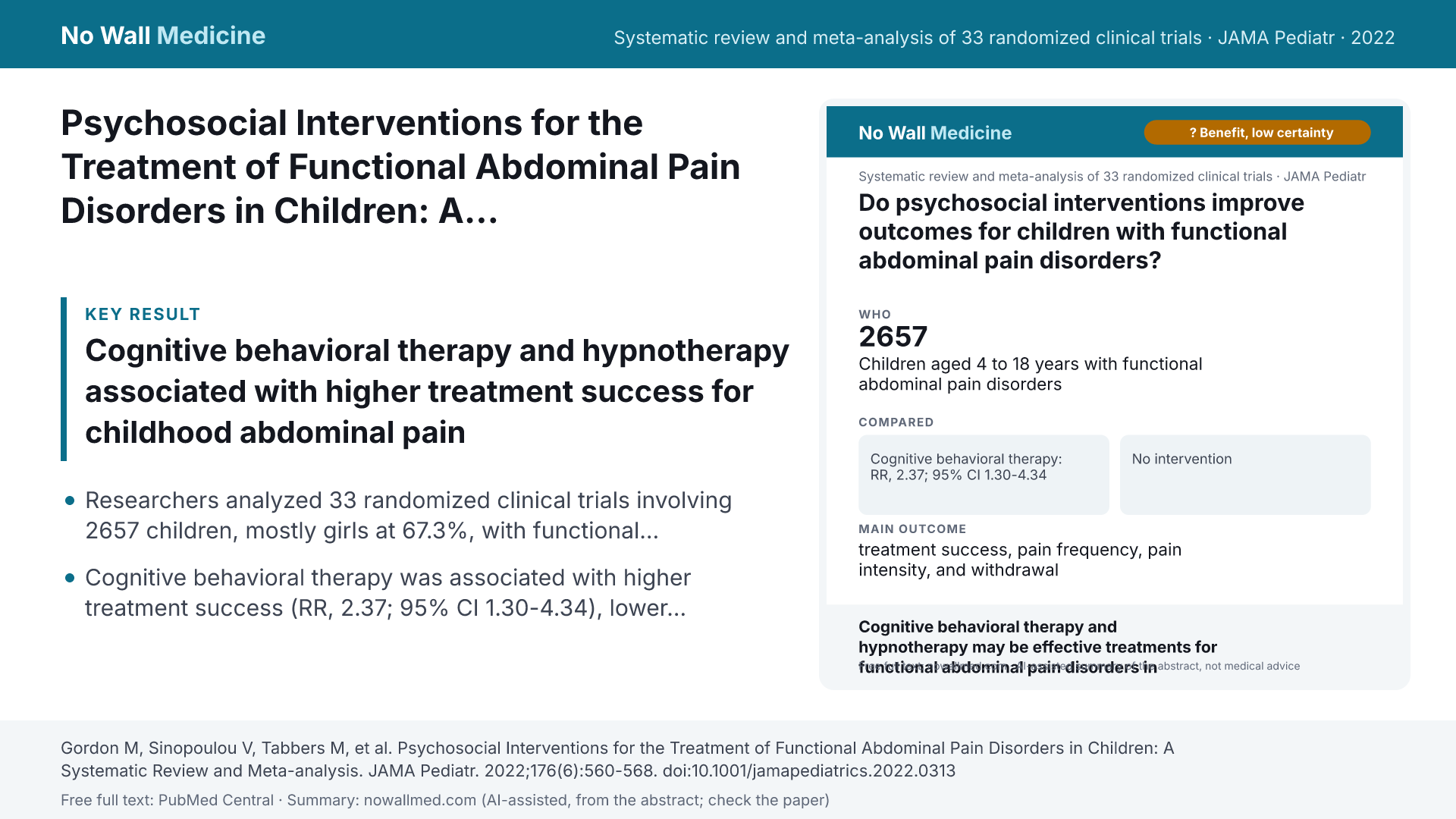
Cognitive behavioral therapy and hypnotherapy associated with higher treatment success for childhood abdominal pain
Psychosocial Interventions for the Treatment of Functional Abdominal Pain Disorders in Children: A Systematic Review and Meta-analysis
Systematic review and meta-analysis of 33 randomized clinical trialsBenefit, low certainty
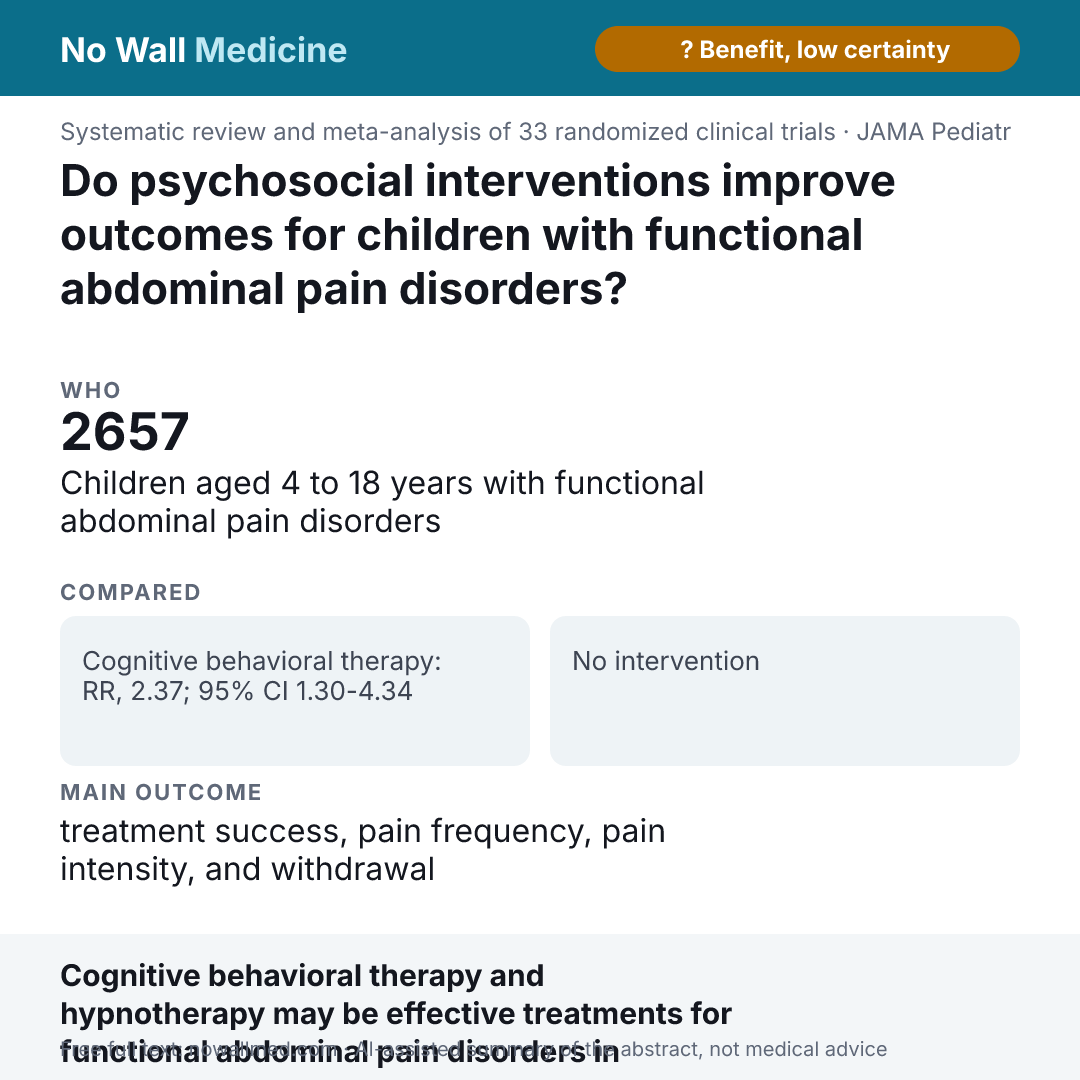
Do psychosocial interventions improve outcomes for children with functional abdominal pain disorders?
Who
2657
Children aged 4 to 18 years with functional abdominal pain disorders
Compared
Cognitive behavioral therapy: RR, 2.37; 95% CI 1.30-4.34
No intervention
Main outcome
treatment success, pain frequency, pain intensity, and withdrawal
Result: RR, 2.37 (95% CI 1.30-4.34)
Bottom line: Cognitive behavioral therapy and hypnotherapy may be effective treatments for functional abdominal pain disorders in children.
Limitation: Risk of bias and imprecision in several included studies.
JAMA Pediatr · 2022-04-12 · Save PNG
Clinical question: Do psychosocial interventions improve outcomes for children with functional abdominal pain disorders?
Key points
- Researchers analyzed 33 randomized clinical trials involving 2657 children, mostly girls at 67.3%, with functional abdominal pain disorders.
- Cognitive behavioral therapy was associated with higher treatment success (RR, 2.37; 95% CI 1.30-4.34), lower pain frequency (RR, -0.36; 95% CI, -0.63 to -0.09), and lower pain intensity (RR, -0.58; 95% CI, -0.83 to -0.32) compared to no intervention.
- Hypnotherapy was associated with higher treatment success compared to no intervention (RR, 2.86; 95% CI, 1.19-6.83), though certainty of evidence was low.
Limitation the authors note: The authors noted that risk of bias and imprecision affected the certainty of evidence for several outcomes.
Headline and key points written with AI from the paper’s abstract, with every number checked against it. Read the paper before relying on them.
Was this summary helpful?
Subject terms
Headline, design, result, key points, caveat and citation as plain text.
Cite this article
Gordon M, Sinopoulou V, Tabbers M, et al. Psychosocial Interventions for the Treatment of Functional Abdominal Pain Disorders in Children: A Systematic Review and Meta-analysis. JAMA Pediatr. 2022;176(6):560-568. doi:10.1001/jamapediatrics.2022.0313
Spotted a mistake? Suggest a correction