Propofol-ketamine combination was associated with less lung collapse than propofol alone during pediatric MRI sedation
Pulmonary Atelectasis After Sedation With Propofol vs Propofol-Ketamine for Magnetic Resonance Imaging in Children: A Randomized Clinical Trial
Double-masked randomized clinical trialBenefit found
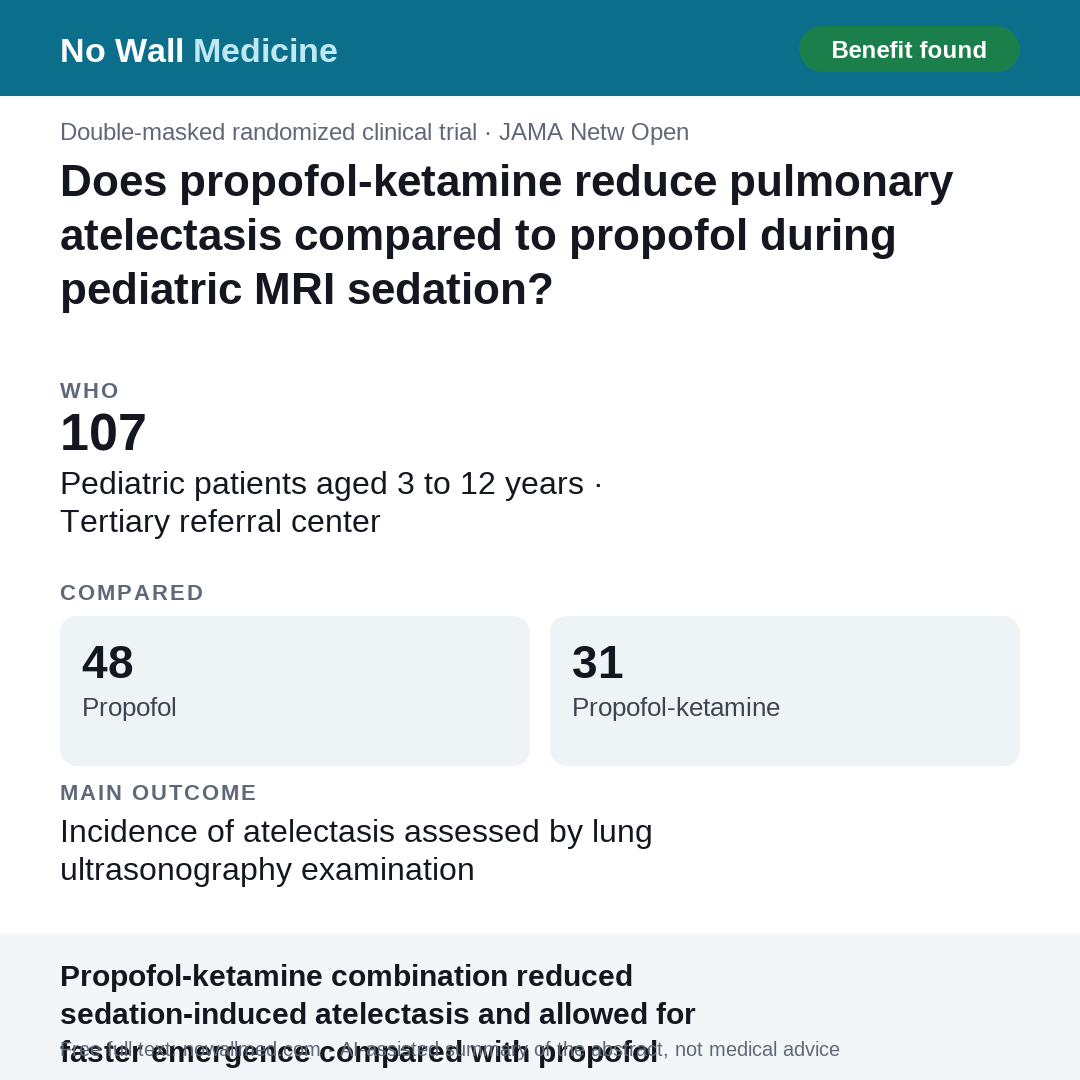
Does propofol-ketamine reduce pulmonary atelectasis compared to propofol during pediatric MRI sedation?
Who
107
Pediatric patients aged 3 to 12 years · Tertiary referral center
Compared
48Propofol (88.9%)
31Propofol-ketamine (58.5%)
Main outcome
Incidence of atelectasis assessed by lung ultrasonography examination
Result: relative risk, 0.7 (95% CI, 0.5-0.8)
Bottom line: Propofol-ketamine combination reduced sedation-induced atelectasis and allowed for faster emergence compared with propofol alone.
JAMA Netw Open · 2024-11-04Download image
Clinical question: Does propofol-ketamine reduce pulmonary atelectasis compared to propofol during pediatric MRI sedation?
Why it matters: It is unknown how different anesthetic agents used for routine magnetic resonance imaging sedation impact pulmonary function in children.
Key points
- Researchers studied 107 children aged 3 to 12 years undergoing magnetic resonance imaging under deep sedation.
- The incidence of pulmonary atelectasis, or collapsed lung tissue, was 58.5% in the propofol-ketamine group compared to 88.9% in the propofol group.
- Children receiving the propofol-ketamine combination had a faster emergence time with a median of 15 minutes compared to 25 minutes for propofol alone.
Headline and key points written with AI from the paper’s abstract, with every number checked against it. Read the paper before relying on them.
Topics
Cite this article
Bang YJ, Kim J, Gil NS, Sim WS, Ahn HJ, Park MH. Pulmonary Atelectasis After Sedation With Propofol vs Propofol-Ketamine for Magnetic Resonance Imaging in Children: A Randomized Clinical Trial. JAMA Netw Open. 2024. doi:10.1001/jamanetworkopen.2024.33029
Spotted a mistake? Suggest a correction
Top studies every Monday
The week’s key trials and guidelines in your specialties, plus any topics you follow. By email, free.
Get the weekly digest