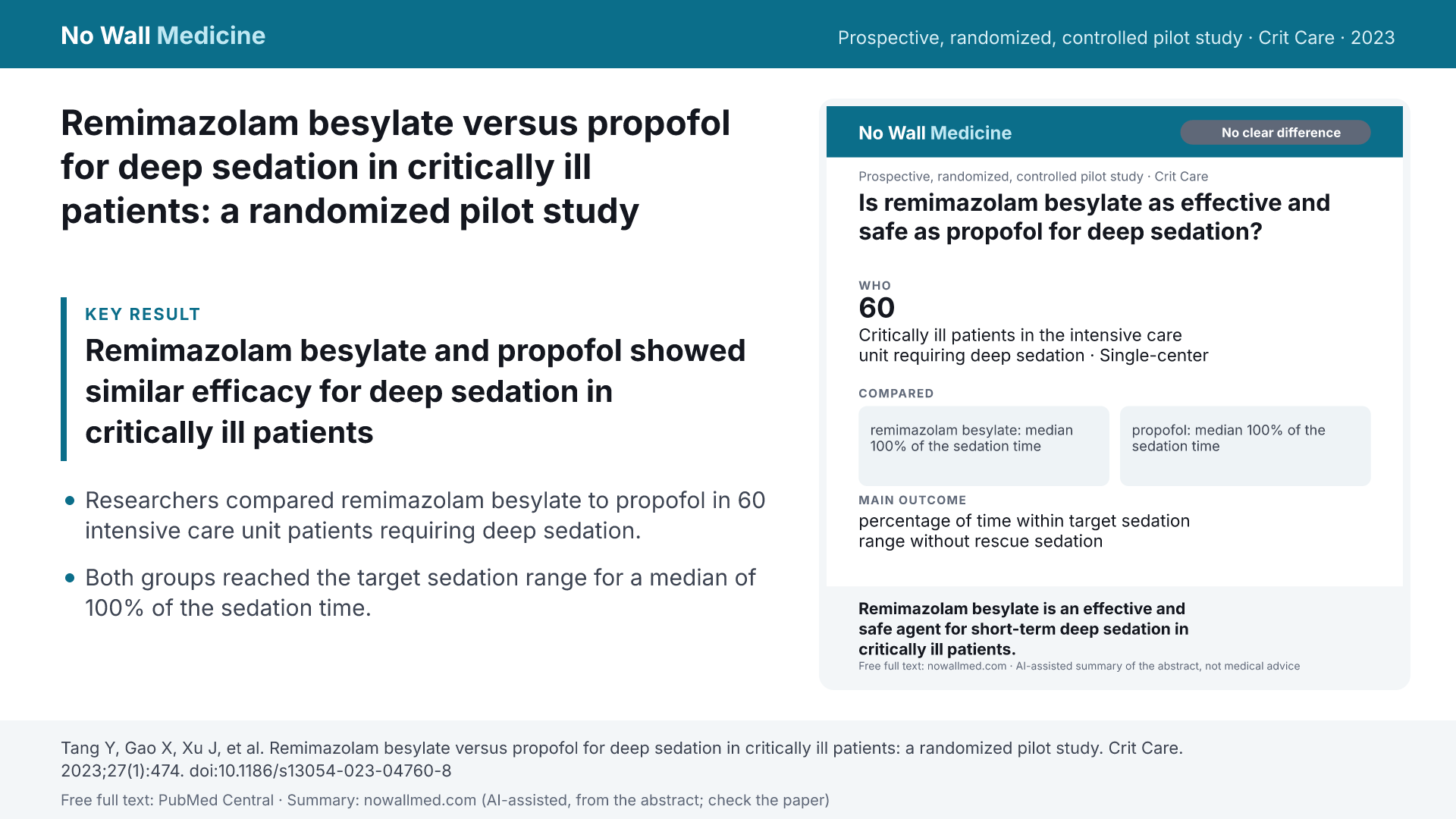
Remimazolam besylate and propofol showed similar efficacy for deep sedation in critically ill patients
Remimazolam besylate versus propofol for deep sedation in critically ill patients: a randomized pilot study
Prospective, randomized, controlled pilot studyNo clear difference
Is remimazolam besylate as effective and safe as propofol for deep sedation?
Who
60
Critically ill patients in the intensive care unit requiring deep sedation · Single-center intensive care unit
Compared
remimazolam besylate: median 100% of the sedation time
propofol: median 100% of the sedation time
Main outcome
percentage of time within target sedation range without rescue sedation
Bottom line: Remimazolam besylate is an effective and safe agent for short-term deep sedation in critically ill patients.
Crit Care · 2023-12-04Download image
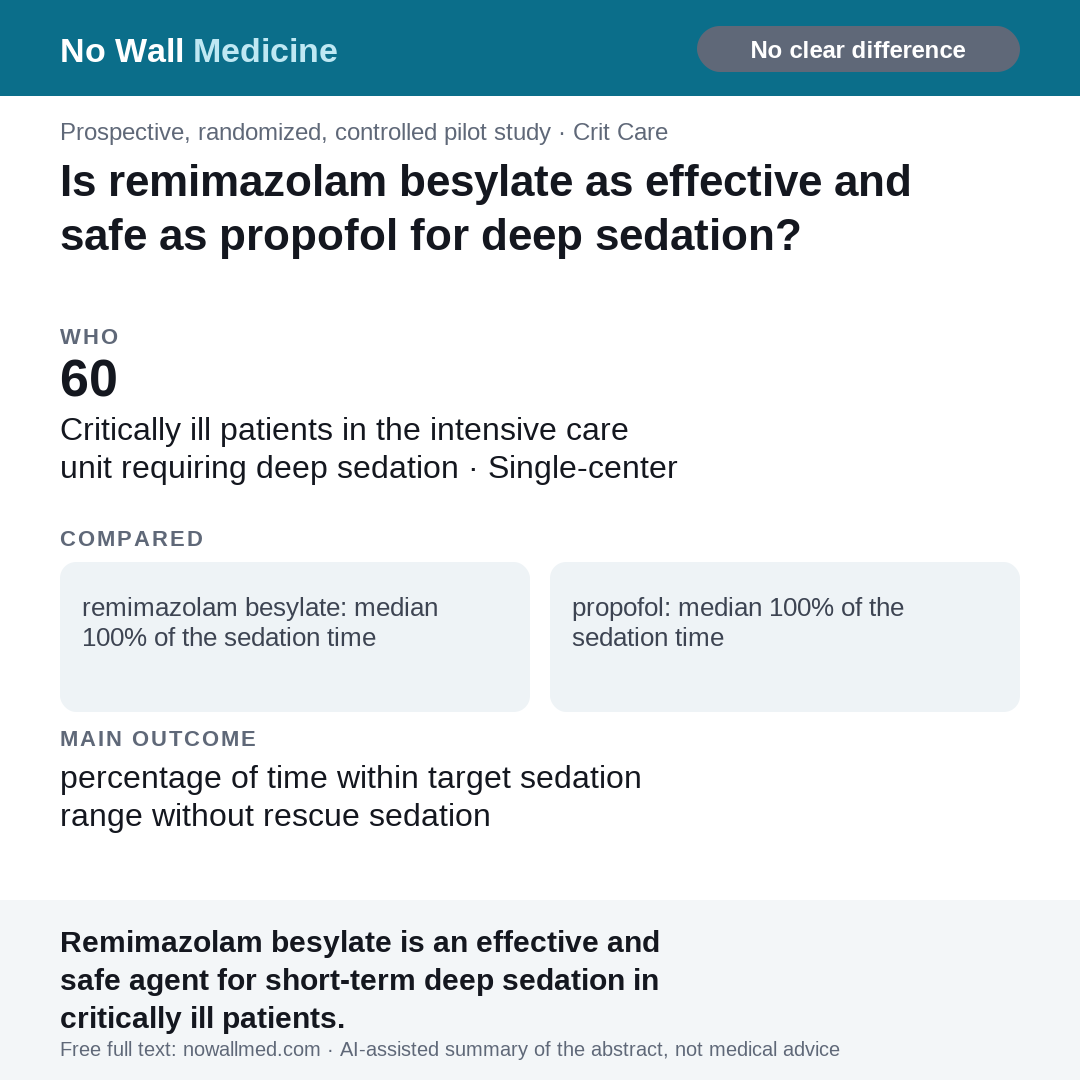
Clinical question: Is remimazolam besylate as effective and safe as propofol for deep sedation?
Key points
- Researchers compared remimazolam besylate to propofol in 60 intensive care unit patients requiring deep sedation.
- Both groups reached the target sedation range for a median of 100% of the sedation time.
- There were no significant differences between groups regarding ventilator-free hours, successful extubation, length of stay, 28-day mortality, or hypotension rates.
Limitation the authors note: This was a single-center, prospective, randomized, controlled pilot study.
Headline and key points written with AI from the paper’s abstract, with every number checked against it. Read the paper before relying on them.
Was this summary helpful?
Subject terms
Cite this article
Tang Y, Gao X, Xu J, et al. Remimazolam besylate versus propofol for deep sedation in critically ill patients: a randomized pilot study. Crit Care. 2023. doi:10.1186/s13054-023-04760-8
Spotted a mistake? Suggest a correction