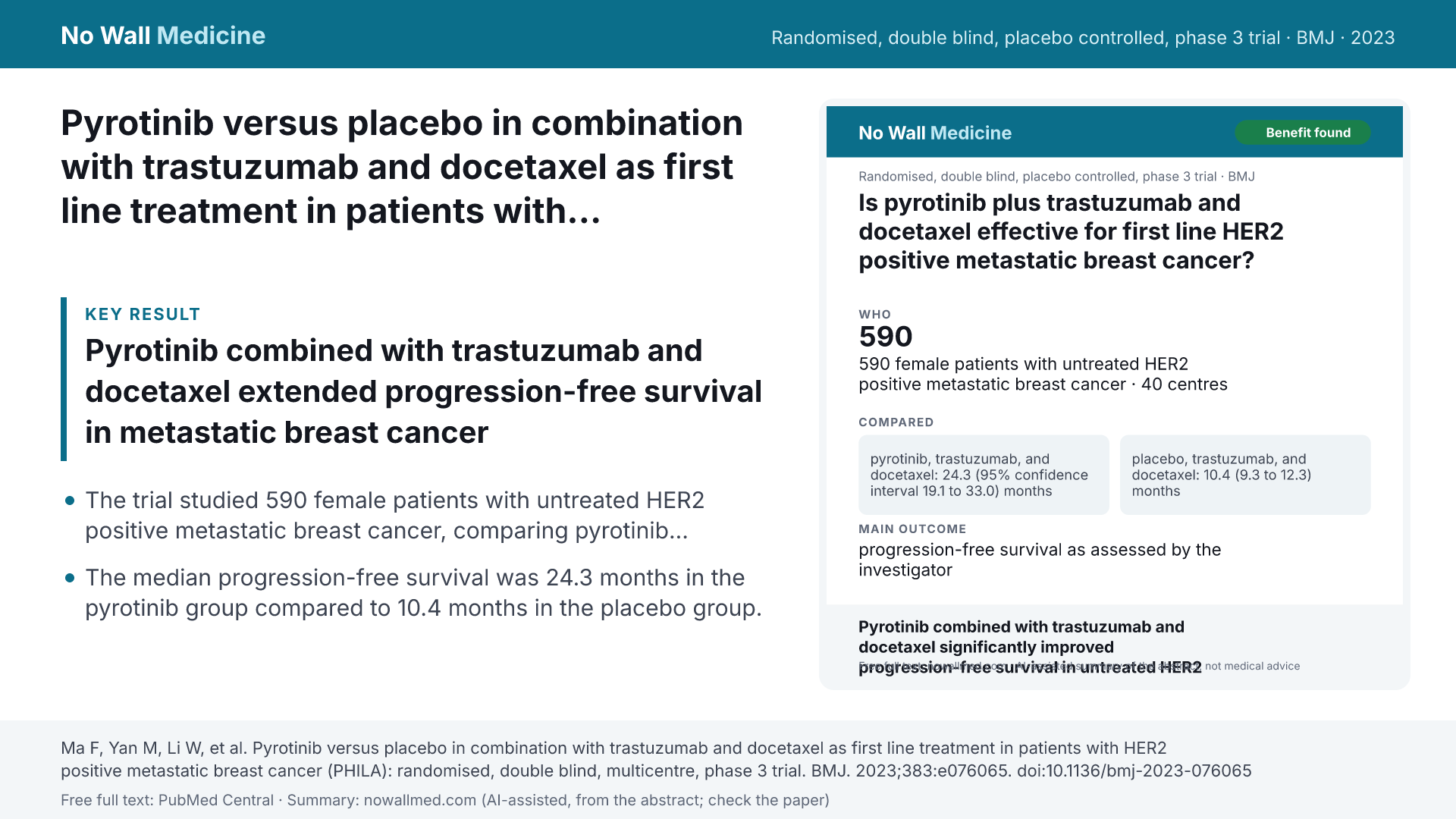
Pyrotinib combined with trastuzumab and docetaxel extended progression-free survival in metastatic breast cancer
Pyrotinib versus placebo in combination with trastuzumab and docetaxel as first line treatment in patients with HER2 positive metastatic breast cancer (PHILA): randomised, double blind, multicentre, phase 3 trial
Randomised, double blind, placebo controlled, phase 3 trialBenefit found
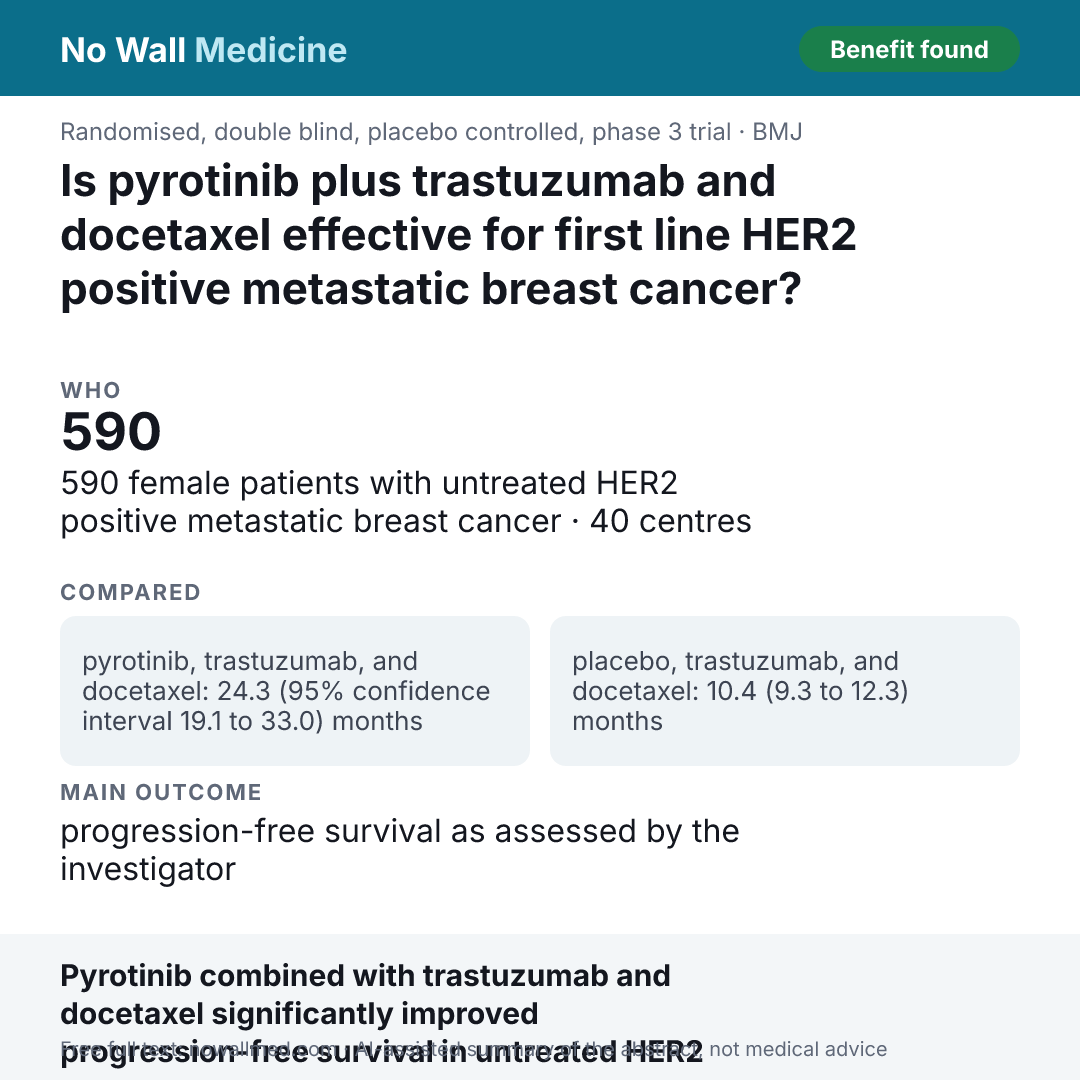
Is pyrotinib plus trastuzumab and docetaxel effective for first line HER2 positive metastatic breast cancer?
Who
590
590 female patients with untreated HER2 positive metastatic breast cancer · 40 centres in China
Compared
pyrotinib, trastuzumab, and docetaxel: 24.3 (95% confidence interval 19.1 to 33.0) months
placebo, trastuzumab, and docetaxel: 10.4 (9.3 to 12.3) months
Main outcome
progression-free survival as assessed by the investigator
Result: hazard ratio 0.41 (95% confidence interval 0.32 to 0.53)
Bottom line: Pyrotinib combined with trastuzumab and docetaxel significantly improved progression-free survival in untreated HER2 positive metastatic breast cancer.
BMJ · 2023-10-31 · Save PNG
Same trial (NCT03863223)
Papers we list that report this registered trial, oldest first. Read a secondary analysis alongside the main results.
- Main results Benefit found
This paper BMJ 2023-10 - Related analysis Benefit found
Pyrotinib combined with trastuzumab and docetaxel improved survival in metastatic breast cancer patients BMJ 2026-03
Clinical question: Is pyrotinib plus trastuzumab and docetaxel effective for first line HER2 positive metastatic breast cancer?
Key points
- The trial studied 590 female patients with untreated HER2 positive metastatic breast cancer, comparing pyrotinib plus trastuzumab and docetaxel to a placebo plus trastuzumab and docetaxel.
- The median progression-free survival was 24.3 months in the pyrotinib group compared to 10.4 months in the placebo group.
- Grade 3 or higher treatment-related adverse events occurred in 90% of the pyrotinib group and 76% of the placebo group.
Headline and key points written with AI from the paper’s abstract, with every number checked against it. Read the paper before relying on them.
Was this summary helpful?
Abstract
Objective
To assess the efficacy and safety of pyrotinib (an irreversible pan-HER (human epidermal growth factor receptor) inhibitor), trastuzumab, and docetaxel compared with placebo, trastuzumab, and docetaxel for untreated HER2 positive metastatic breast cancer. Design
Randomised, double blind, placebo controlled, multicentre, phase 3 trial. Setting
40 centres in China between 6 May 2019 and 17 January 2022. Participants
590 female patients (median age 52 (interquartile range 46-58) years) with untreated HER2 positive metastatic breast cancer. Interventions
Eligible patients were randomised 1:1 to receive either oral pyrotinib (400 mg once daily) or placebo, both combined with intravenous trastuzumab (8 mg/kg in cycle 1 and 6 mg/kg in subsequent cycles) and docetaxel (75 mg/m2) on day 1 of each 21 day cycle. Randomisation was stratified by treatment history of trastuzumab in the (neo)adjuvant setting and hormone receptor status. Patients, investigators, and the sponsor's study team were masked to treatment assignment. Main outcome measures
The primary endpoint was progression-free survival as assessed by the investigator. Results
Of the 590 randomised patients, 297 received pyrotinib, trastuzumab, and docetaxel treatment (pyrotinib group), and 293 received placebo, trastuzumab, and docetaxel treatment (placebo group). At data cut-off on 25 May 2022, the median follow-up was 15.5 months. The median progression-free survival according to the investigator was significantly longer in the pyrotinib group than in the placebo group (24.3 (95% confidence interval 19.1 to 33.0) months versus 10.4 (9.3 to 12.3) months; hazard ratio 0.41 (95% confidence interval 0.32 to 0.53); one sided P<0.001). Treatment related adverse events of grade 3 or higher were reported in 267 (90%) of the 297 patients in the pyrotinib group and 224 (76%) of the 293 patients in the placebo group. No treatment related deaths occurred in the pyrotinib group, and one (<1%; diabetic hyperosmolar coma) treatment related death occurred in the placebo group. Survival and toxicities are still under assessment with longer follow-up. Conclusions
Pyrotinib, trastuzumab, and docetaxel showed superiority by significantly improving progression-free survival compared with placebo, trastuzumab, and docetaxel in patients with untreated HER2 positive metastatic breast cancer. The toxicity was manageable. The findings support this dual anti-HER2 regimen as an alternative first line treatment option in this patient population. Trial registration
ClinicalTrials.gov NCT03863223.
Abstract reproduced under the article’s CC BY NC licence.
Subject terms
Headline, design, result, key points, caveat and citation as plain text.
Cite this article
Ma F, Yan M, Li W, et al. Pyrotinib versus placebo in combination with trastuzumab and docetaxel as first line treatment in patients with HER2 positive metastatic breast cancer (PHILA): randomised, double blind, multicentre, phase 3 trial. BMJ. 2023;383:e076065. doi:10.1136/bmj-2023-076065
Spotted a mistake? Suggest a correction