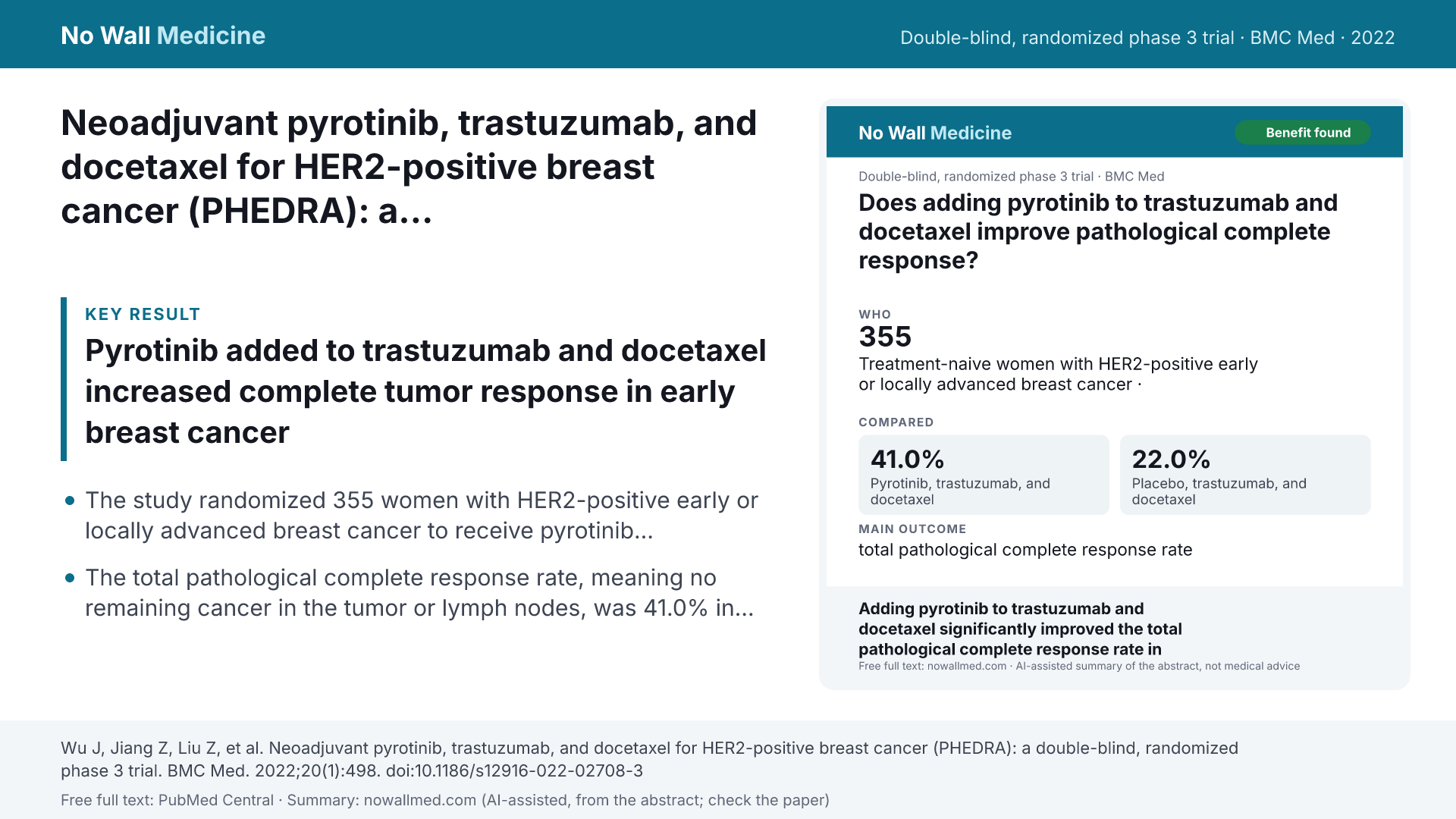
Pyrotinib added to trastuzumab and docetaxel increased complete tumor response in early breast cancer
Neoadjuvant pyrotinib, trastuzumab, and docetaxel for HER2-positive breast cancer (PHEDRA): a double-blind, randomized phase 3 trial
Double-blind, randomized phase 3 trialBenefit found
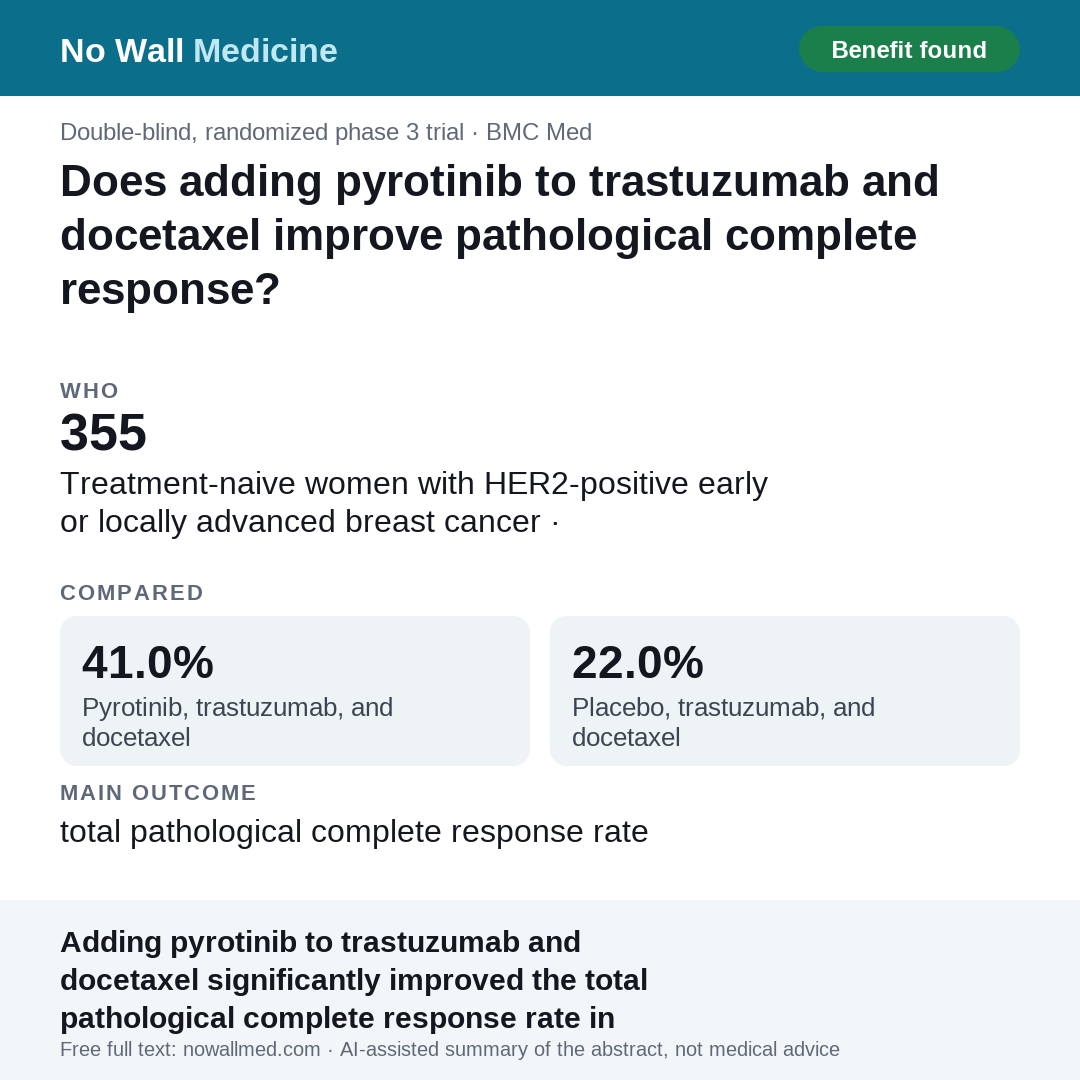
Does adding pyrotinib to trastuzumab and docetaxel improve pathological complete response?
Who
355
Treatment-naive women with HER2-positive early or locally advanced breast cancer · Multicenter
Compared
41.0%Pyrotinib, trastuzumab, and docetaxel (95% CI 34.0 to 48.4)
22.0%Placebo, trastuzumab, and docetaxel (95% CI 16.6 to 28.7)
Main outcome
total pathological complete response rate
Result: difference 19.0% (95% CI 9.5 to 28.4)
Bottom line: Adding pyrotinib to trastuzumab and docetaxel significantly improved the total pathological complete response rate in HER2-positive breast cancer.
BMC Med · 2022-12-27Download image
Clinical question: Does adding pyrotinib to trastuzumab and docetaxel improve pathological complete response?
Why it matters: It was unknown if adding pyrotinib to trastuzumab and docetaxel would increase the total pathological complete response rate in the neoadjuvant setting for HER2-positive breast cancer.
In absolute numbers
Pyrotinib, trastuzumab, and docetaxel: 41% · Placebo, trastuzumab, and docetaxel: 22% → a difference of 19 percentage points, so about 6 people would need the treatment for 1 more to benefit (number needed to treat) over the trial’s follow-up.
Worked out by us from the two group results above, not reported by the authors. Check the paper for the exact outcome and timing.
Key points
- The study randomized 355 women with HER2-positive early or locally advanced breast cancer to receive pyrotinib plus trastuzumab and docetaxel or a placebo plus trastuzumab and docetaxel.
- The total pathological complete response rate, meaning no remaining cancer in the tumor or lymph nodes, was 41.0% in the pyrotinib group compared to 22.0% in the placebo group.
- Grade 3 or worse diarrhea occurred in 44.4% of the pyrotinib group compared to 5.1% in the placebo group.
Headline and key points written with AI from the paper’s abstract, with every number checked against it. Read the paper before relying on them.
Was this summary helpful?
Subject terms
Cite this article
Wu J, Jiang Z, Liu Z, Yang B, Yang H, Tang J. Neoadjuvant pyrotinib, trastuzumab, and docetaxel for HER2-positive breast cancer (PHEDRA): a double-blind, randomized phase 3 trial. BMC Med. 2022. doi:10.1186/s12916-022-02708-3
Spotted a mistake? Suggest a correction