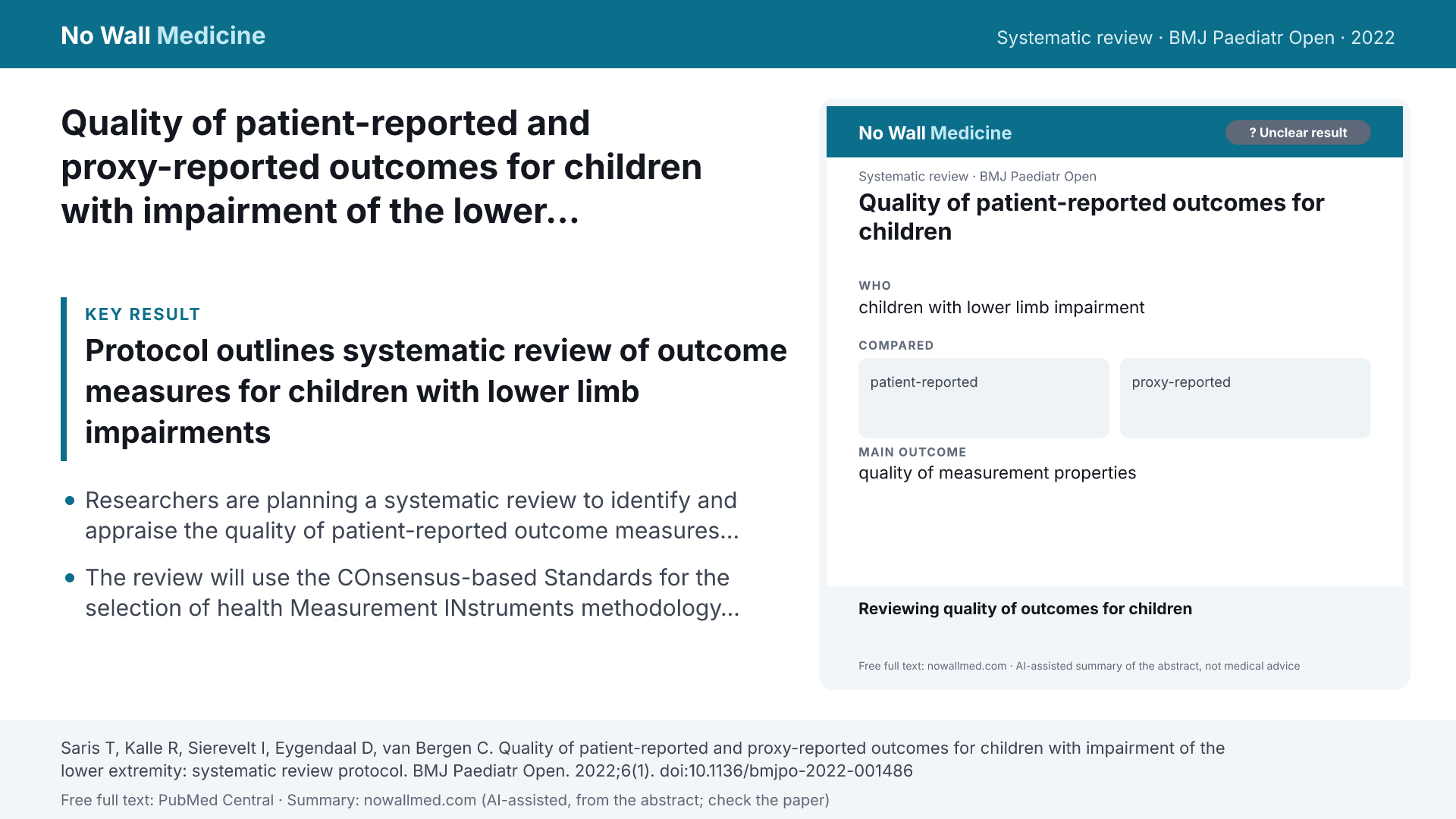
Protocol outlines systematic review of outcome measures for children with lower limb impairments
Quality of patient-reported and proxy-reported outcomes for children with impairment of the lower extremity: systematic review protocol
Systematic reviewUnclear result
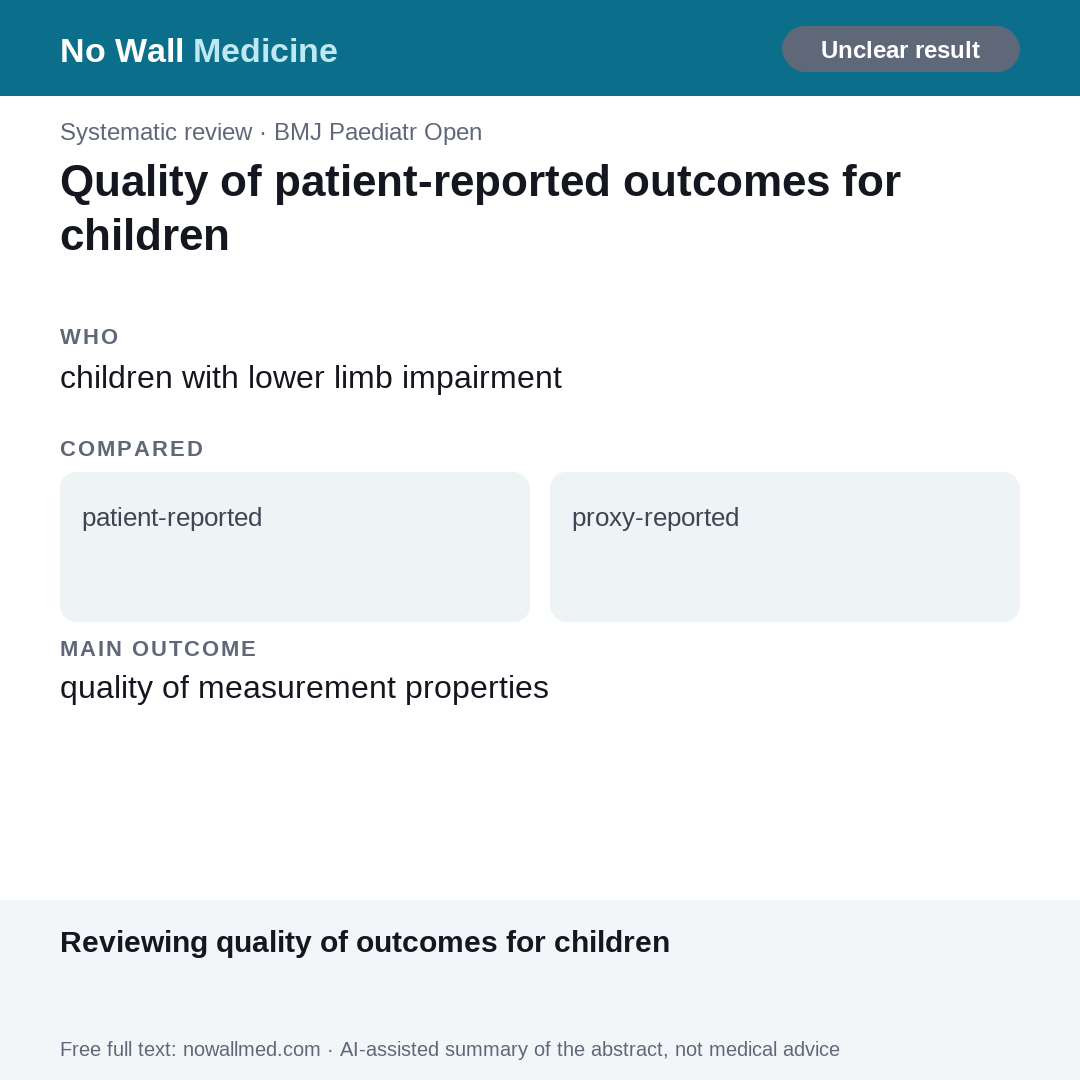
Quality of patient-reported outcomes for children
Who
children with lower limb impairment
Compared
patient-reported
proxy-reported
Main outcome
quality of measurement properties
Bottom line: Reviewing quality of outcomes for children
BMJ Paediatr Open · 2022-09-02Download image
Why it matters: It is unclear which specific tools are most reliable for measuring health outcomes in children with lower limb impairments.
Key points
- Researchers are planning a systematic review to identify and appraise the quality of patient-reported outcome measures for children with lower extremity impairments.
- The review will use the COnsensus-based Standards for the selection of health Measurement INstruments methodology to evaluate measurement properties.
Headline and key points written with AI from the paper’s abstract, with every number checked against it. Read the paper before relying on them.
Was this summary helpful?
Abstract
Introduction
As patient-reported outcome measures (PROMs) have become of significant importance in evaluation of care and clinical research, adequately selecting the appropriate instrument is an integral part of paediatric orthopaedic research and clinical practice. This systematic review aims to provide a comprehensive overview of PROMs targeted at children with impairment of the lower limb, and to critically appraise and summarise the quality of their measurement properties by applying the COnsensus-based Standards for the selection of health Measurement INstruments (COSMIN) methodology. Method and analysis
A systematic search of the MEDLINE and EMBASE databases will be performed to identify relevant publications reporting on the development and/or validation of PROMs used for evaluating children with impairment of the lower extremity. Data extraction and quality assessment of the included studies will be undertaken by two reviewers independently and in accordance with COSMIN guidelines. Ethics and dissemination
It is not necessary to obtain ethical approval for this systematic review. The results will be published in a peer-reviewed journal and will be presented at relevant conferences to enhance information dissemination. Prospero registration number
CRD42021287323.
Abstract reproduced under the article’s CC BY NC licence.
Subject terms
Cite this article
Saris T, Kalle R, Sierevelt I, Eygendaal D, van Bergen C. Quality of patient-reported and proxy-reported outcomes for children with impairment of the lower extremity: systematic review protocol. BMJ Paediatr Open. 2022. doi:10.1136/bmjpo-2022-001486
Spotted a mistake? Suggest a correction