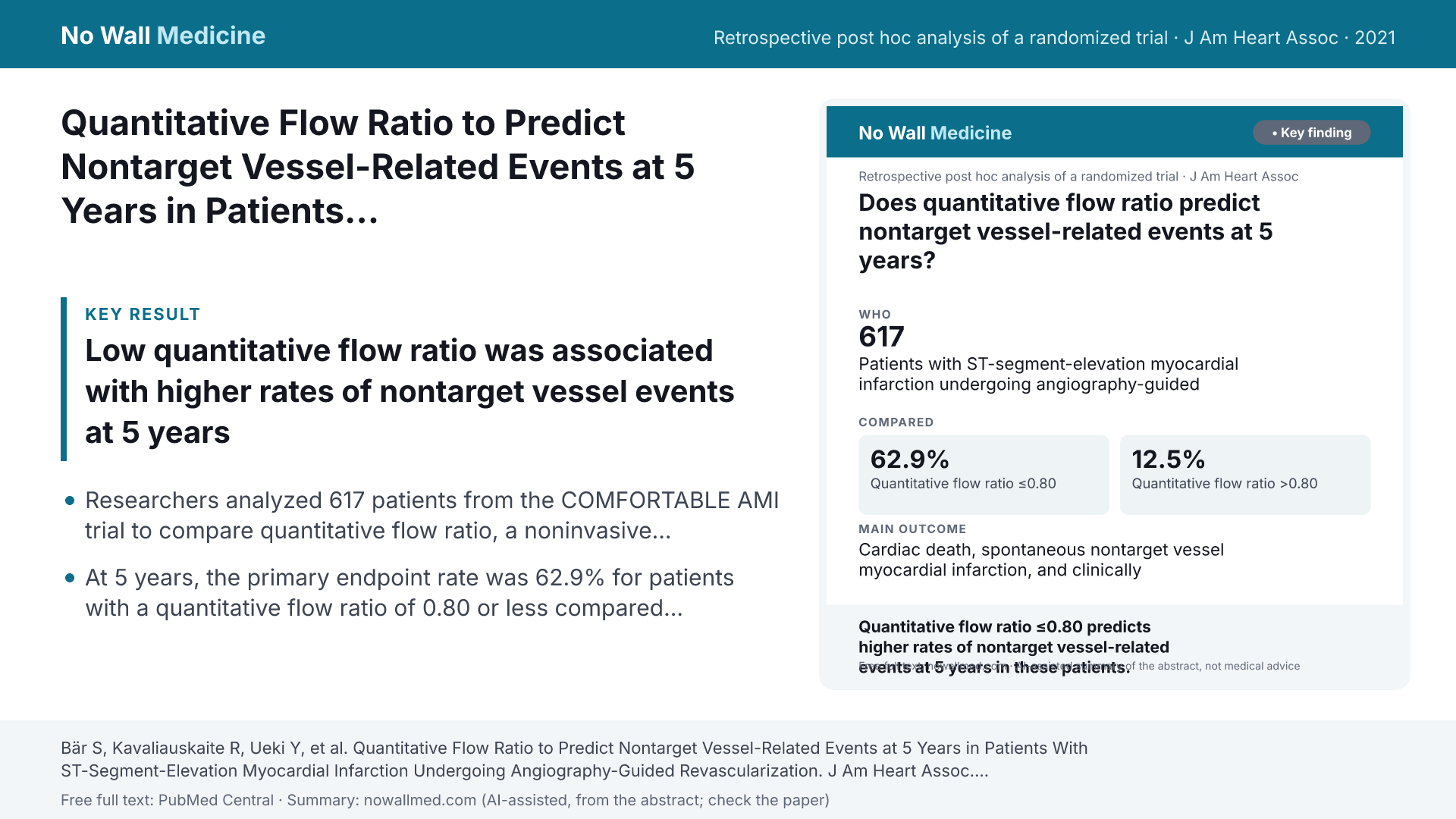
Low quantitative flow ratio was associated with higher rates of nontarget vessel events at 5 years
Quantitative Flow Ratio to Predict Nontarget Vessel-Related Events at 5 Years in Patients With ST-Segment-Elevation Myocardial Infarction Undergoing Angiography-Guided Revascularization
Retrospective post hoc analysis of a randomized trialBenefit found
Does quantitative flow ratio predict nontarget vessel-related events at 5 years?
Who
617
Patients with ST-segment-elevation myocardial infarction undergoing angiography-guided revascularization · Multicenter
Compared
62.9%Quantitative flow ratio ≤0.80
12.5%Quantitative flow ratio >0.80
Main outcome
Cardiac death, spontaneous nontarget vessel myocardial infarction, and clinically indicated nontarget vessel revascularization
Result: hazard ratio 7.33 (95% CI 4.54-11.83)
Bottom line: Quantitative flow ratio ≤0.80 predicts higher rates of nontarget vessel-related events at 5 years in these patients.
J Am Heart Assoc · 2021-04-26Download image
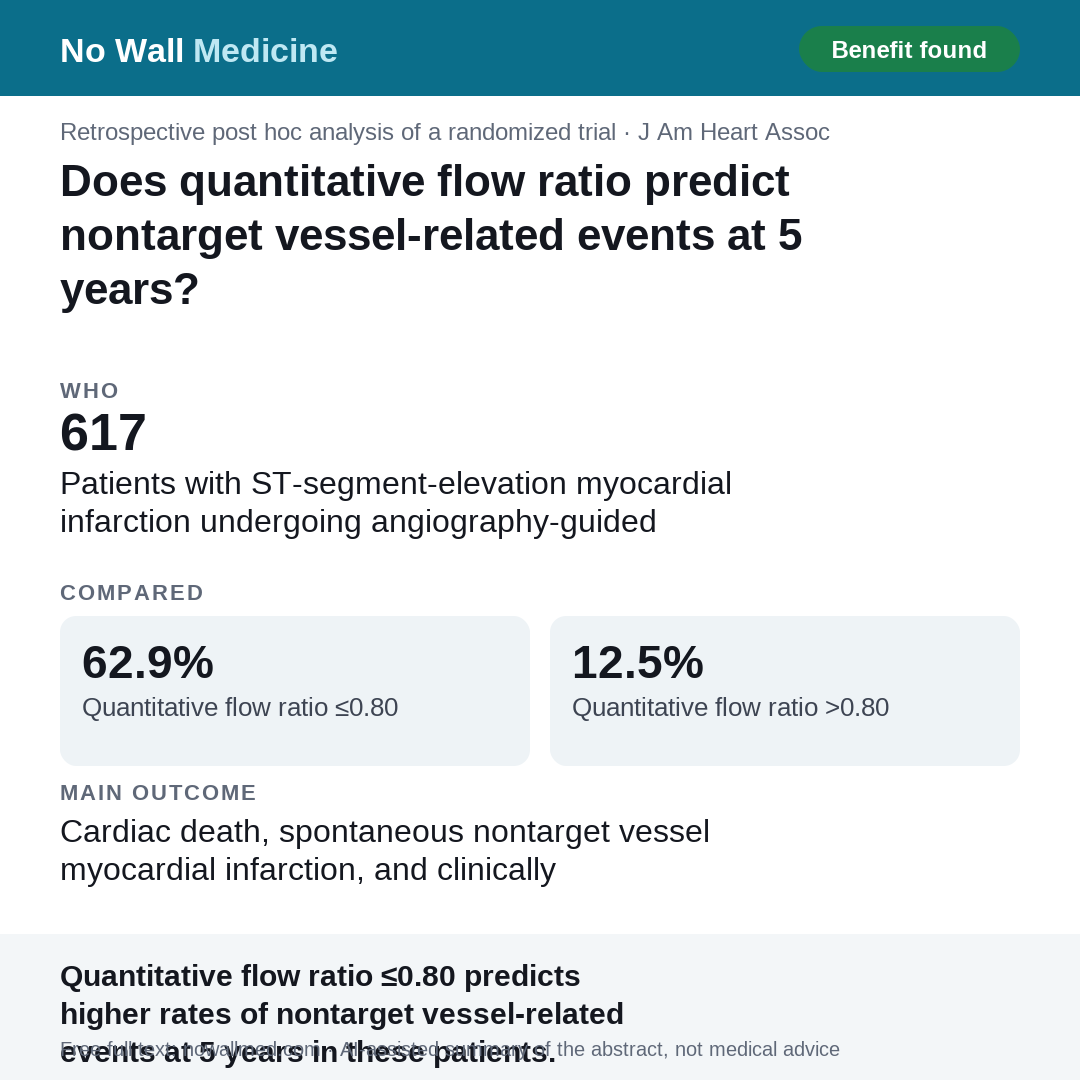
Clinical question: Does quantitative flow ratio predict nontarget vessel-related events at 5 years?
Why it matters: It was unknown if quantitative flow ratio provides additional predictive value over standard angiography for assessing nonculprit lesions in patients with ST-segment-elevation myocardial infarction.
Key points
- Researchers analyzed 617 patients from the COMFORTABLE AMI trial to compare quantitative flow ratio, a noninvasive method to assess blood flow, against standard angiography.
- At 5 years, the primary endpoint rate was 62.9% for patients with a quantitative flow ratio of 0.80 or less compared to 12.5% for those with a ratio above 0.80.
- A quantitative flow ratio of 0.80 or less was associated with higher rates of nontarget vessel heart attack and nontarget vessel revascularization, but not cardiac death.
Limitation the authors note: This was a retrospective post hoc analysis of data from a randomized trial.
Headline and key points written with AI from the paper’s abstract, with every number checked against it. Read the paper before relying on them.
Was this summary helpful?
Subject terms
Cite this article
Bär S, Kavaliauskaite R, Ueki Y, Otsuka T, Kelbæk H, Engstrøm T. Quantitative Flow Ratio to Predict Nontarget Vessel-Related Events at 5 Years in Patients With ST-Segment-Elevation Myocardial Infarction Undergoing Angiography-Guided Revascularization. J Am Heart Assoc. 2021. doi:10.1161/JAHA.120.019052
Spotted a mistake? Suggest a correction
Top studies every Monday
The week’s key trials and guidelines in your specialties, plus any topics you follow. By email, free.
Get the weekly digest