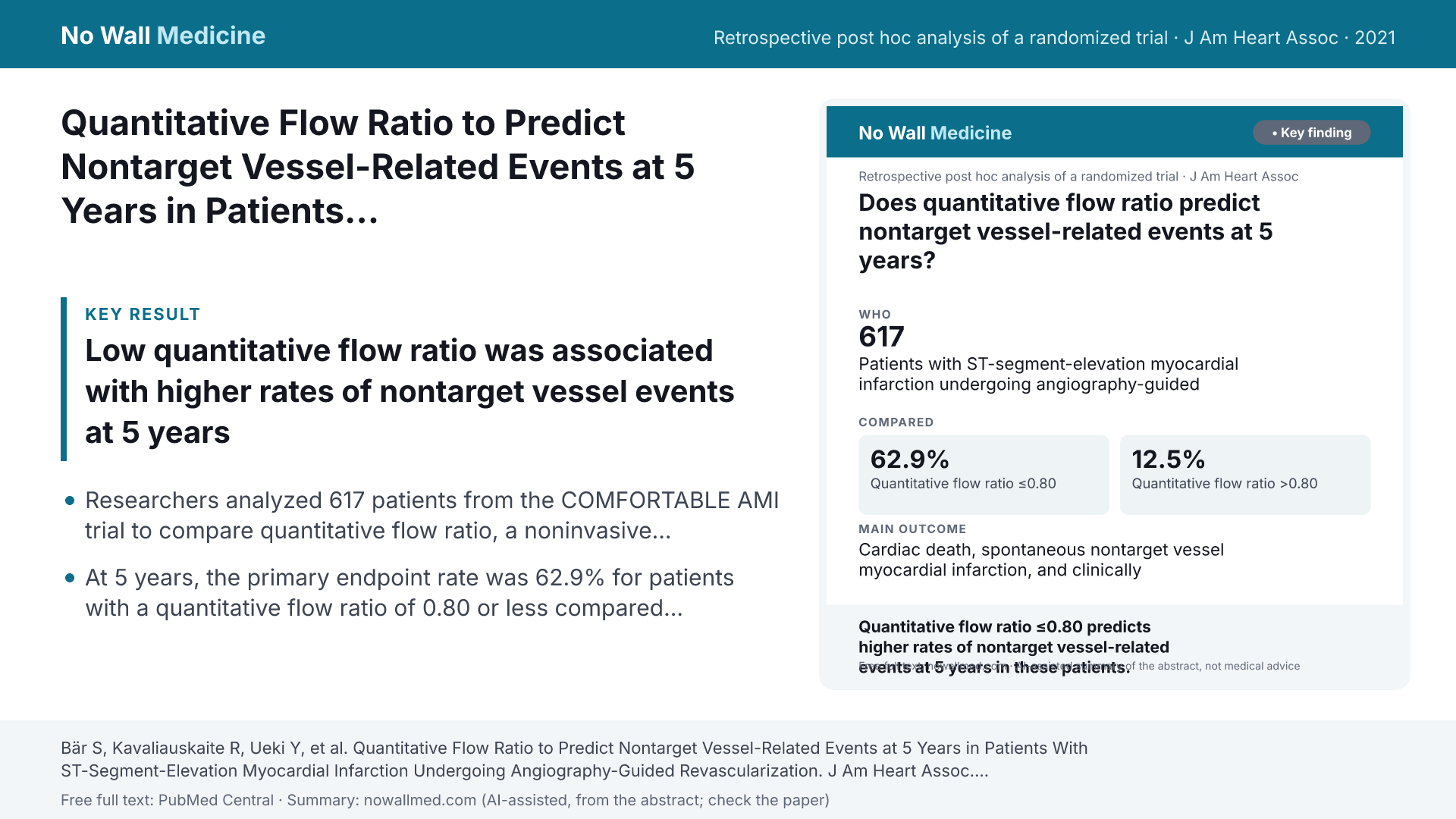
Quantitative Flow Ratio to Predict Nontarget Vessel-Related Events at 5 Years in Patients With ST-Segment-Elevation Myocardial Infarction Undergoing Angiography-Guided Revascularization
Key result: Low quantitative flow ratio was associated with higher rates of nontarget vessel events at 5 years
Retrospective post hoc analysis of a randomized trialKey finding
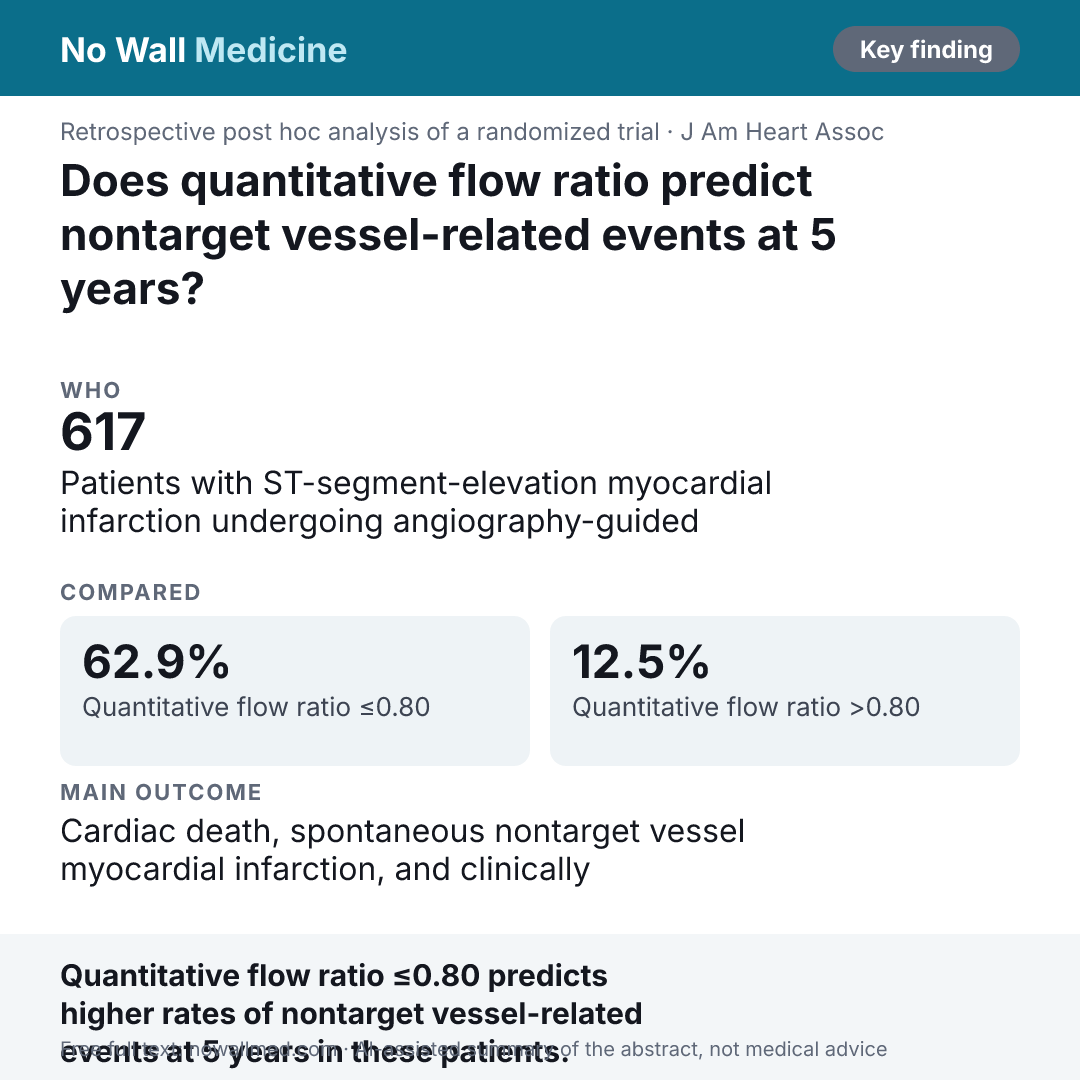
Does quantitative flow ratio predict nontarget vessel-related events at 5 years?
Who
617
Patients with ST-segment-elevation myocardial infarction undergoing angiography-guided revascularization · Multicenter
Compared
62.9%Quantitative flow ratio ≤0.80
12.5%Quantitative flow ratio >0.80
Main outcome
Cardiac death, spontaneous nontarget vessel myocardial infarction, and clinically indicated nontarget vessel revascularization
Result: hazard ratio 7.33 (95% CI 4.54-11.83)
Bottom line: Quantitative flow ratio ≤0.80 predicts higher rates of nontarget vessel-related events at 5 years in these patients.
J Am Heart Assoc · 2021-04-26 · Save PNG
Key points
- Researchers analyzed 617 patients from the COMFORTABLE AMI trial to compare quantitative flow ratio, a noninvasive method to assess blood flow, against standard angiography.
- At 5 years, the primary endpoint rate was 62.9% for patients with a quantitative flow ratio of 0.80 or less compared to 12.5% for those with a ratio above 0.80.
- A quantitative flow ratio of 0.80 or less was associated with higher rates of nontarget vessel heart attack and nontarget vessel revascularization, but not cardiac death.
Limitation the authors note: This was a retrospective post hoc analysis of data from a randomized trial.
Discussion prompts
- Would these patients look like yours? Who was left out?
- Is the main outcome one that matters to patients?
- Is the difference large enough to change what you do?
Cite: Bär S, Kavaliauskaite R, Ueki Y, et al. Quantitative Flow Ratio to Predict Nontarget Vessel-Related Events at 5 Years in Patients With ST-Segment-Elevation Myocardial Infarction Undergoing Angiography-Guided Revascularization. J Am Heart Assoc. 2021;10(9):e019052. doi:10.1161/JAHA.120.019052
Free full text: PubMed Central · Summary and visual abstract: nowallmed.com/a/quantitative-flow-ratio-to-predict-nontarget-vessel-related-events-at-3t9bnu/ (AI-assisted from the abstract; check the paper before relying on it).