Quantitative mid-treatment imaging biomarkers for response prediction after radiotherapy in head and neck cancer: a systematic review and meta-analysis
Systematic review and meta-analysisBenefit found
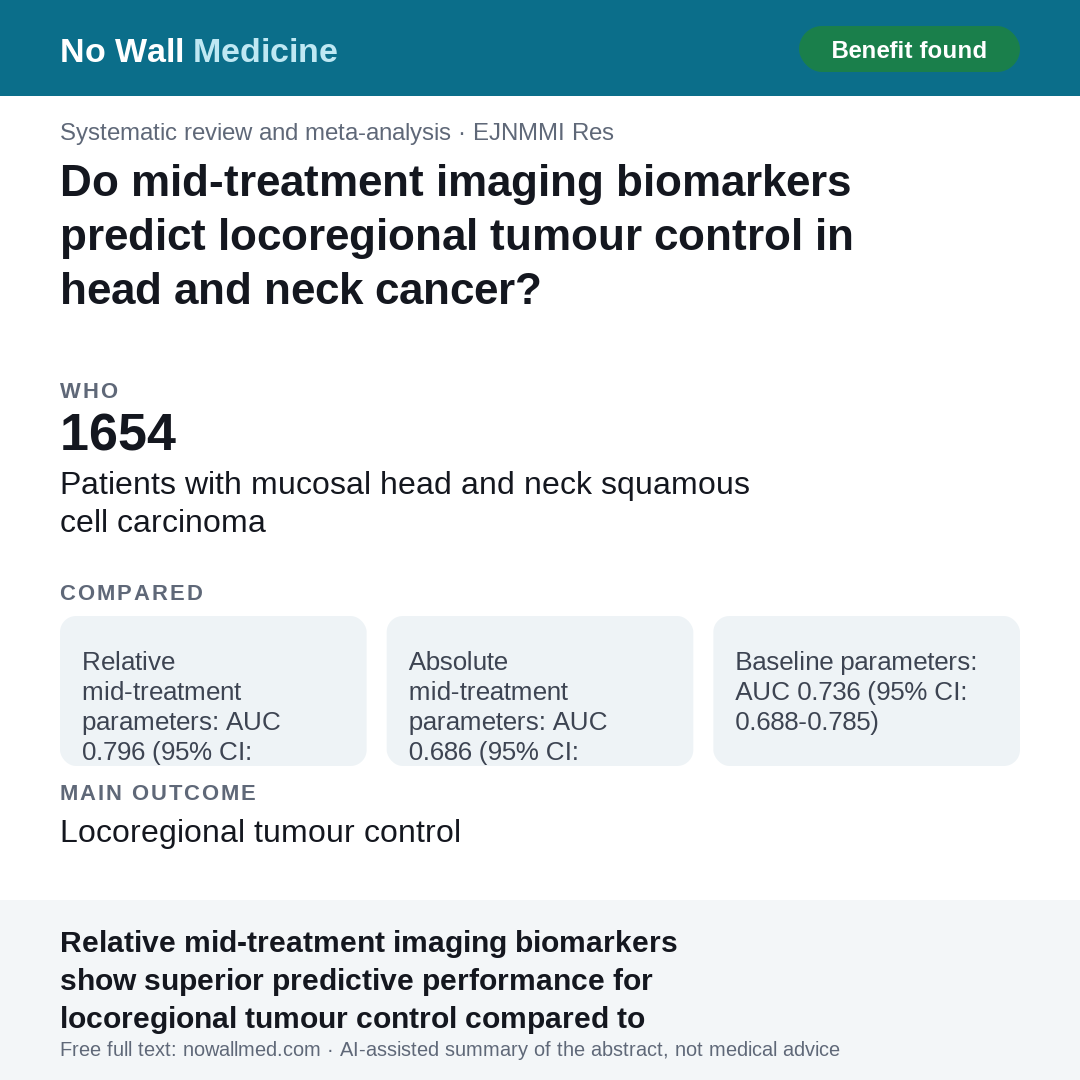
Do mid-treatment imaging biomarkers predict locoregional tumour control in head and neck cancer?
Who
1654
Patients with mucosal head and neck squamous cell carcinoma
Compared
Relative mid-treatment parameters: AUC 0.796 (95% CI: 0.762-0.831)
Absolute mid-treatment parameters: AUC 0.686 (95% CI: 0.628-0.745)
Baseline parameters: AUC 0.736 (95% CI: 0.688-0.785)
Main outcome
Locoregional tumour control
Result: AUC 0.796 (95% CI: 0.762-0.831) for relative mid-treatment parameters
Bottom line: Relative mid-treatment imaging biomarkers show superior predictive performance for locoregional tumour control compared to baseline or absolute measures.
EJNMMI Res · 2026-06-06Download image
Clinical question: Do mid-treatment imaging biomarkers predict locoregional tumour control in head and neck cancer?
Abstract
Background
To systematically review and meta-analyse the prognostic value of quantitative mid-treatment imaging biomarkers for predicting locoregional tumour control in patients undergoing definitive radiotherapy for mucosal head and neck squamous cell carcinoma. Main body
A systematic literature search (2005-2023) was conducted in PubMed, EMBASE, Scopus, and Cochrane databases according to a pre-registered PROSPERO protocol. Studies evaluating quantitative imaging features derived from CT, MRI, or PET during radiotherapy were included. Imaging features were grouped as baseline, absolute mid-treatment, or relative mid-treatment (delta) parameters. A random-effects meta-analysis was performed on studies reporting receiver operating characteristic (ROC)-based area under the curve (AUC) values. Forty-one studies encompassing 1654 patients were included. Seventeen studies (n = 612 patients) reported sufficient data for meta-analysis. The pooled AUC for relative mid-treatment parameters was 0.796 (95% CI: 0.762-0.831), demonstrating higher predictive performance than absolute mid-treatment parameters (AUC 0.686; 95% CI: 0.628-0.745). Baseline parameters showed moderate predictive ability (AUC 0.736; 95% CI: 0.688-0.785), and while numerically lower than relative mid-treatment parameters, this difference did not reach statistical significance. Diffusion-weighted MRI (ΔADCmean) and FDG-PET (ΔMTV, ΔTLG) emerged as the most consistently predictive modalities. Relative measures offer practical advantages, including internal self-normalisation and improved reproducibility across imaging platforms. Conclusions
Relative mid-treatment imaging biomarkers demonstrate superior predictive performance compared to baseline and absolute measures, supporting their potential role in adaptive radiotherapy strategies. Further prospective multi-centre studies with standardised imaging protocols and external validation are essential for clinical translation.
Cite this article
Trada Y, T Lee M, Jameson MG, Keall P, Moses D, Fowler A. Quantitative mid-treatment imaging biomarkers for response prediction after radiotherapy in head and neck cancer: a systematic review and meta-analysis. EJNMMI Res. 2026. doi:10.1186/s13550-026-01446-4
Spotted a mistake? Suggest a correction