Quantitative Muscle Magnetic Resonance Outcomes in Patients With Duchenne Muscular Dystrophy: An Exploratory Analysis From the EMBARK Randomized Clinical Trial
Randomized, double-blind trialBenefit found
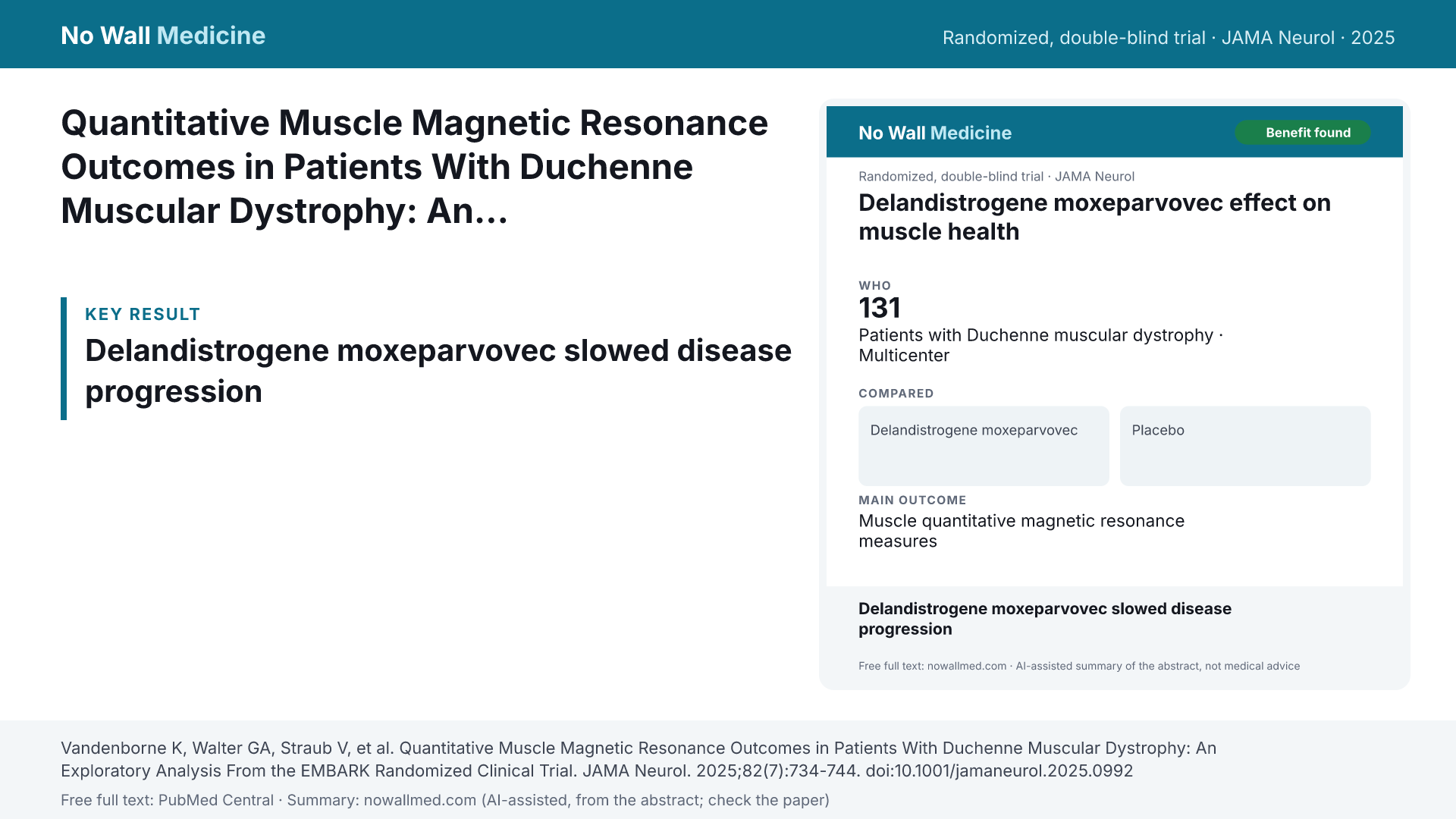
Delandistrogene moxeparvovec effect on muscle health
Who
131
Patients with Duchenne muscular dystrophy · Multicenter
Compared
Delandistrogene moxeparvovec
Placebo
Main outcome
Muscle quantitative magnetic resonance measures
Result: Treatment led to decreased fat accumulation and improved T2 vs placebo
Bottom line: Delandistrogene moxeparvovec slowed disease progression
JAMA Neurol · 2025-05-12Download image

Abstract
Importance
Delandistrogene moxeparvovec is a recombinant adeno-associated virus rhesus isolate serotype 74 vector-based gene transfer therapy for the treatment of Duchenne muscular dystrophy (DMD) in patients with a confirmed pathogenic variant of the DMD gene. In a subset of patients in the EMBARK (A Gene Transfer Therapy Study to Evaluate the Safety and Efficacy of Delandistrogene Moxeparvovec [SRP-9001] in Participants With DMD) randomized clinical trial, changes in muscle health and pathology were assessed to evaluate the therapeutic impact of the treatment on disease progression. Objective
To determine the effect of delandistrogene moxeparvovec on muscle quantitative magnetic resonance (QMR) measures of disease progression in patients in the EMBARK trial. Design, setting, and participants
This was a phase 3, double-blind, placebo-controlled (October 2021-September 2023; week 52 cutoff date: September 13, 2023), multicenter randomized clinical trial that included 131 patients. Patients were randomized, and 125 were treated with either delandistrogene moxeparvovec (n = 63) or placebo (n = 62). The current study focused on a subset of patients who underwent muscle QMR imaging. Intervention
Single-administration intravenous delandistrogene moxeparvovec (1.33 × 10¹⁴ vector genome/kg) or placebo. Main outcomes and measures
Change from baseline to week 52 in muscle MR was a prespecified exploratory end point. Proton MR spectroscopy (MRS) and 8-point Dixon MR imaging (MRI) measured muscle fat fraction (FF); multislice spin echo MRI measured transverse relaxation time (T2). MRS FF was measured in the soleus and vastus lateralis. MRI FF and T2 were measured in 5 leg muscle locations important for ambulation. A post hoc global statistical test combining all muscles and modalities assessed overall treatment effect. Results
In this exploratory EMBARK analysis, 39 male participants (delandistrogene moxeparvovec, n = 19; placebo, n = 20; mean [SD] age, 6.10 [1.04] years; mean [SD] baseline North Star Ambulatory Assessment total score, 22.99 [3.71] points) underwent muscle MRI. Treated patients showed less disease progression vs placebo on MR measures. Across muscles and modalities, magnitudes of FF change favored delandistrogene moxeparvovec; between-group differences in least-squares mean change ranged from -1.01 (95% CI, -2.79 to 0.77; soleus) to -0.71 (95% CI, -3.21 to 1.80; vastus lateralis) for MRS FF and -3.09 (95% CI, -7.62 to 1.45; vastus lateralis) to -0.44 (95% CI, -4.01 to 3.12; hamstrings) for MRI FF. T2 reductions (improvements; 4 of 5 muscles) were observed in treated patients vs increases (worsening; all muscles) in placebo patients; within-group differences in least-squares mean change ranged from -1.06 (95% CI, -2.10 to -0.02; soleus) to 0.17 (95% CI, -1.76 to 2.10; biceps femoris) in the delandistrogene moxeparvovec group and from 1.12 (95% CI, 0.08-2.16; soleus) to 2.94 (95% CI, 0.84-5.03; quadriceps) in the placebo group. The global statistical test supported treatment benefit (P = .03). Conclusions and relevance
Results reveal that QMR outcomes consistently favored delandistrogene moxeparvovec across muscle groups, with treatment leading to decreased fat accumulation and improved T2 vs placebo over 52 weeks. Consistent with treatment effects on functional outcomes observed in the EMBARK trial, these results suggest stabilization or less progression of muscle pathology with delandistrogene moxeparvovec-adding to the totality of evidence supporting disease stabilization or slowing of disease progression with delandistrogene moxeparvovec. Trial registration
ClinicalTrials.gov Identifier: NCT05096221.
Subject terms
Cite this article
Vandenborne K, Walter GA, Straub V, Willcocks RJ, Forbes SC, Mercuri EM. Quantitative Muscle Magnetic Resonance Outcomes in Patients With Duchenne Muscular Dystrophy: An Exploratory Analysis From the EMBARK Randomized Clinical Trial. JAMA Neurol. 2025. doi:10.1001/jamaneurol.2025.0992
Spotted a mistake? Suggest a correction
Top studies every Monday
The week’s key trials and guidelines in your specialties, plus any topics you follow. By email, free.
Get the weekly digest