Black, Hispanic, and Asian patients were less likely to receive catheter ablation for atrial fibrillation
Racial and Ethnic Disparities in Catheter Ablation Utilization for Atrial Fibrillation: A Systematic Review and Meta-Analysis
Systematic review and meta-analysisHarm found
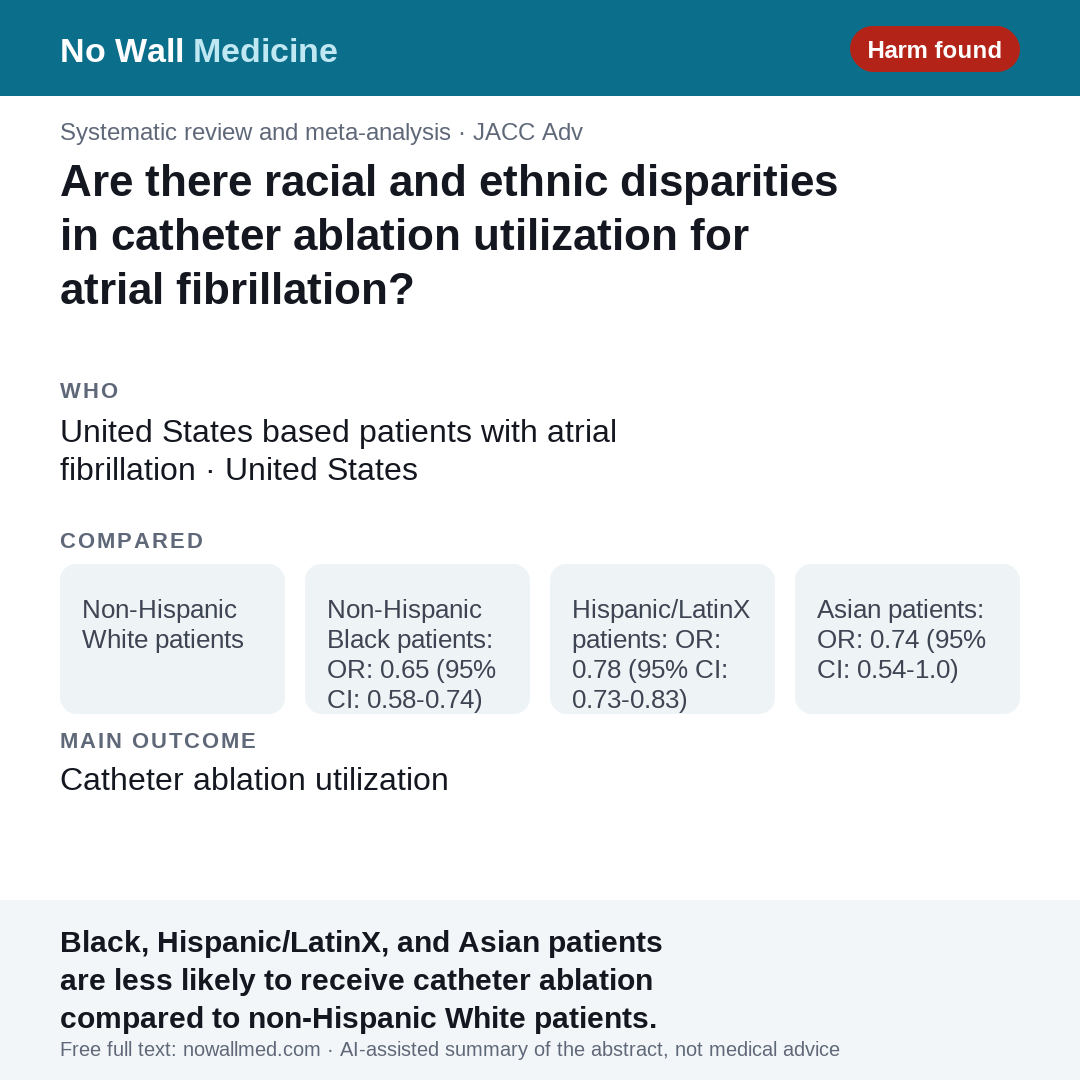
Are there racial and ethnic disparities in catheter ablation utilization for atrial fibrillation?
Who
United States based patients with atrial fibrillation · United States
Compared
Non-Hispanic White patients
Non-Hispanic Black patients: OR: 0.65 (95% CI: 0.58-0.74)
Hispanic/LatinX patients: OR: 0.78 (95% CI: 0.73-0.83)
Asian patients: OR: 0.74 (95% CI: 0.54-1.0)
Main outcome
Catheter ablation utilization
Bottom line: Black, Hispanic/LatinX, and Asian patients are less likely to receive catheter ablation compared to non-Hispanic White patients.
Limitation: High between-study heterogeneity due to differences in population, methods, and risk adjustment.
JACC Adv · 2025-08-25Download image
Clinical question: Are there racial and ethnic disparities in catheter ablation utilization for atrial fibrillation?
Why it matters: Inconsistent estimates in existing research make it difficult to compare the scale of disparities and understand the root causes of unequal access to heart procedures.
Key points
- Researchers analyzed 18 studies to quantify disparities in catheter ablation, a procedure to treat irregular heart rhythms, across different racial and ethnic groups in the United States.
- Compared to non-Hispanic White patients, non-Hispanic Black patients had an odds ratio of 0.65 (95% CI: 0.58-0.74), Hispanic/LatinX patients had 0.78 (95% CI: 0.73-0.83), and Asian patients had 0.74 (95% CI: 0.54-1.0).
- The meta-analysis found a high degree of between-study heterogeneity due to differences in study populations, methods, and how researchers adjusted for other variables.
Limitation the authors note: The authors noted a high degree of between-study heterogeneity likely caused by differences in source population, methods, and risk adjustment.
Headline and key points written with AI from the paper’s abstract, with every number checked against it. Read the paper before relying on them.
Was this summary helpful?
Cite this article
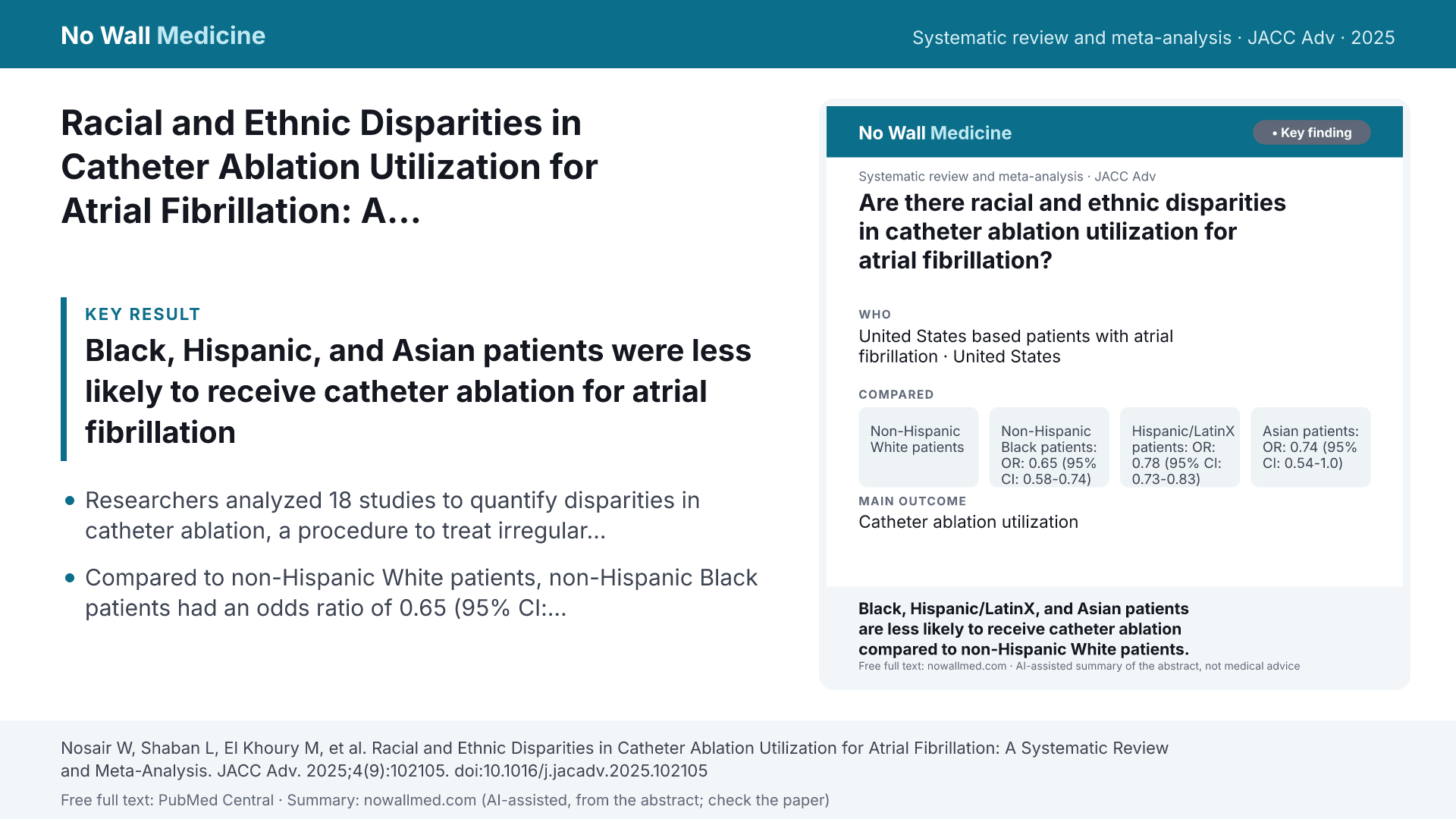
Nosair W, Shaban L, El Khoury M, et al. Racial and Ethnic Disparities in Catheter Ablation Utilization for Atrial Fibrillation: A Systematic Review and Meta-Analysis. JACC Adv. 2025. doi:10.1016/j.jacadv.2025.102105
Spotted a mistake? Suggest a correction