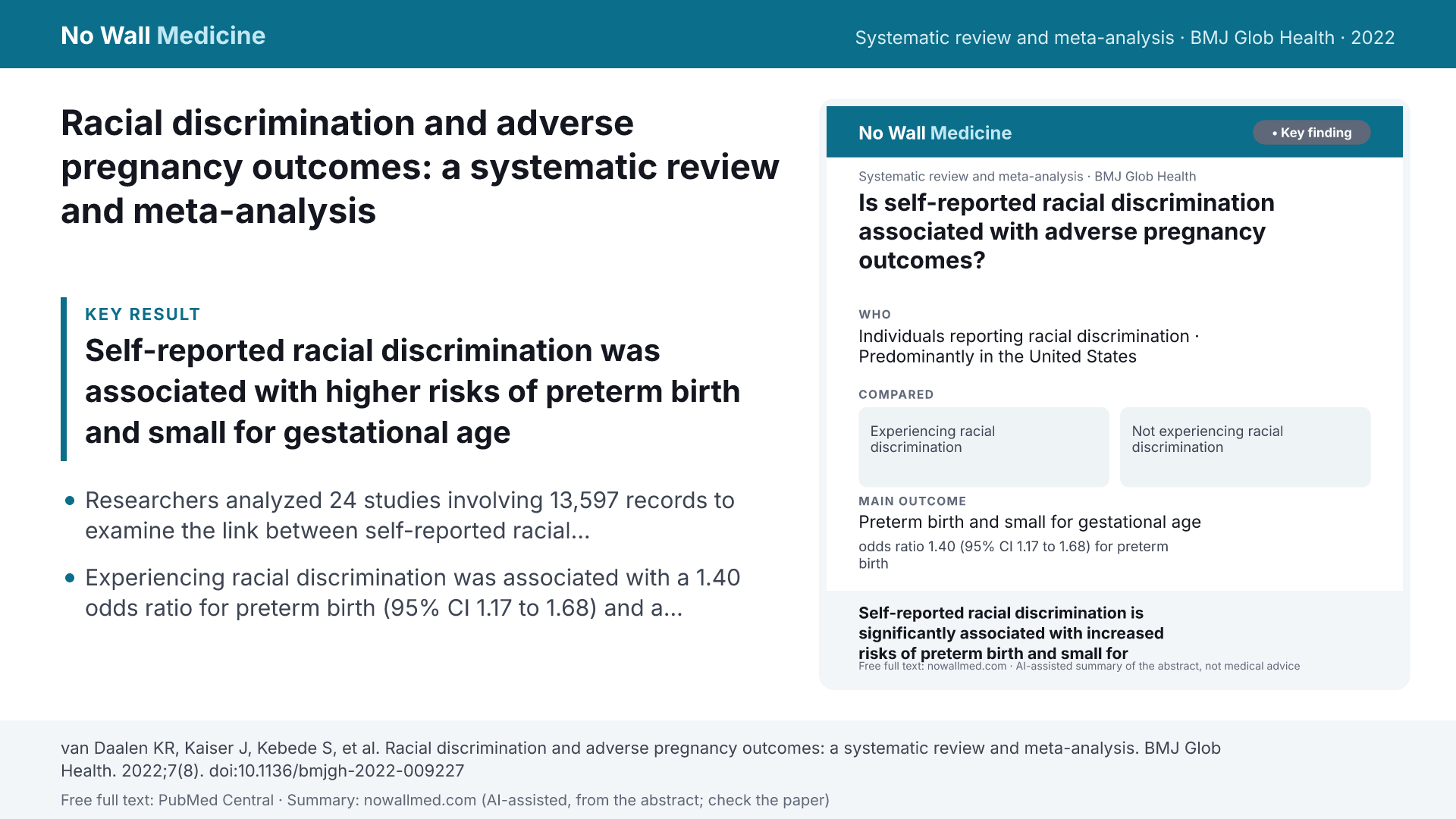
Self-reported racial discrimination was associated with higher risks of preterm birth and small for gestational age
Racial discrimination and adverse pregnancy outcomes: a systematic review and meta-analysis
Systematic review and meta-analysisKey finding
Is self-reported racial discrimination associated with adverse pregnancy outcomes?
Who
Individuals reporting racial discrimination · Predominantly in the United States
Compared
Experiencing racial discrimination
Not experiencing racial discrimination
Main outcome
Preterm birth and small for gestational age
Result: odds ratio 1.40 (95% CI 1.17 to 1.68) for preterm birth
Bottom line: Self-reported racial discrimination is significantly associated with increased risks of preterm birth and small for gestational age.
BMJ Glob Health · 2022-08-02Download image
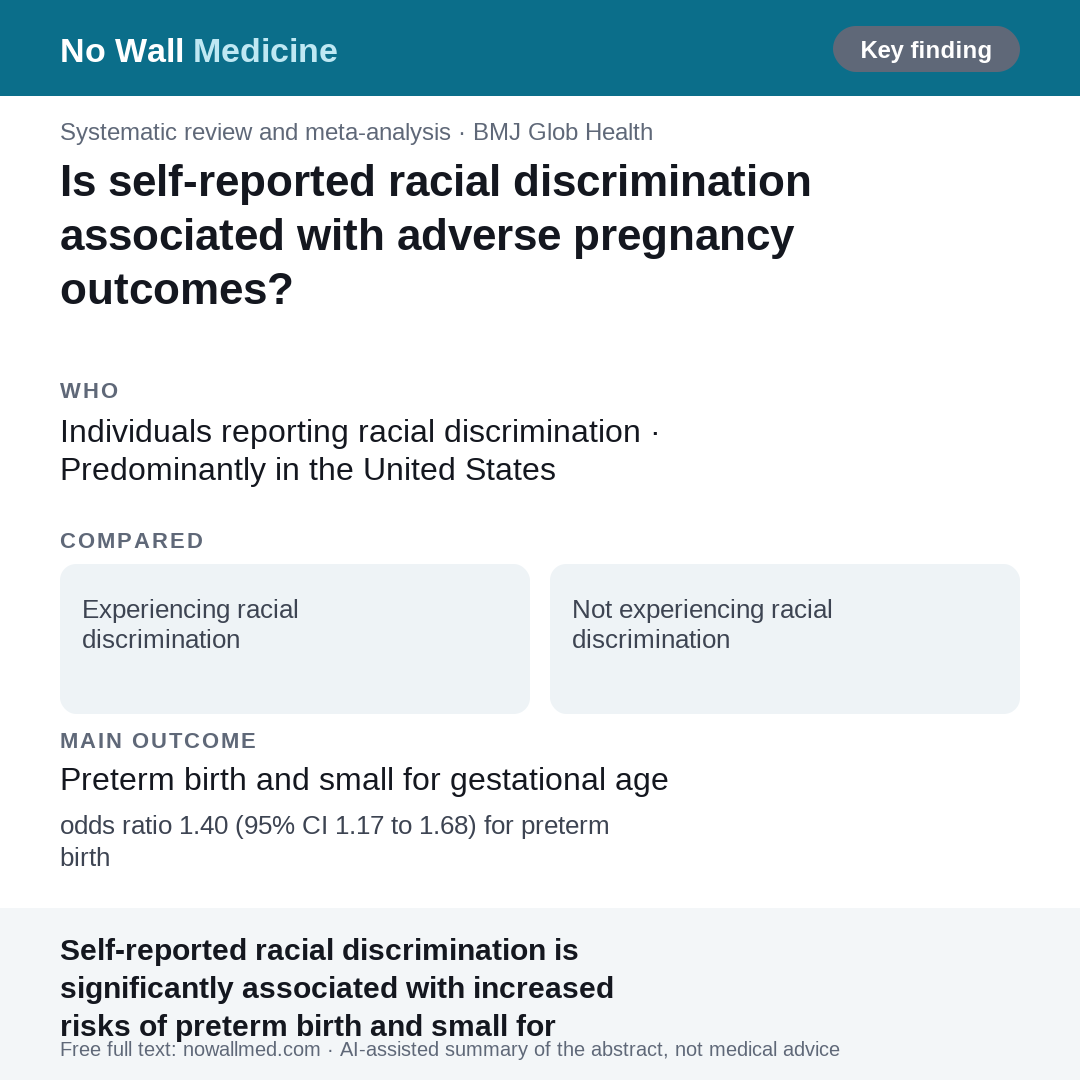
Clinical question: Is self-reported racial discrimination associated with adverse pregnancy outcomes?
Why it matters: The specific association between self-reported racial discrimination and various adverse pregnancy outcomes needed to be quantified through a systematic review and meta-analysis.
Key points
- Researchers analyzed 24 studies involving 13,597 records to examine the link between self-reported racial discrimination and pregnancy outcomes.
- Experiencing racial discrimination was associated with a 1.40 odds ratio for preterm birth (95% CI 1.17 to 1.68) and a 1.23 odds ratio for small for gestational age (95% CI 0.76 to 1.99).
- When low-quality studies were excluded, the association with preterm birth remained at an odds ratio of 1.31 (95% CI 1.08 to 1.59).
Limitation the authors note: The authors noted that higher quality evidence from large ethnographically diverse cohorts is needed to further explore these associations and underlying mechanisms.
Headline and key points written with AI from the paper’s abstract, with every number checked against it. Read the paper before relying on them.
Was this summary helpful?
Abstract
Introduction
Racial discrimination has been consistently linked to various health outcomes and health disparities, including studies associating racial discrimination with patterns of racial disparities in adverse pregnancy outcomes. To expand our knowledge, this systematic review and meta-analysis assesses all available evidence on the association between self-reported racial discrimination and adverse pregnancy outcomes. Methods
Eight electronic databases were searched without language or time restrictions, through January 2022. Data were extracted using a pre-piloted extraction tool. Quality assessment was conducted using the Newcastle-Ottawa Scale (NOS), and across all included studies using the Grading of Recommendations Assessment, Development and Evaluation (GRADE) approach. Random effects meta-analyses were performed on preterm birth and small for gestational age. Heterogenicity was assessed using Cochran's χ2 test and I2 statistic. Results
Of 13 597 retrieved records, 24 articles were included. Studies included cohort, case-control and cross-sectional designs and were predominantly conducted in the USA (n=20). Across all outcomes, significant positive associations (between experiencing racial discrimination and an adverse pregnancy event) and non-significant associations (trending towards positive) were reported, with no studies reporting significant negative associations. The overall pooled odds ratio (OR) for preterm birth was 1.40 (95% CI 1.17 to 1.68; 13 studies) and for small for gestational age it was 1.23 (95% CI 0.76 to 1.99; 3 studies). When excluding low-quality studies, the preterm birth OR attenuated to 1.31 (95% CI 1.08 to 1.59; 10 studies). Similar results were obtained across sensitivity and subgroup analyses, indicating a significant positive association. Conclusion
These results suggest that racial discrimination has adverse impacts on pregnancy outcomes. This is supported by the broader literature on racial discrimination as a risk factor for adverse health outcomes. To further explore this association and underlying mechanisms, including mediating and moderating factors, higher quality evidence from large ethnographically diverse cohorts is needed.
Abstract reproduced under the article’s CC BY licence.
Subject terms
Headline, design, result, key points, caveat and citation as plain text.
Cite this article
van Daalen KR, Kaiser J, Kebede S, et al. Racial discrimination and adverse pregnancy outcomes: a systematic review and meta-analysis. BMJ Glob Health. 2022. doi:10.1136/bmjgh-2022-009227
Spotted a mistake? Suggest a correction