Surgery did not significantly reduce mortality for localized prostate cancer
Radical prostatectomy versus observation for localized prostate cancer
Why it matters: Radical prostatectomy did not significantly reduce all-cause or prostate-cancer deaths compared with observation in men with localized prostate cancer.
Related landmark trials: ProtecT
Context written by the NoWall Medicine team.
Randomized trialNo clear difference
Surgery vs observation for prostate cancer
Who
731
Men with localized prostate cancer
Compared
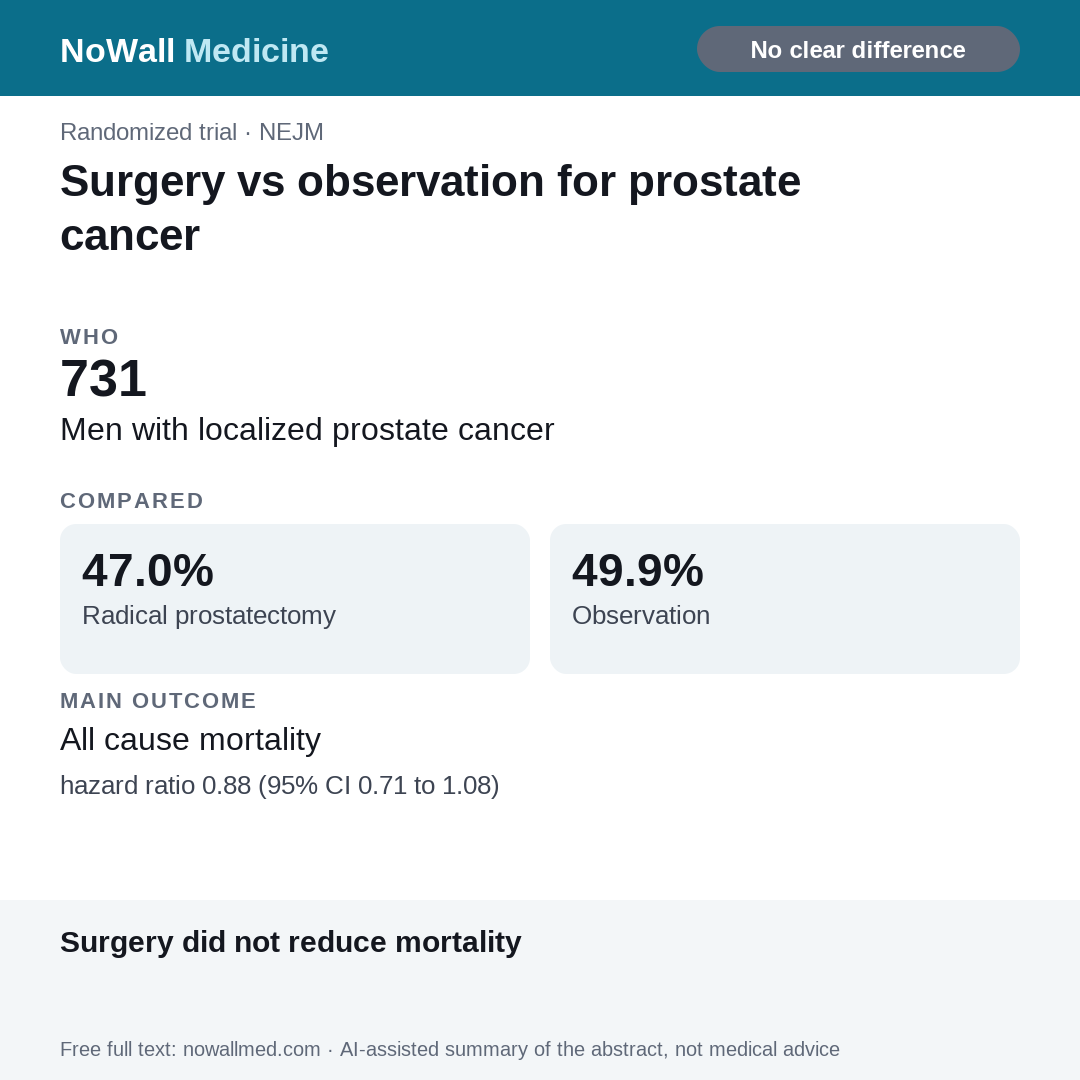
47.0%Radical prostatectomy (171/364)
49.9%Observation (183/367)
Main outcome
All cause mortality
Result: hazard ratio 0.88 (95% CI 0.71 to 1.08)
Bottom line: Surgery did not reduce mortality
Funded by: Department of Veterans Affairs
NEJM · 2012-07-20Download image
Trial at a glance
Bottom line: Radical prostatectomy did not significantly reduce all-cause or prostate-cancer mortality, as compared with observation
Clinical question
Radical prostatectomy versus observation for localized prostate cancer
Design
Randomized trial. 44 Department of Veterans Affairs sites and 8 National Cancer Institute sites, November 1994 through January 2002
Who was studied
731 men with localized prostate cancer, mean age 67 years
Key inclusion criteria
- histologically confirmed, clinically localized prostate cancer
- PSA value of less than 50 ng per milliliter
- age of 75 years or less
- negative results on a bone scan for metastatic disease
Interventions
- radical prostatectomy: surgery
- observation: no surgery
Primary outcome
all-cause mortality. hazard ratio, 0.88; 95% confidence interval [CI], 0.71 to 1.08; P = 0.22; absolute risk reduction, 2.9 percentage points
Secondary outcomes
- prostate-cancer mortality: hazard ratio, 0.63; 95% CI, 0.36 to 1.09; P = 0.09; absolute risk reduction, 2.6 percentage points
Harms
Adverse events within 30 days after surgery occurred in 21.4% of men, including one death
Limitations reported by the authors
- using prostate-cancer mortality as an outcome
Funding
Department of Veterans Affairs Cooperative Studies Program and others
Written with AI from the full paper; every number was checked against it. Read the paper before relying on it.
Key points
- 731 men with localized prostate cancer were randomly assigned to surgery or observation.
- Surgery had a hazard ratio of 0.88 for all-cause mortality, with 2.9 percentage points absolute risk reduction.
- 21.4% of men had adverse events within 30 days after surgery, including one death.
Limitation the authors note: The study was conducted during the early era of prostate-specific antigen testing
Headline and key points written with AI from the paper’s abstract, with every number checked against it. Read the paper before relying on them.
Topics
Spotted a mistake? Suggest a correction
More in Urology
Checkpoint inhibitor regimens benefit renal cell carcinoma patients with poor prognosis most
Which Patients with Advanced Clear Cell Renal Cell Carcinoma Benefit Most from First-line Checkpoint Inhibitor Combination Regimens: A Meta-analysis of Individual Patient Data and Aggregate Data from Randomised Trials
Male factor infertility is influenced by genetics, environment, and lifestyle choices
Key Determinants and Clinical Impact of Male Factor Infertility: From Etiology to Treatment
Nectin-4-targeted PET/CT compared to FDG PET/CT for urothelial carcinoma staging
Diagnostic Performance of Nectin-4-targeted [68Ga]Ga-DOTA-N188 PET/CT versus [18F]-FDG PET/CT for Staging of Locally Advanced and Metastatic Urothelial Carcinoma: A Prospective, Single-center, Phase 2 Feasibility Trial
Robotic surgery worked as well as open surgery for Wilms tumor in selected cases
Exploring the Limits of Robotic Surgery for Wilms Tumor: A Descriptive Analysis