Adding posterior wall isolation to catheter ablation shows no long-term benefit for persistent atrial fibrillation
Radiofrequency catheter ablation of persistent atrial fibrillation by pulmonary vein isolation with or without left atrial posterior wall isolation: long-term outcomes of the CAPLA trial
Multi-centre, international, randomized studyNo clear difference
Does adding posterior wall isolation to pulmonary vein isolation improve long-term outcomes in persistent atrial fibrillation?
Who
338
Patients with persistent atrial fibrillation undergoing radiofrequency catheter ablation · Multi-centre, international
Compared
35.5%Pulmonary vein isolation plus posterior wall isolation
42.1%Pulmonary vein isolation alone
Main outcome
Freedom from any documented atrial arrhythmia recurrence
Result: hazard ratio 1.15, 95% confidence interval 0.88-1.51
Bottom line: Adding posterior wall isolation to pulmonary vein isolation did not significantly improve long-term freedom from atrial arrhythmia recurrence.
Eur Heart J · 2024-09-01Download image
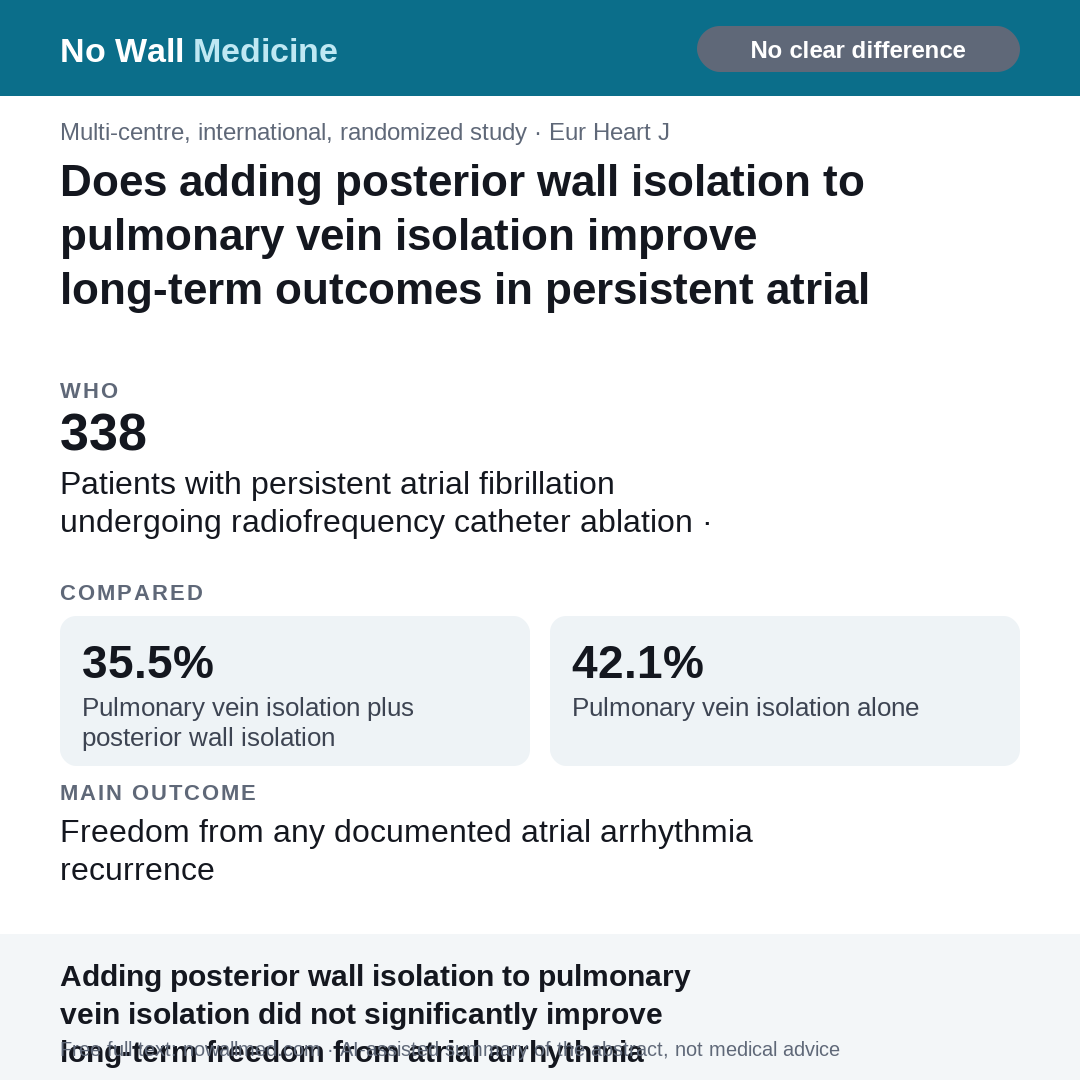
Clinical question: Does adding posterior wall isolation to pulmonary vein isolation improve long-term outcomes in persistent atrial fibrillation?
Key points
- Researchers followed 338 patients with persistent atrial fibrillation for a median of 3.62 years to compare pulmonary vein isolation alone against pulmonary vein isolation plus posterior wall isolation.
- Freedom from recurrent atrial arrhythmia at 3 years was 35.5% in the combined group versus 42.1% in the pulmonary vein isolation alone group, which was not statistically significant.
- At 3 years, the median atrial fibrillation burden was 0% for both groups and sinus rhythm was present in 85.1% of the combined group and 87.1% of the single group.
Headline and key points written with AI from the paper’s abstract, with every number checked against it. Read the paper before relying on them.
Was this summary helpful?
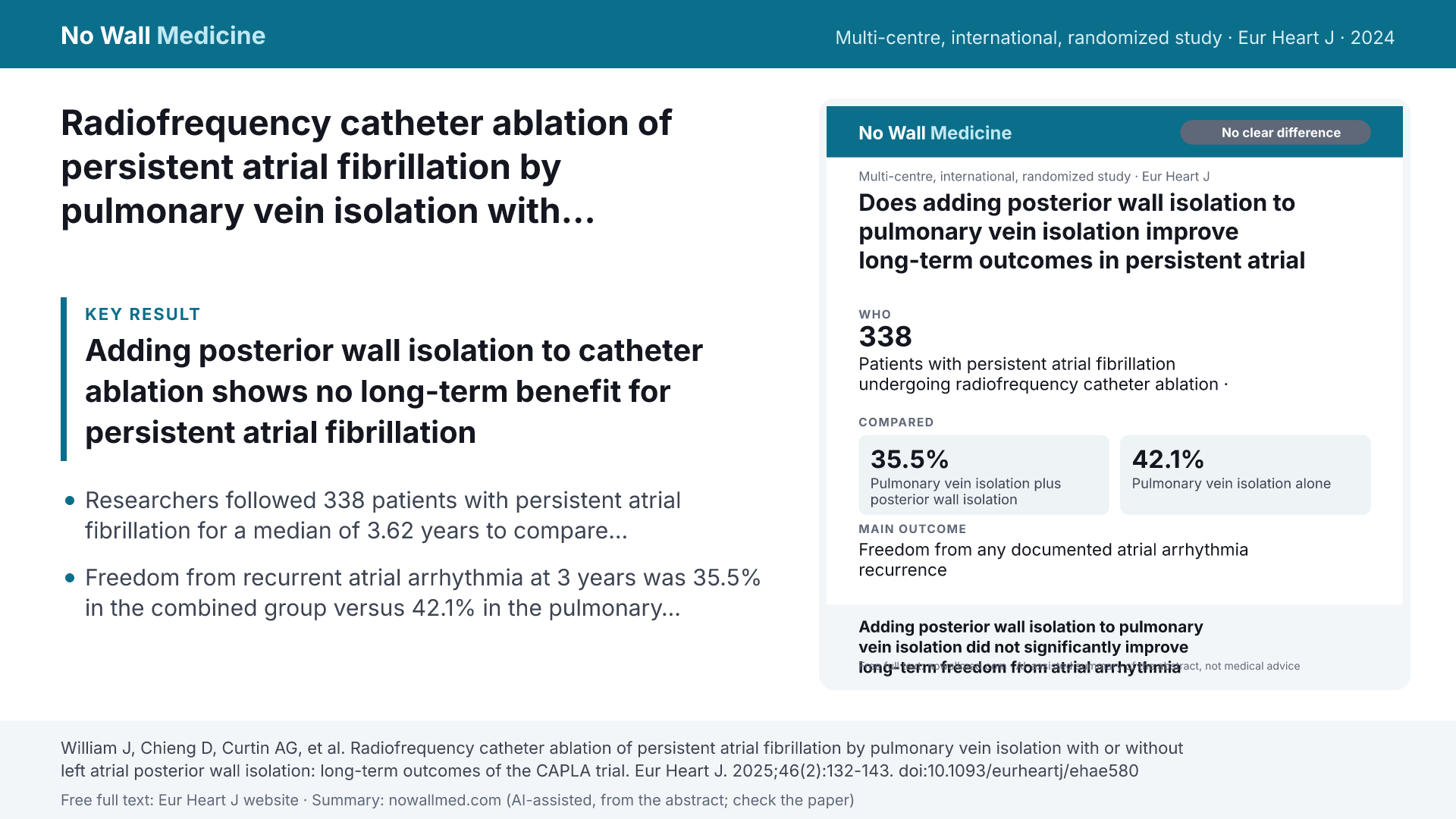
Subject terms
Headline, design, result, key points, caveat and citation as plain text.
Cite this article
William J, Chieng D, Curtin AG, et al. Radiofrequency catheter ablation of persistent atrial fibrillation by pulmonary vein isolation with or without left atrial posterior wall isolation: long-term outcomes of the CAPLA trial. Eur Heart J. 2024. doi:10.1093/eurheartj/ehae580
Spotted a mistake? Suggest a correction