Radiofrequency identification tags were associated with lower positive margin rates than wire localization for breast lesions
Radiofrequency identification tag localization of nonpalpable breast lesions: a systematic review and meta-analysis
Systematic review and meta-analysisBenefit found
Is radiofrequency identification tag localization effective compared to wire-guided localization for nonpalpable breast lesions?
Who
3234
3,234 patients with 497 benign and 2,741 malignant lesions
Compared
Radiofrequency identification tag localization: 12% positive margins
Wire-guided localization
Main outcome
Positive margins and re-excision rates
Result: odds ratio 0.71 (95% CI 0.54-0.95) for positive margins
Bottom line: Radiofrequency identification tag localization has significantly lower positive margin rates than wire-guided localization for nonpalpable breast lesions.
Limitation: Moderate bias was reported in 16/19 studies, serious bias in 3/19.
Eur Radiol Exp · 2025-12-22Download image
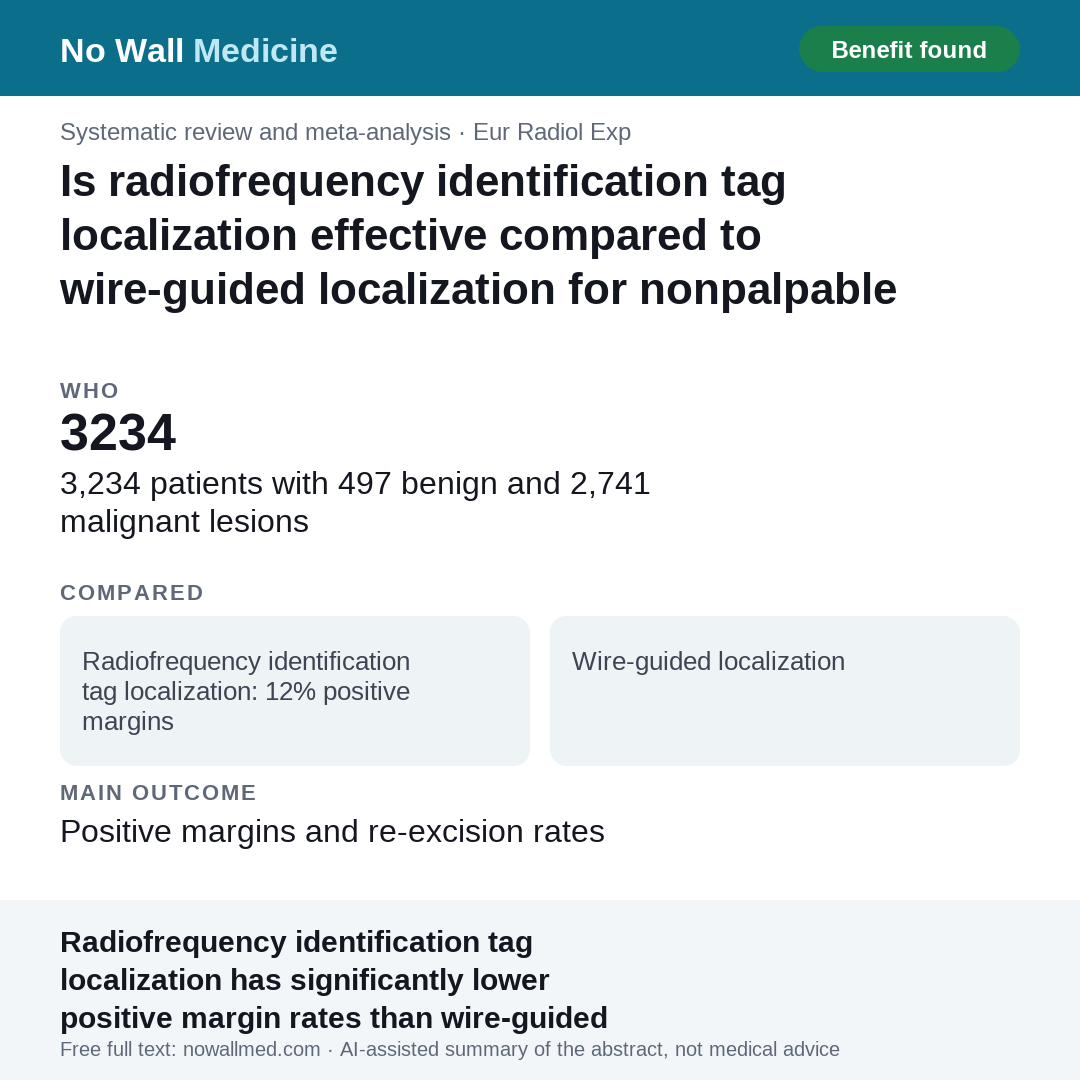
Clinical question: Is radiofrequency identification tag localization effective compared to wire-guided localization for nonpalpable breast lesions?
Why it matters: Clinicians need to determine if radiofrequency identification tags are an effective and safe alternative to traditional wire-guided localization for nonpalpable breast lesions.
Key points
- Researchers analyzed 19 studies involving 3,234 patients with 497 benign and 2,741 malignant nonpalpable breast lesions.
- Radiofrequency identification tag localization was associated with significantly lower positive margin rates than wire-guided localization, with an odds ratio of 0.71.
- No difference was observed between radiofrequency identification tags and wire-guided localization regarding re-excision rates, which is the need for a second surgery.
Limitation the authors note: The authors state that randomized trials are required to better elucidate the benefit of radiofrequency identification tag localization over wire-guided localization.
Headline and key points written with AI from the paper’s abstract, with every number checked against it. Read the paper before relying on them.
Was this summary helpful?
Subject terms
Cite this article
Daly GR, Alabdulrahman M, Dowling GP, Hehir C, Briody H, Almasri S. Radiofrequency identification tag localization of nonpalpable breast lesions: a systematic review and meta-analysis. Eur Radiol Exp. 2025. doi:10.1186/s41747-025-00657-z
Spotted a mistake? Suggest a correction
Top studies every Monday
The week’s key trials and guidelines in your specialties, plus any topics you follow. By email, free.
Get the weekly digest