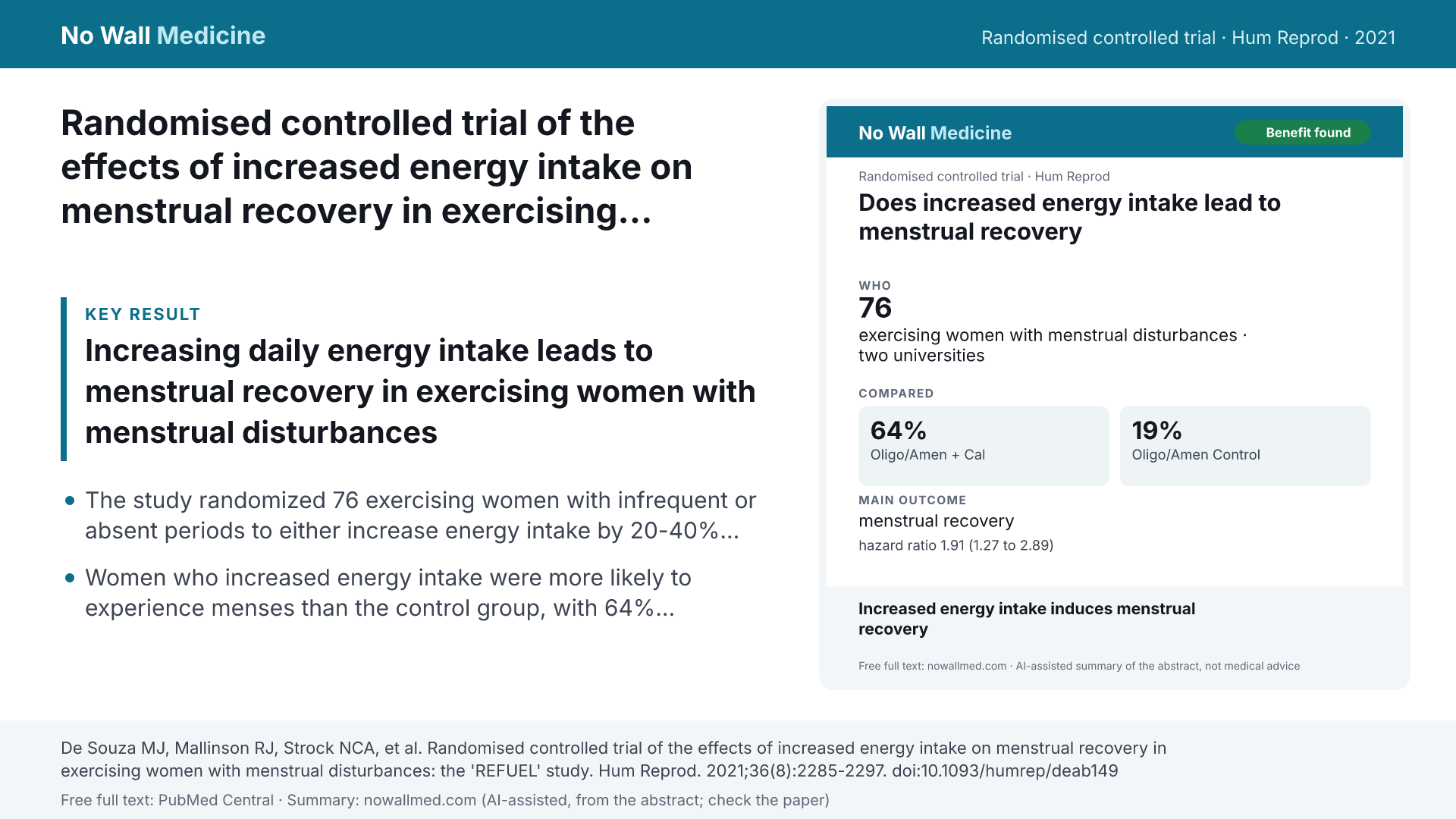
Increasing daily energy intake leads to menstrual recovery in exercising women with menstrual disturbances
Randomised controlled trial of the effects of increased energy intake on menstrual recovery in exercising women with menstrual disturbances: the 'REFUEL' study
Randomised controlled trialBenefit found
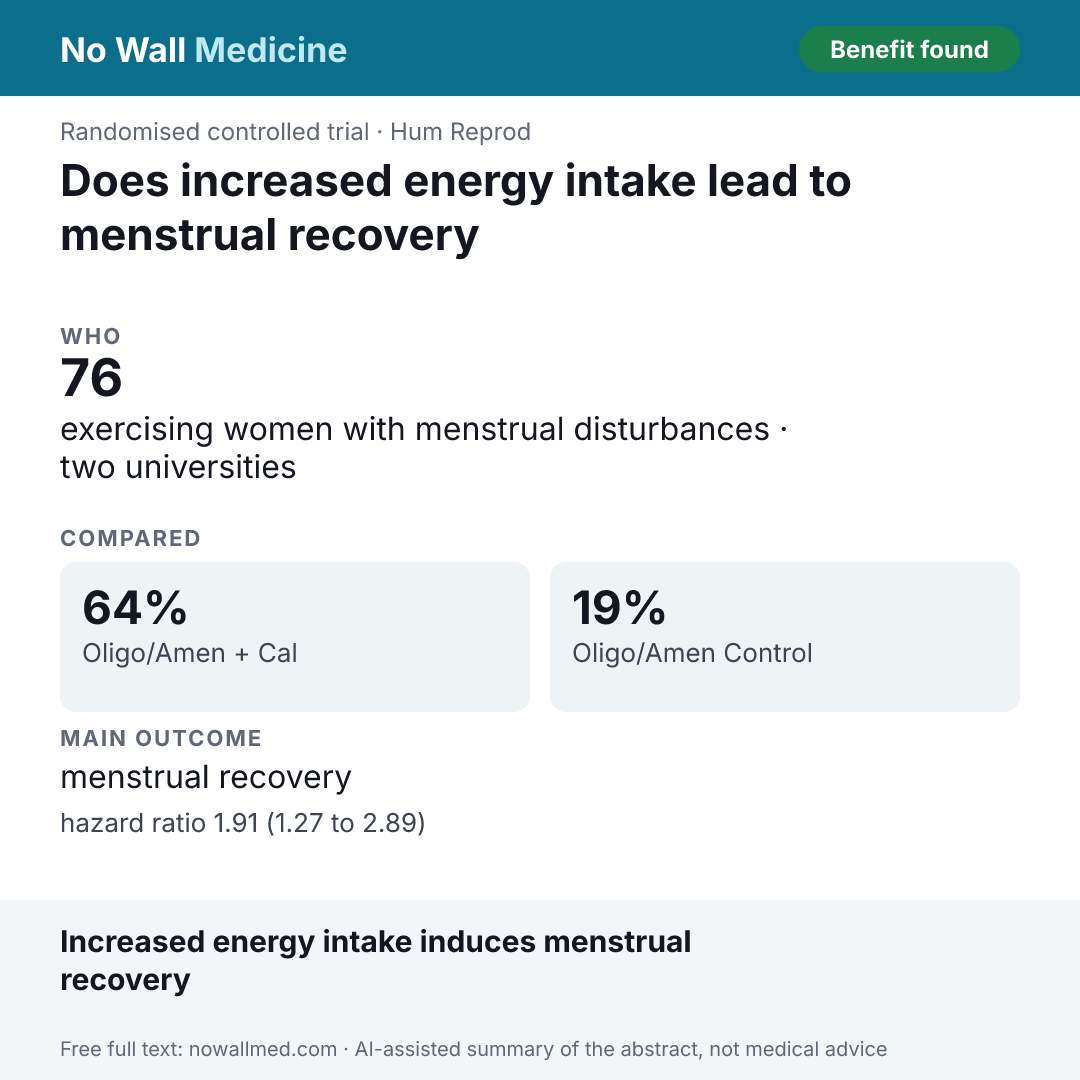
Does increased energy intake lead to menstrual recovery
Who
76
exercising women with menstrual disturbances · two universities
Compared
64%Oligo/Amen + Cal
19%Oligo/Amen Control
Main outcome
menstrual recovery
Result: hazard ratio 1.91 (1.27 to 2.89)
Bottom line: Increased energy intake induces menstrual recovery
Limitation: greater than expected dropout rate
Funded by: U.S. Department of Defense
Hum Reprod · 2021-06-25 · Save PNG
Same trial (NCT00392873)
Papers we list that report this registered trial, oldest first. Read a secondary analysis alongside the main results.
- Main results Benefit found
This paper Hum Reprod 2021-06 - Related analysis
Increased energy intake did not improve bone mineral density in exercising women with menstrual disturbances Am J Clin Nutr 2022-02
Key points
- The study randomized 76 exercising women with infrequent or absent periods to either increase energy intake by 20-40% or maintain their baseline intake for 12 months.
- Women who increased energy intake were more likely to experience menses than the control group, with 64% showing improved menstrual function compared to 19% in the control group.
- The group with increased energy intake showed greater increases in body weight, percent body fat, and total triiodothyronine, a thyroid hormone, compared to the control group.
Limitation the authors note: The study had a greater than expected dropout rate for the 12-month intervention.
Headline and key points written with AI from the paper’s abstract, with every number checked against it. Read the paper before relying on them.
Was this summary helpful?
Subject terms
Headline, design, result, key points, caveat and citation as plain text.
Cite this article
De Souza MJ, Mallinson RJ, Strock NCA, et al. Randomised controlled trial of the effects of increased energy intake on menstrual recovery in exercising women with menstrual disturbances: the 'REFUEL' study. Hum Reprod. 2021;36(8):2285-2297. doi:10.1093/humrep/deab149
Spotted a mistake? Suggest a correction