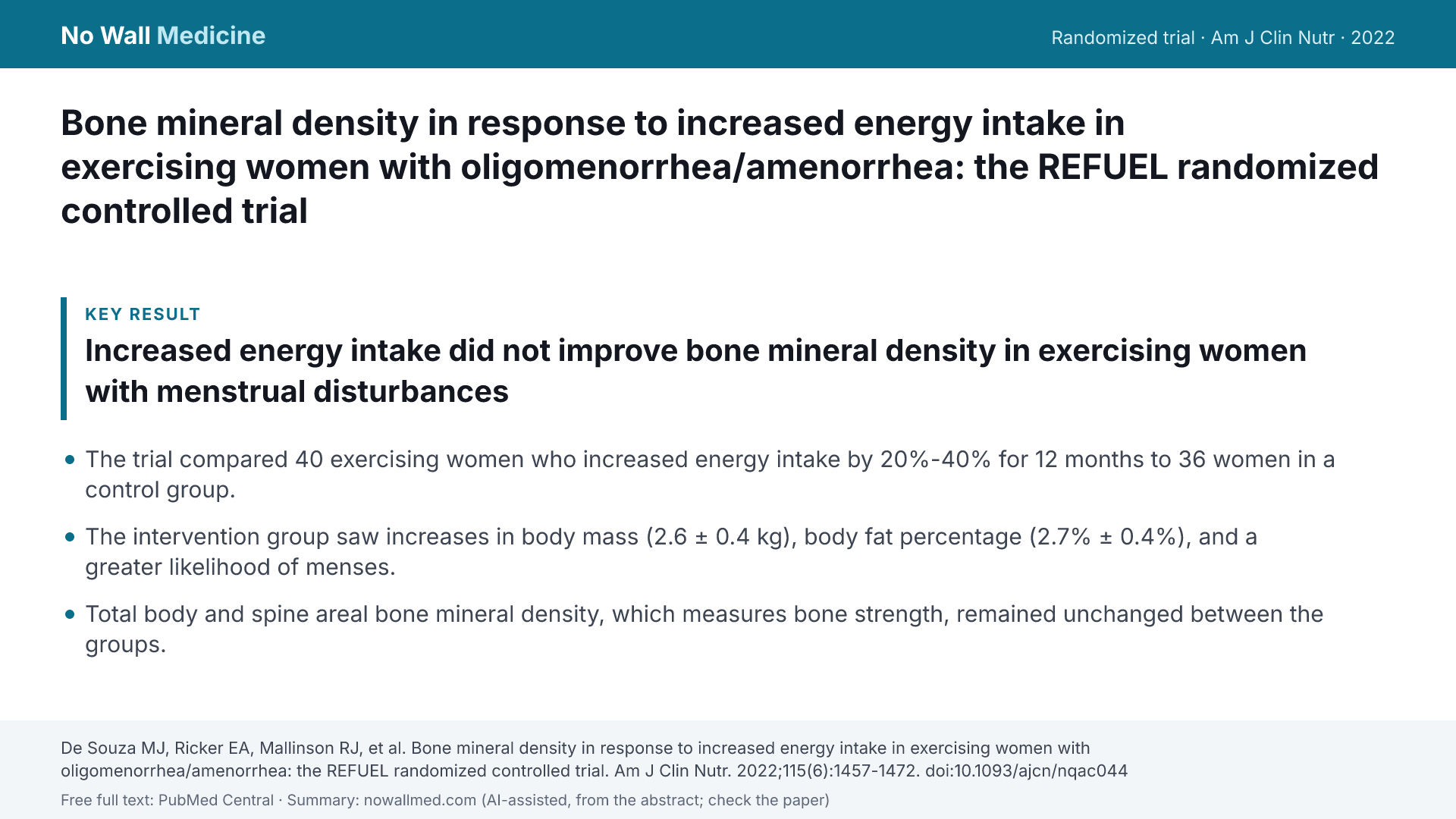
Increased energy intake did not improve bone mineral density in exercising women with menstrual disturbances
Bone mineral density in response to increased energy intake in exercising women with oligomenorrhea/amenorrhea: the REFUEL randomized controlled trial
Same trial (NCT00392873)
Papers we list that report this registered trial, oldest first. Read a secondary analysis alongside the main results.
- Main results Benefit found
Increasing daily energy intake leads to menstrual recovery in exercising women with menstrual disturbances Hum Reprod 2021-06 - Related analysis
This paper Am J Clin Nutr 2022-02
Key points
- The trial compared 40 exercising women who increased energy intake by 20%-40% for 12 months to 36 women in a control group.
- The intervention group saw increases in body mass (2.6 ± 0.4 kg), body fat percentage (2.7% ± 0.4%), and a greater likelihood of menses.
- Total body and spine areal bone mineral density, which measures bone strength, remained unchanged between the groups.
Limitation the authors note: The 12-mo intervention may have been too short and the energy increase may have been insufficient to increase estrogen or improve bone mineral density.
Headline and key points written with AI from the paper’s abstract, with every number checked against it. Read the paper before relying on them.
Was this summary helpful?
Subject terms
Headline, design, result, key points, caveat and citation as plain text.
Cite this article
De Souza MJ, Ricker EA, Mallinson RJ, et al. Bone mineral density in response to increased energy intake in exercising women with oligomenorrhea/amenorrhea: the REFUEL randomized controlled trial. Am J Clin Nutr. 2022;115(6):1457-1472. doi:10.1093/ajcn/nqac044
Spotted a mistake? Suggest a correction