Intestinal adsorbent was associated with shorter diarrhea duration in a feasibility trial in The Gambia
Randomised feasibility study of an intestinal adsorbent in acute diarrhoea in The Gambia
Randomised controlled feasibility trialBenefit found
Does an intestinal adsorbent reduce diarrhoea duration and severity in children?
Who
50
Children aged 6-59 months with acute diarrhoea · The Gambia, Edward Francis Small Teaching Hospital
Compared
Standard treatment
Standard treatment with polymethylsiloxane polyhydrate
Main outcome
Time from randomisation to the last watery stool
Result: mean difference -19.3 hours (95% CI -30.9 to -7.8)
Bottom line: Polymethylsiloxane polyhydrate may reduce the time until the last watery stool in children with acute diarrhoea.
BMJ Paediatr Open · 2025-01-23Download image
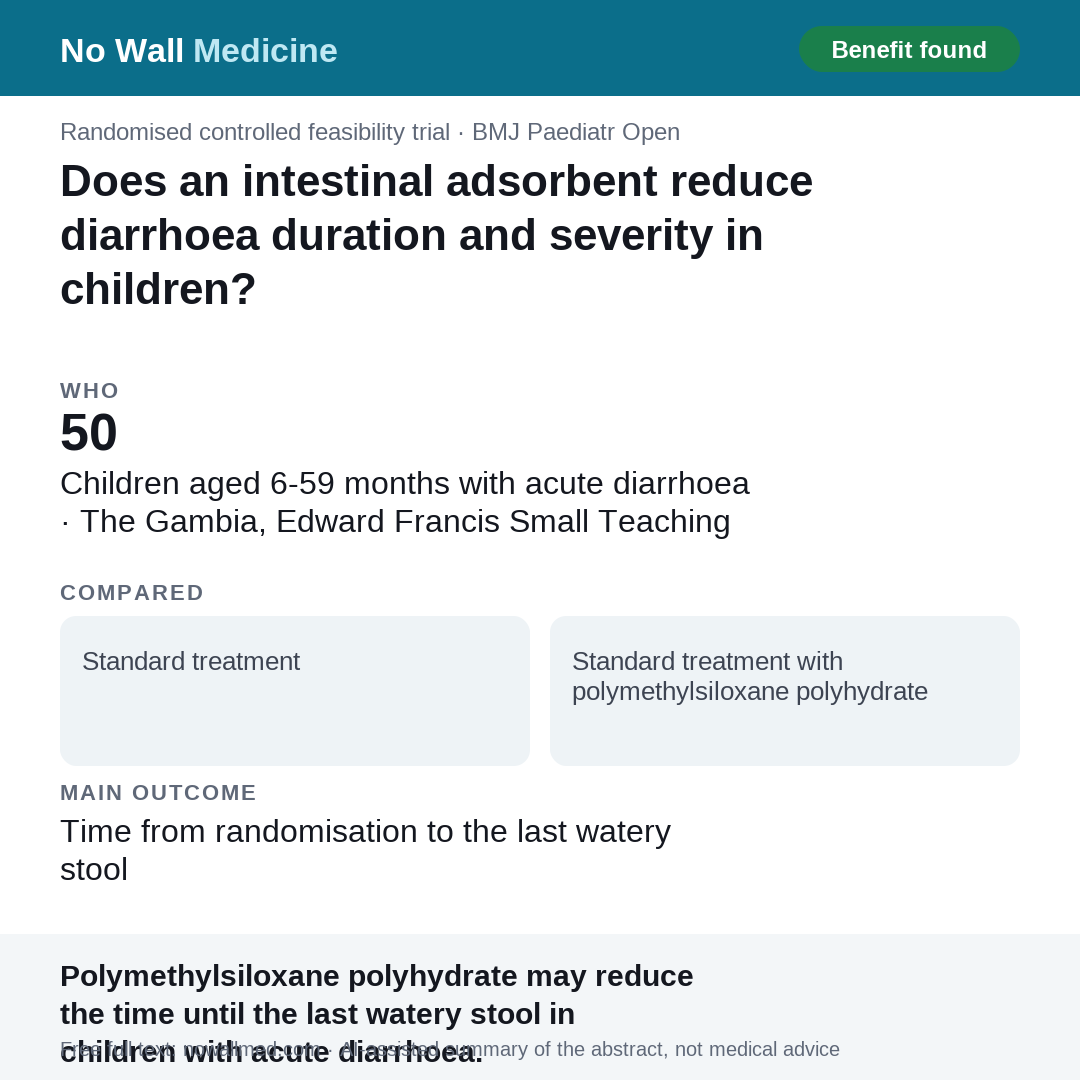
Clinical question: Does an intestinal adsorbent reduce diarrhoea duration and severity in children?
Why it matters: It is unknown if an intestinal adsorbent can reduce the duration and severity of acute diarrhea in children.
Key points
- Researchers studied 50 children aged 6-59 months with acute diarrhea who received either standard treatment or standard treatment plus polymethylsiloxane polyhydrate, a substance that binds to toxins in the gut.
- The time from randomization to the last watery stool was shorter in the intervention group by a mean difference of -19.3 hours (95% CI -30.9 to -7.8).
- Stool frequency was lower in the intervention group on days 2 (95% CI -0.8 to -1.3 to -0.3) and 3 (95% CI -0.8; -1.3 to -0.3).
Limitation the authors note: Patient-held diaries did not collect reliable information.
Headline and key points written with AI from the paper’s abstract, with every number checked against it. Read the paper before relying on them.
Abstract
Background
Diarrhoea remains a leading cause of death in children. An intestinal adsorbent may reduce diarrhoea duration and severity. Methods
Randomised controlled feasibility trial with two phases: phase 1 (0-4 hours and double-blind) and phase 2 (up to 5 days and open-label). 50 children aged 6-59 months with acute diarrhoea presenting with no or some dehydration to the emergency paediatric unit and outpatient clinic at Edward Francis Small Teaching Hospital, Banjul, The Gambia were randomised to either standard treatment (oral rehydration fluid and zinc) or standard treatment with polymethylsiloxane polyhydrate for up to 5 days. Results
Recruitment was completed in 7 months. All but one child completed the study. There were no major protocol deviations although patient-held diaries did not collect reliable information. Time from randomisation to the last watery stool (primary outcome) was shorter in the intervention than control arm (mean difference -19.3 hours, 95% CI -30.9 to -7.8). Stool frequency was lower in the intervention arm on days 2 (95% CI -0.8 to -1.3 to -0.3) and 3 (95% CI -0.8; -1.3 to -0.3). One serious event (death) occurred in the control arm. Conclusions
A randomised, controlled trial is feasible. Further clinical trials are warranted to confirm the efficacy of polymethylsiloxane polyhydrate in acute diarrhoea and inform management guidelines. Trial registration number
PACTR202302683128875.
Abstract reproduced under the article’s CC BY NC licence.
Topics
Cite this article
Rahden P, Fatty A, Jobarteh ML, Sallah A, Jaiteh E, Allen A. Randomised feasibility study of an intestinal adsorbent in acute diarrhoea in The Gambia. BMJ Paediatr Open. 2025. doi:10.1136/bmjpo-2024-003133
Spotted a mistake? Suggest a correction
Top studies every Monday
The week’s key trials and guidelines in your specialties, plus any topics you follow. By email, free.
Get the weekly digest