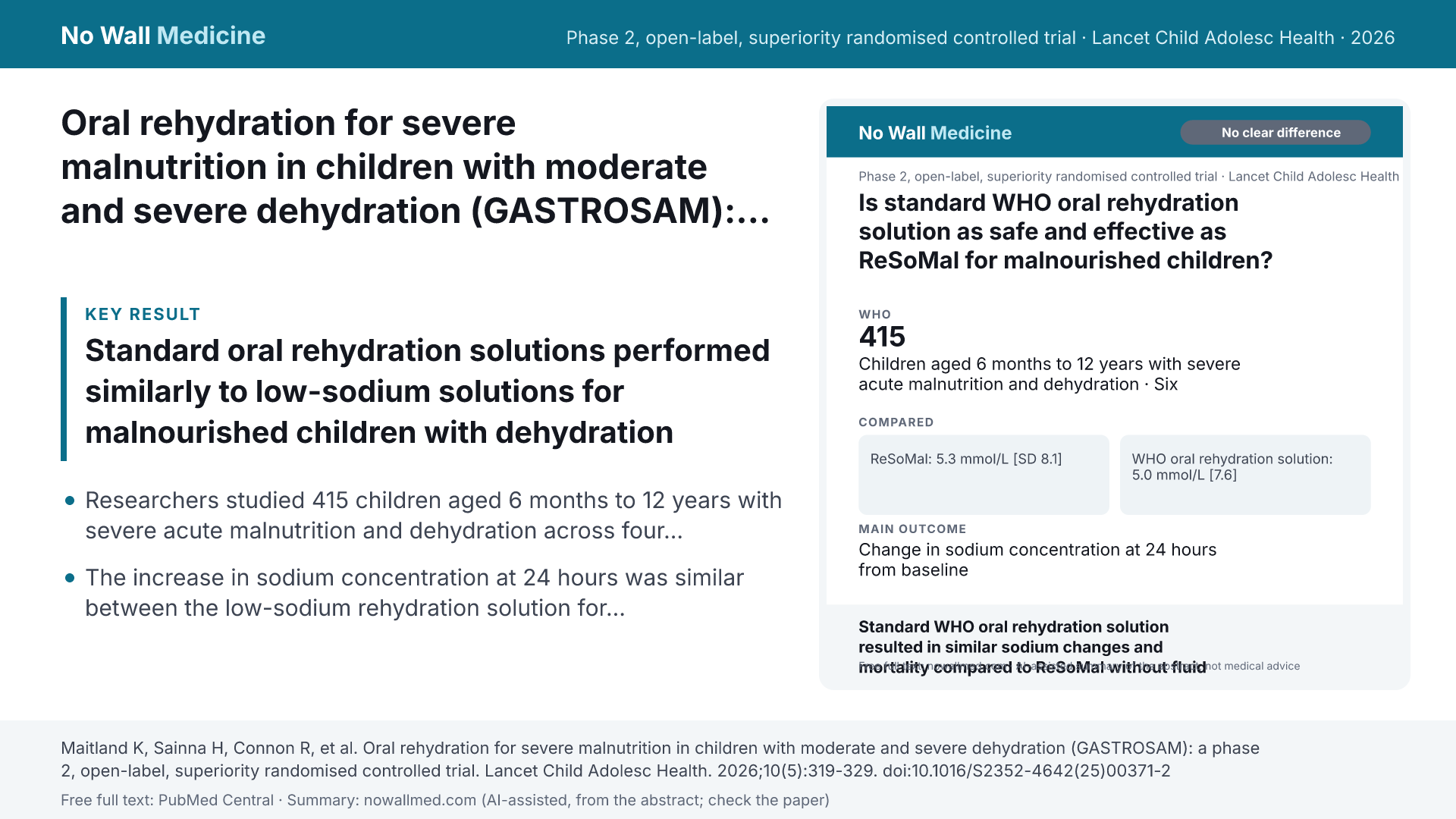
Standard oral rehydration solutions performed similarly to low-sodium solutions for malnourished children with dehydration
Oral rehydration for severe malnutrition in children with moderate and severe dehydration (GASTROSAM): a phase 2, open-label, superiority randomised controlled trial
Phase 2, open-label, superiority randomised controlled trialNo clear difference
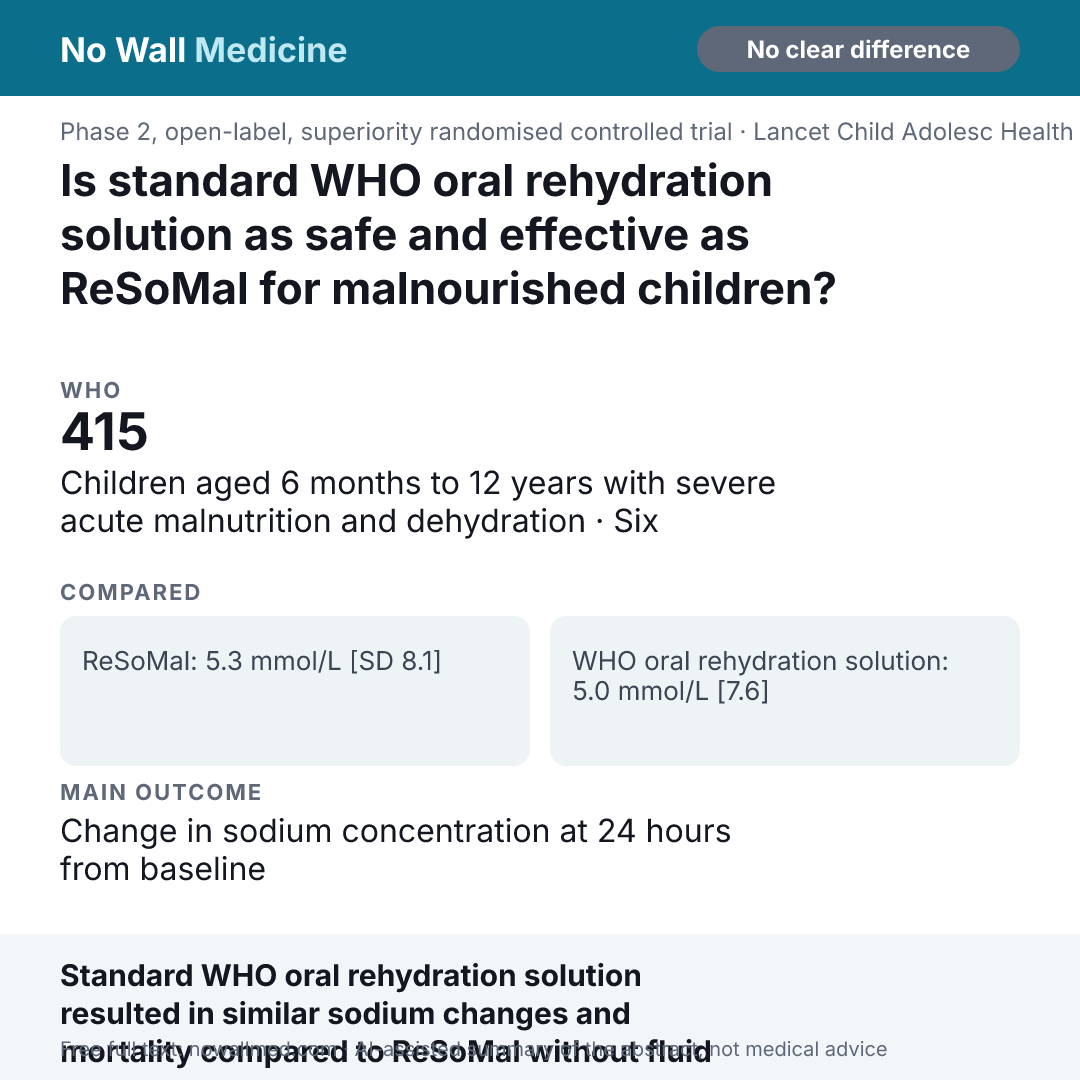
Is standard WHO oral rehydration solution as safe and effective as ReSoMal for malnourished children?
Who
415
Children aged 6 months to 12 years with severe acute malnutrition and dehydration · Six hospitals in Kenya, Niger, Nigeria, and Uganda
Compared
ReSoMal: 5.3 mmol/L [SD 8.1]
WHO oral rehydration solution: 5.0 mmol/L [7.6]
Main outcome
Change in sodium concentration at 24 hours from baseline
Result: mean difference -0.6 (95% CI -1.9 to 0.7)
Bottom line: Standard WHO oral rehydration solution resulted in similar sodium changes and mortality compared to ReSoMal without fluid overload.
Funded by: Medical Research Council, UK Department for International Development, Wellcome, and Médecins Sans Frontières
Lancet Child Adolesc Health · 2026-03-10 · Save PNG
Same trial (ISRCTN76149273)
Papers we list that report this registered trial, oldest first. Read a secondary analysis alongside the main results.
- Related analysis
Intravenous Rehydration for Severe Acute Malnutrition with Gastroenteritis NEJM 2025-06 - Main results No clear difference
This paper Lancet Child Adolesc Health 2026-03
Clinical question: Is standard WHO oral rehydration solution as safe and effective as ReSoMal for malnourished children?
Key points
- Researchers studied 415 children aged 6 months to 12 years with severe acute malnutrition and dehydration across four African countries.
- The increase in sodium concentration at 24 hours was similar between the low-sodium rehydration solution for malnutrition (5.3 mmol/L) and standard oral rehydration solutions (5.0 mmol/L).
- There was no difference in mortality at 28 days between the two groups, and no cases of fluid overload were observed.
Headline and key points written with AI from the paper’s abstract, with every number checked against it. Read the paper before relying on them.
Was this summary helpful?
Abstract
Background
International guidelines for treatment of children with severe acute malnutrition advise against giving standard oral rehydration solutions (ORS) for dehydration secondary to diarrhoea. Instead, they recommend exclusive use of low-sodium rehydration solution for malnutrition (ReSoMal), due to concerns about both sodium and fluid overload. Supportive evidence is lacking, warranting reappraisal of this guidance. We aimed to assess the safety and superiority of standard WHO-ORS versus ReSoMal. Methods
GASTROSAM was a phase 2, factorial, open-label, superiority randomised controlled trial conducted at six hospitals in four African countries (Kenya, Niger, Nigeria, and Uganda). Children aged 6 months to 12 years with severe acute malnutrition who were admitted to hospital with severe (stratum A) or moderate (stratum B) dehydration and diarrhoea were randomly assigned in a 1:1 ratio to receive ReSoMal or low-osmolarity WHO-ORS. A simultaneous randomisation in stratum A compared two intravenous strategies versus an oral control rehydration strategy (results reported elsewhere). Children with severe dehydration (stratum A) received their allocated ORS as soon as possible. The primary endpoint was change in sodium concentration at 24 h from baseline in all randomised participants and analysed on an intention-to-treat basis. Children with lived experience were not involved in the study design. The trial is registered on the ISRCTN registry (ISRCTN76149273) and the Pan-African Clinical Trials Registry (PACTR202103852542919). Findings
Between Sept 2, 2019, and Oct 27, 2024, 415 eligible children were enrolled (218 [53%] male; 197 [47%] female); 272 were enrolled into stratum A (137 to ReSoMal and 135 to WHO-ORS) and 143 were enrolled into stratum B (69 to ReSoMal and 74 to WHO-ORS). Children were followed up for 28 days; 11 (3%) were lost to follow-up or withdrew. The primary endpoint was assessed in 387 (93%) of 415 participants. The increase in sodium concentration was similar in both groups (5·3 mmol/L [SD 8·1] with ReSoMal vs 5·0 mmol/L [7·6] with WHO-ORS; mean difference for WHO-ORS vs ReSoMal -0·6 [95% CI -1·9 to 0·7], p=0·37). There was no difference in day 28 mortality between the WHO-ORS and ReSoMal groups (19 [9%] vs 24 [12%]; adjusted hazard ratio 0·76 [95% CI 0·41 to 1·41], p=0·39). Fluid overload events (pulmonary oedema and cardiac overload) were actively monitored: none was observed. Interpretation
WHO-ORS resulted in similar outcomes to ReSoMal, and neither strategy led to fluid overload. This finding informs the simplification of guidelines supporting the use of WHO-ORS for the management of dehydration in children regardless of nutritional status. Funding
Joint Global Health Trials Scheme of the UK Medical Research Council, UK Department for International Development, Wellcome, and Médecins Sans Frontières.
Abstract reproduced under the article’s CC BY licence.
Subject terms
Headline, design, result, key points, caveat and citation as plain text.
Cite this article
Maitland K, Sainna H, Connon R, et al. Oral rehydration for severe malnutrition in children with moderate and severe dehydration (GASTROSAM): a phase 2, open-label, superiority randomised controlled trial. Lancet Child Adolesc Health. 2026;10(5):319-329. doi:10.1016/S2352-4642(25)00371-2
Spotted a mistake? Suggest a correction