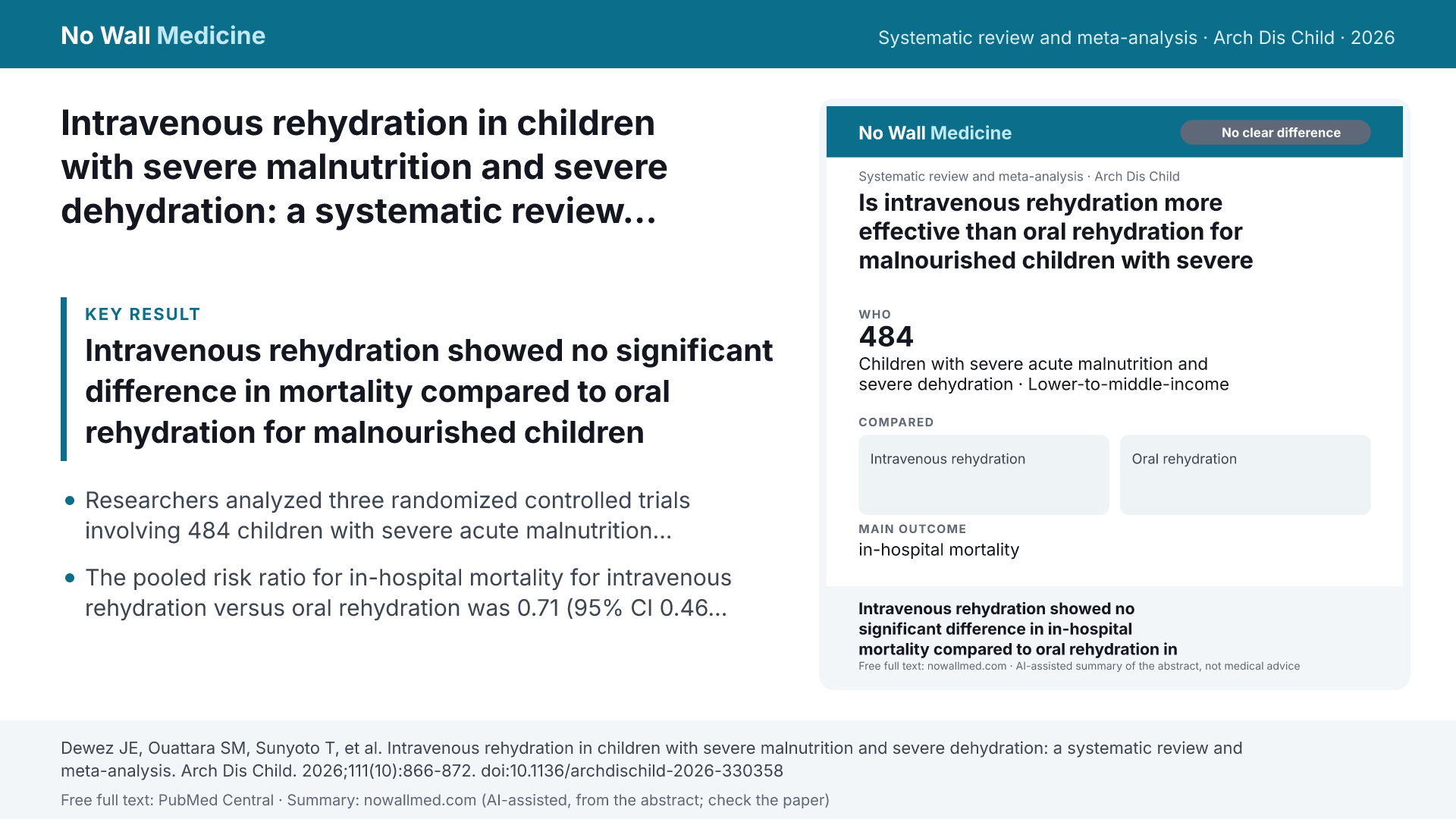
Intravenous rehydration showed no significant difference in mortality compared to oral rehydration for malnourished children
Intravenous rehydration in children with severe malnutrition and severe dehydration: a systematic review and meta-analysis
Systematic review and meta-analysisNo clear difference
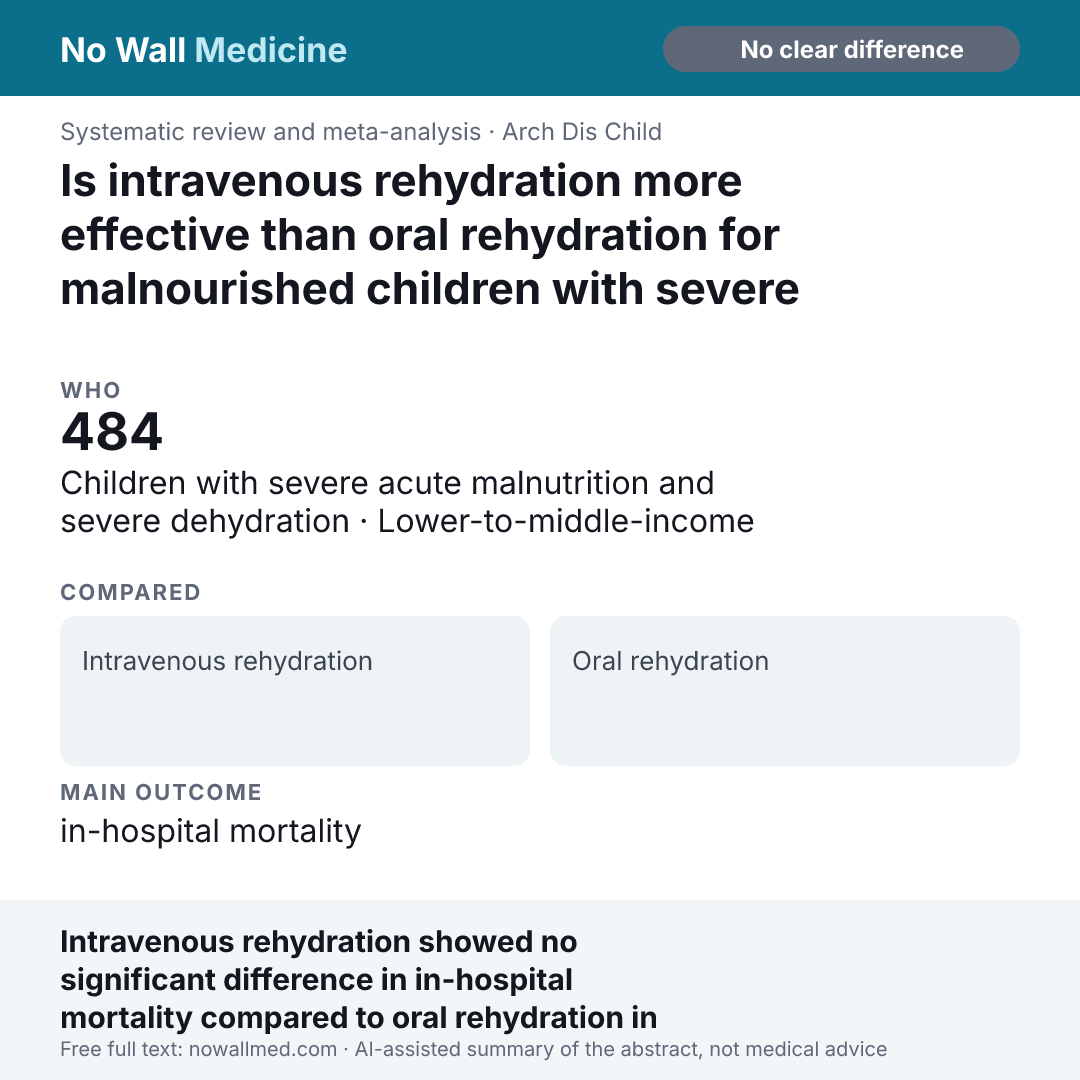
Is intravenous rehydration more effective than oral rehydration for malnourished children with severe dehydration?
Who
484
Children with severe acute malnutrition and severe dehydration · Lower-to-middle-income countries
Compared
Intravenous rehydration
Oral rehydration
Main outcome
in-hospital mortality
Result: risk ratio 0.71 (95% CI 0.46 to 1.10)
Bottom line: Intravenous rehydration showed no significant difference in in-hospital mortality compared to oral rehydration in children with severe malnutrition.
Limitation: Only three randomized controlled trials were identified
Arch Dis Child · 2026-09-18 · Save PNG
Clinical question: Is intravenous rehydration more effective than oral rehydration for malnourished children with severe dehydration?
Key points
- Researchers analyzed three randomized controlled trials involving 484 children with severe acute malnutrition and severe dehydration caused by gastroenteritis.
- The pooled risk ratio for in-hospital mortality for intravenous rehydration versus oral rehydration was 0.71 (95% CI 0.46 to 1.10).
- Intravenous rehydration was associated with a lower risk of severe hyponatraemia, which is low blood sodium, at 24 hours with a risk ratio of 0.66 (95% CI 0.44 to 0.99).
Headline and key points written with AI from the paper’s abstract, with every number checked against it. Read the paper before relying on them.
Was this summary helpful?
Abstract
Objectives
To compare the efficacy and safety of intravenous rehydration (IVR) versus oral rehydration (OR) strategies in children with severe acute malnutrition (SAM) and severe dehydration. Design
Systematic review and meta-analysis. Setting
Lower-to-middle-income countries. Patients
Children with SAM are hospitalised with severe dehydration secondary to gastroenteritis. Interventions
Randomised trials of IVR and OR (standard of care) MAIN OUTCOME MEASURES: Primary: in-hospital mortality. Secondary: fluid overload events, development of shock requiring intravenous boluses, severe electrolyte abnormalities at 24 hours and day 28 mortality. Results
We identified three RCTs comprising 484 participants with severe malnutrition (72 had kwashiorkor, two had some risk of bias, and one had low risk of bias). The pooled risk ratio (RR) for in-hospital mortality for IVR versus OR is 0.71 (95% CI 0.46 to 1.10; I2=0.0%) with moderate certainty of evidence. No fluid overload events were reported, pooled RR 0.99 (95% CI 0.10 to 9.35). The pooled RR of severe hyponatraemia (sodium <125 or <130 mmol/L) at 24 hours was 0.66 (95% CI 0.44 to 0.99). Only one trial reported RR for shock development, hypernatraemia (sodium >145 mmol/L) or 28-day mortality with IVR versus OR (RRs 0.56, 95% CI 0.21 to 1.48; RR 2.05, 95% CI 0.50 to 8.58 and RR 0.85, 95% CI 0.44 to 1.65, respectively). Subgroup analyses for in-hospital mortality were carried out for region and risk of bias rating, giving p=0.85 and p=0.54 for heterogeneity, respectively. Conclusions
The estimated effect of using IVR versus OR in children with SAM with severe dehydration ranges from a 54% relative reduction to a 10% relative increase in the risk of death, with IVR resulting in fewer adverse events. Prospero registration number
CRD42025637956.
Abstract reproduced under the article’s CC BY licence.
Subject terms
Headline, design, result, key points, caveat and citation as plain text.
Cite this article
Dewez JE, Ouattara SM, Sunyoto T, et al. Intravenous rehydration in children with severe malnutrition and severe dehydration: a systematic review and meta-analysis. Arch Dis Child. 2026;111(10):866-872. doi:10.1136/archdischild-2026-330358
Spotted a mistake? Suggest a correction