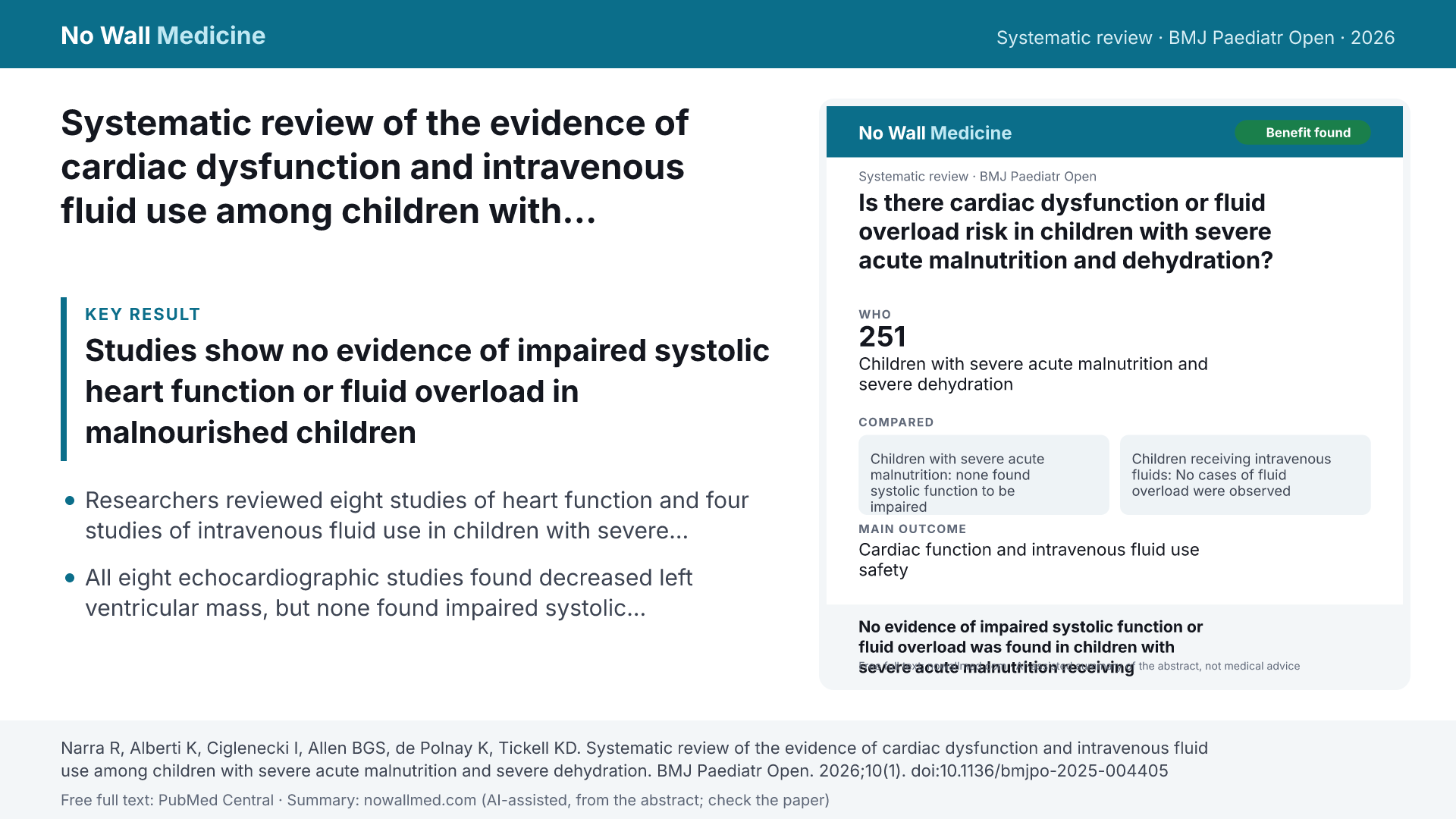
Studies show no evidence of impaired systolic heart function or fluid overload in malnourished children
Systematic review of the evidence of cardiac dysfunction and intravenous fluid use among children with severe acute malnutrition and severe dehydration
Systematic reviewBenefit found
Is there cardiac dysfunction or fluid overload risk in children with severe acute malnutrition and dehydration?
Who
251
Children with severe acute malnutrition and severe dehydration
Compared
Children with severe acute malnutrition: none found systolic function to be impaired
Children receiving intravenous fluids: No cases of fluid overload were observed
Main outcome
Cardiac function and intravenous fluid use safety
Bottom line: No evidence of impaired systolic function or fluid overload was found in children with severe acute malnutrition receiving intravenous fluids.
BMJ Paediatr Open · 2026-04-10 · Save PNG
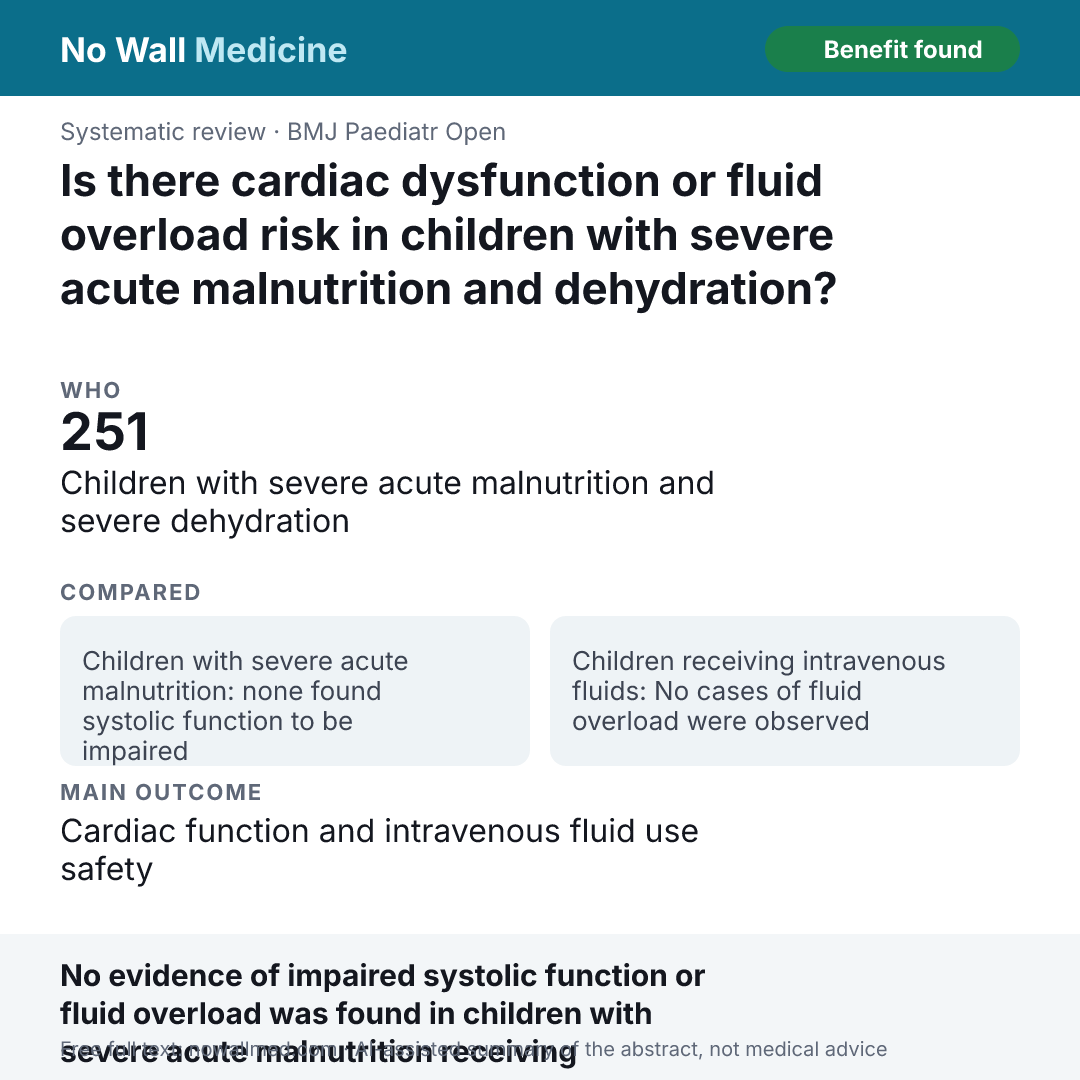
Clinical question: Is there cardiac dysfunction or fluid overload risk in children with severe acute malnutrition and dehydration?
Why it matters: International guidelines severely limit intravenous fluid use in children with severe acute malnutrition and cholera due to concerns about fluid overload.
Key points
- Researchers reviewed eight studies of heart function and four studies of intravenous fluid use in children with severe acute malnutrition.
- All eight echocardiographic studies found decreased left ventricular mass, but none found impaired systolic function, which is the heart's ability to pump blood.
- Among 251 children with severe acute malnutrition who received intravenous fluids, no cases of fluid overload were observed.
Headline and key points written with AI from the paper’s abstract, with every number checked against it. Read the paper before relying on them.
Was this summary helpful?
Abstract
Background
A sizeable proportion of cholera attributed mortality occurs among children with severe acute malnutrition (SAM). International guidelines severely limit the use of intravenous fluids among children with SAM and cholera due to their perceived vulnerability to fluid overload. We reviewed the cardiac function evidence and studies of intravenous fluid use among children with SAM. Methods
Two systematic reviews of Chinese, English, French and Spanish language papers published after the last Global Task Force for Cholera Control recommendations on the treatment of children with cholera and SAM (2017) were conducted. The first included studies of cardiac function among children presenting to hospital with SAM. The second included studies of intravenous fluid use among children with dehydrating diarrhoea and SAM. Results
Among eight echocardiographic studies of cardiac function in children with SAM at presentation to hospital, all found left ventricular mass to be decreased but none found systolic function to be impaired. Seven of the eight studies assessing diastolic function found some degree of mild-to-moderate impairment. Two echocardiographic studies monitored responsiveness to intravenous fluid resuscitation and found no evidence of fluid overload. Finally, four studies gave intravenous fluids to children with SAM and either shock or dehydration. Collectively, these studies included 251 children with SAM given intravenous fluid. No cases of fluid overload were observed. Conclusion
No evidence to support decreased systolic function among children with SAM and no documented cases of fluid overload during intravenous rehydration of these children were identified. These data call into question guidelines that severely restrict intravenous fluids among children with SAM and highly dehydrating conditions such as cholera.
Abstract reproduced under the article’s CC BY NC licence.
Subject terms
Headline, design, result, key points, caveat and citation as plain text.
Cite this article
Narra R, Alberti K, Ciglenecki I, Allen BGS, de Polnay K, Tickell KD. Systematic review of the evidence of cardiac dysfunction and intravenous fluid use among children with severe acute malnutrition and severe dehydration. BMJ Paediatr Open. 2026;10(1). doi:10.1136/bmjpo-2025-004405
Spotted a mistake? Suggest a correction