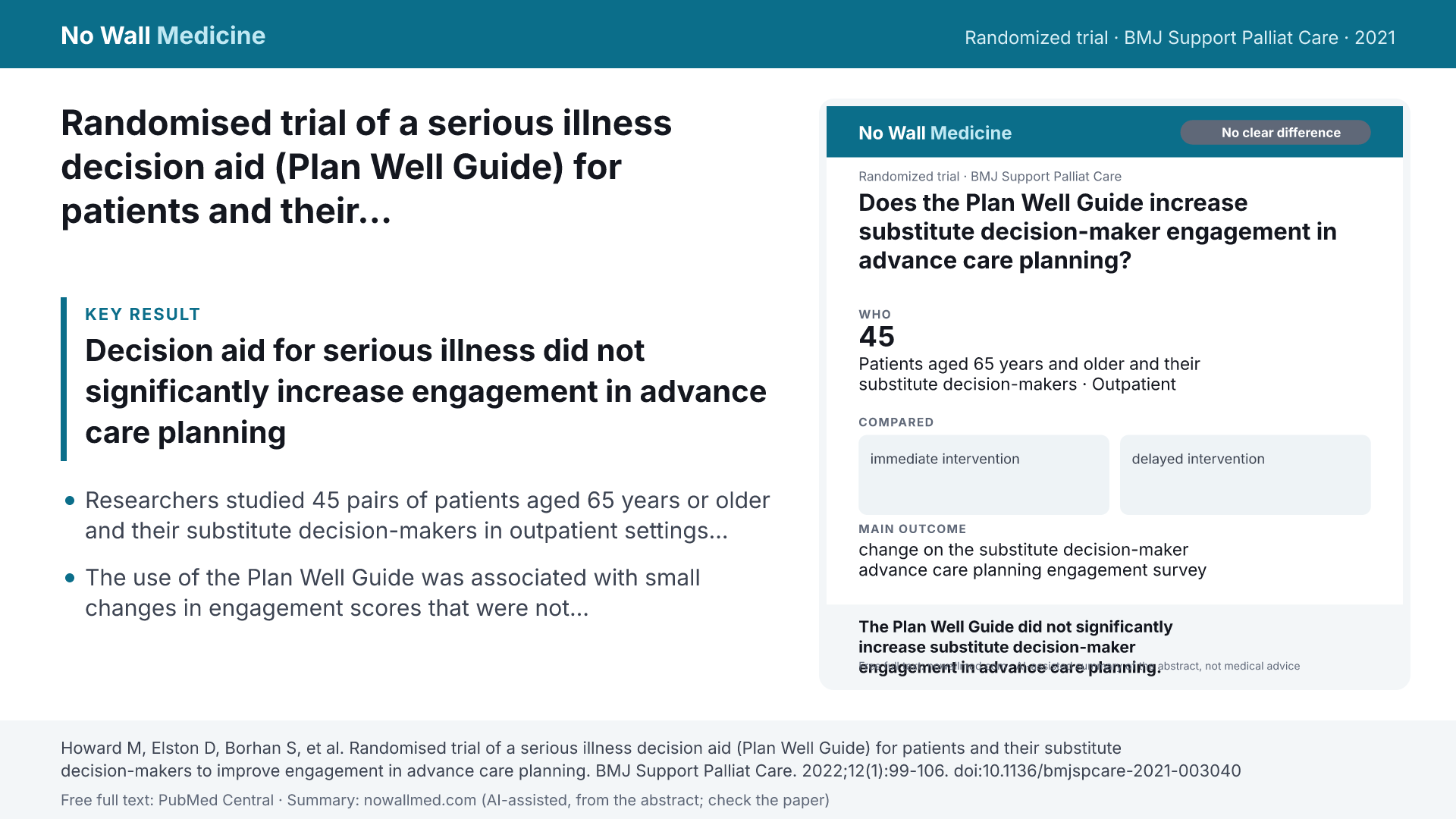
Decision aid for serious illness did not significantly increase engagement in advance care planning
Randomised trial of a serious illness decision aid (Plan Well Guide) for patients and their substitute decision-makers to improve engagement in advance care planning
Randomized trialNo clear difference
Does the Plan Well Guide increase substitute decision-maker engagement in advance care planning?
Who
45
Patients aged 65 years and older and their substitute decision-makers · Outpatient settings in Ontario, Canada
Compared
immediate intervention
delayed intervention
Main outcome
change on the substitute decision-maker advance care planning engagement survey
Result: mean difference 0.2 (95% CI -0.3 to 0.6)
Bottom line: The Plan Well Guide did not significantly increase substitute decision-maker engagement in advance care planning.
BMJ Support Palliat Care · 2021-06-30Download image
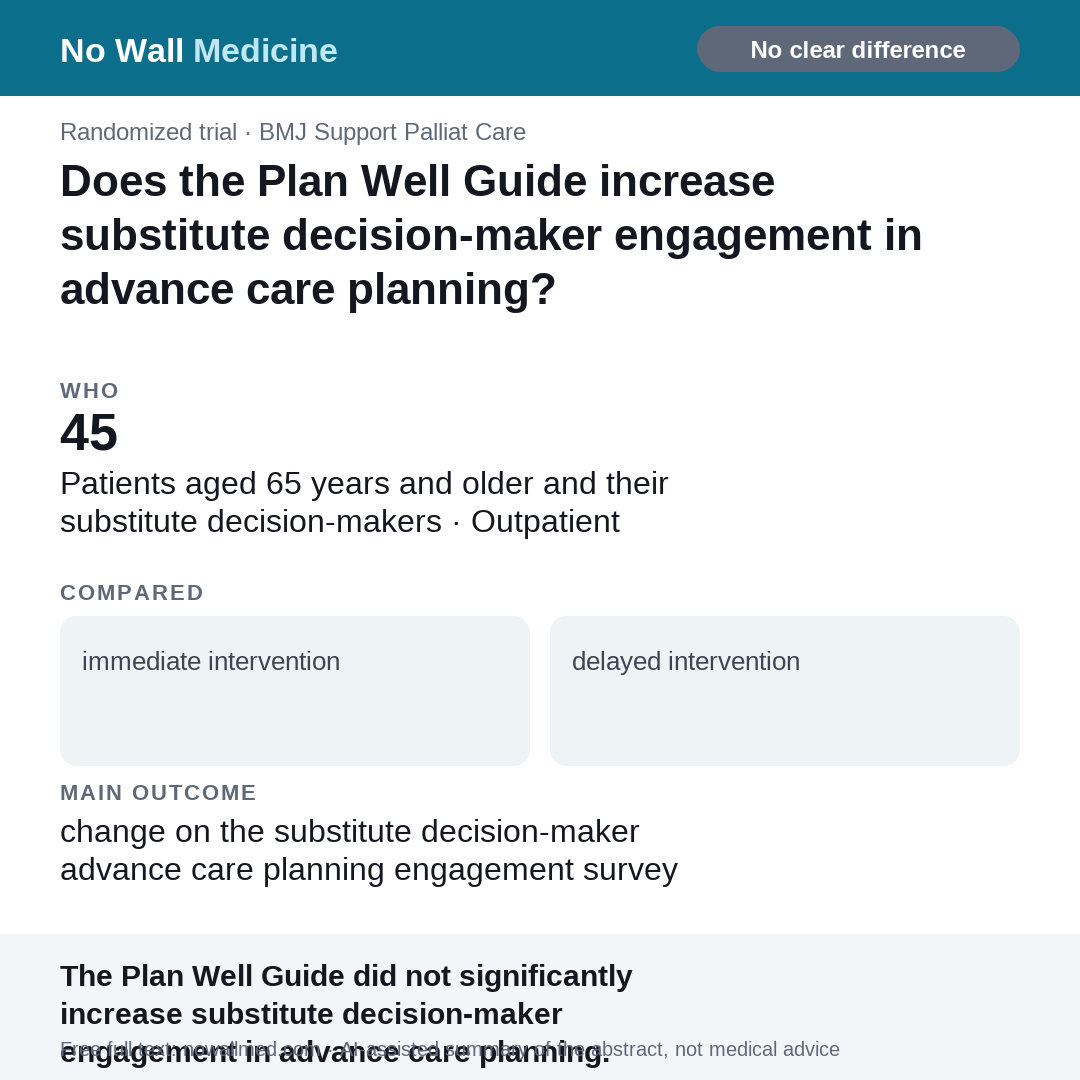
Clinical question: Does the Plan Well Guide increase substitute decision-maker engagement in advance care planning?
Why it matters: It was unknown if a serious illness decision aid could increase the engagement of substitute decision-makers in advance care planning.
Key points
- Researchers studied 45 pairs of patients aged 65 years or older and their substitute decision-makers in outpatient settings in Ontario, Canada.
- The use of the Plan Well Guide was associated with small changes in engagement scores that were not statistically significant (MD=+0.2 for substitute decision-makers and MD=+0.4 for patients).
- A subgroup analysis showed significant treatment effects in substitute decision-makers who had a lower-than-median baseline score.
Limitation the authors note: The trial was stopped early because of difficulties with enrolling and following up participants, resulting in a statistically underpowered study.
Headline and key points written with AI from the paper’s abstract, with every number checked against it. Read the paper before relying on them.
Was this summary helpful?
Abstract
Objective
To evaluate the feasibility and efficacy of a serious illness decision aid (Plan Well Guide) in increasing the engagement of substitute decision-makers (SDM) in advance care planning (ACP). Methods
This trial was conducted (2017-2019) in outpatient settings in Ontario, Canada, aiming to recruit 90 dyads of patients aged 65 years and older at high risk of needing future medical decisions and their SDM. Participants were randomised to receive the intervention immediately or to a 3-month wait period. The Plan Well Guide was administered to the patient and SDM by a facilitator. Outcomes were change on the validated 17-item SDM ACP Engagement Survey (primary) and 15-item patient ACP Engagement Survey (secondary). Results
Of 136 dyads approached, 58 consented and were randomised and 45 completed the study (28 immediate intervention, 17 delayed intervention). The trial was stopped early because of difficulties with enrolling and following up participants. The mean changes on the SDM ACP Engagement Survey and the patient ACP Engagement Survey favoured the first group but were not statistically significant (mean difference (MD)=+0.2 (95% CI: -0.3 to 0.6) and MD=+0.4 (95% CI: -0.1 to 0.8), respectively). In a post-hoc subgroup analysis, significant treatment effects were seen in SDMs with a lower-than-median baseline score compared with those at or above the median. Conclusions
In this statistically underpowered randomised trial, differences in SDM ACP engagement between groups were small. Further information is needed to overcome recruitment challenges and to identify people most likely to benefit from the Plan Well Guide.Trial registration number NCT03239639.
Abstract reproduced under the article’s CC BY NC licence.
Subject terms
Cite this article
Howard M, Elston D, Borhan S, Hafid A, Arora N, Forbes R. Randomised trial of a serious illness decision aid (Plan Well Guide) for patients and their substitute decision-makers to improve engagement in advance care planning. BMJ Support Palliat Care. 2021. doi:10.1136/bmjspcare-2021-003040
Spotted a mistake? Suggest a correction