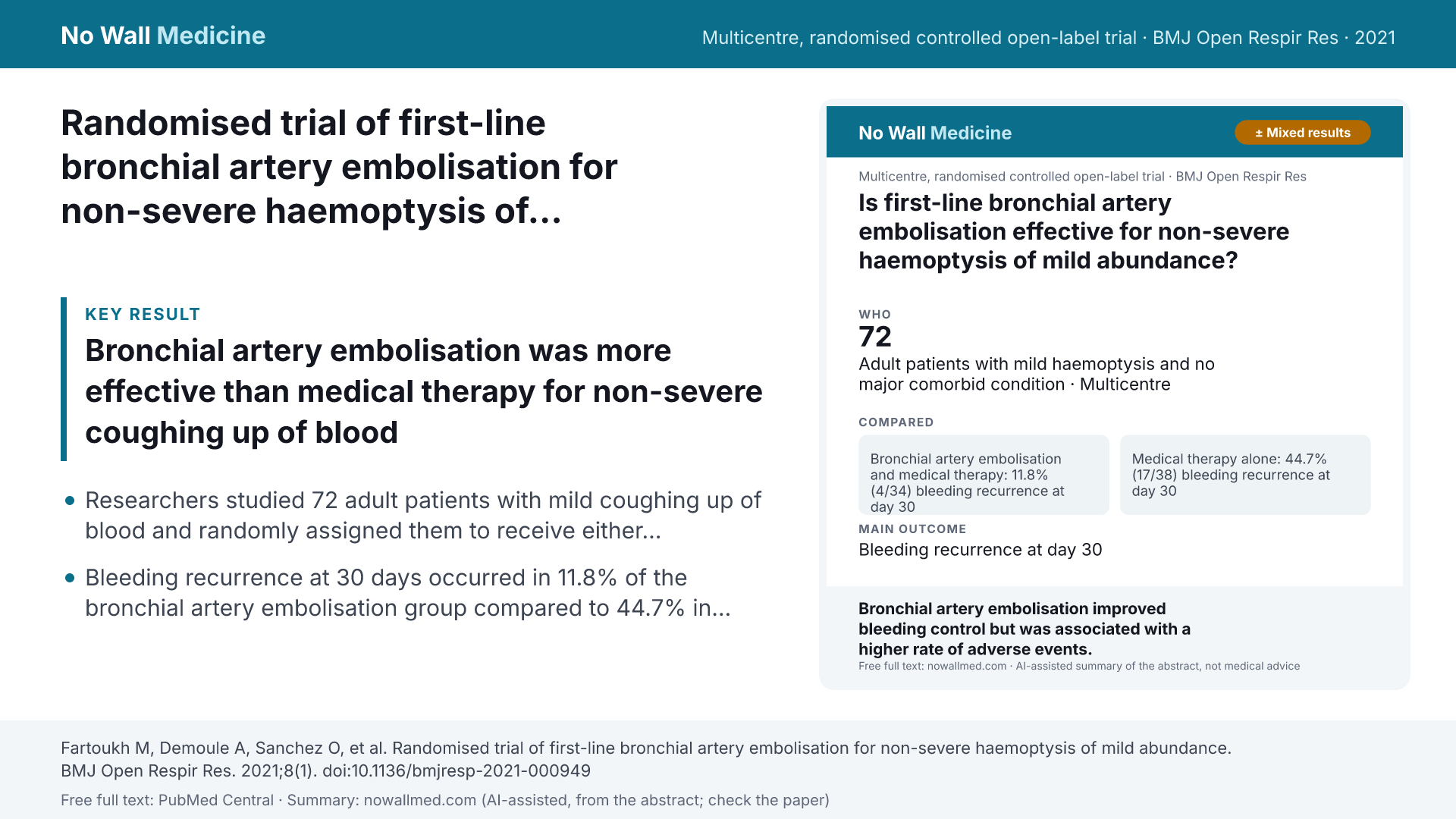
Bronchial artery embolisation was more effective than medical therapy for non-severe coughing up of blood
Randomised trial of first-line bronchial artery embolisation for non-severe haemoptysis of mild abundance
Multicentre, randomised controlled open-label trialMixed results
Is first-line bronchial artery embolisation effective for non-severe haemoptysis of mild abundance?
Who
72
Adult patients with mild haemoptysis and no major comorbid condition · Multicentre
Compared
Bronchial artery embolisation and medical therapy: 11.8% (4/34) bleeding recurrence at day 30
Medical therapy alone: 44.7% (17/38) bleeding recurrence at day 30
Main outcome
Bleeding recurrence at day 30
Result: difference -33% (95% CI -13.8% to -52.1%)
Bottom line: Bronchial artery embolisation improved bleeding control but was associated with a higher rate of adverse events.
BMJ Open Respir Res · 2021-06-05Download image
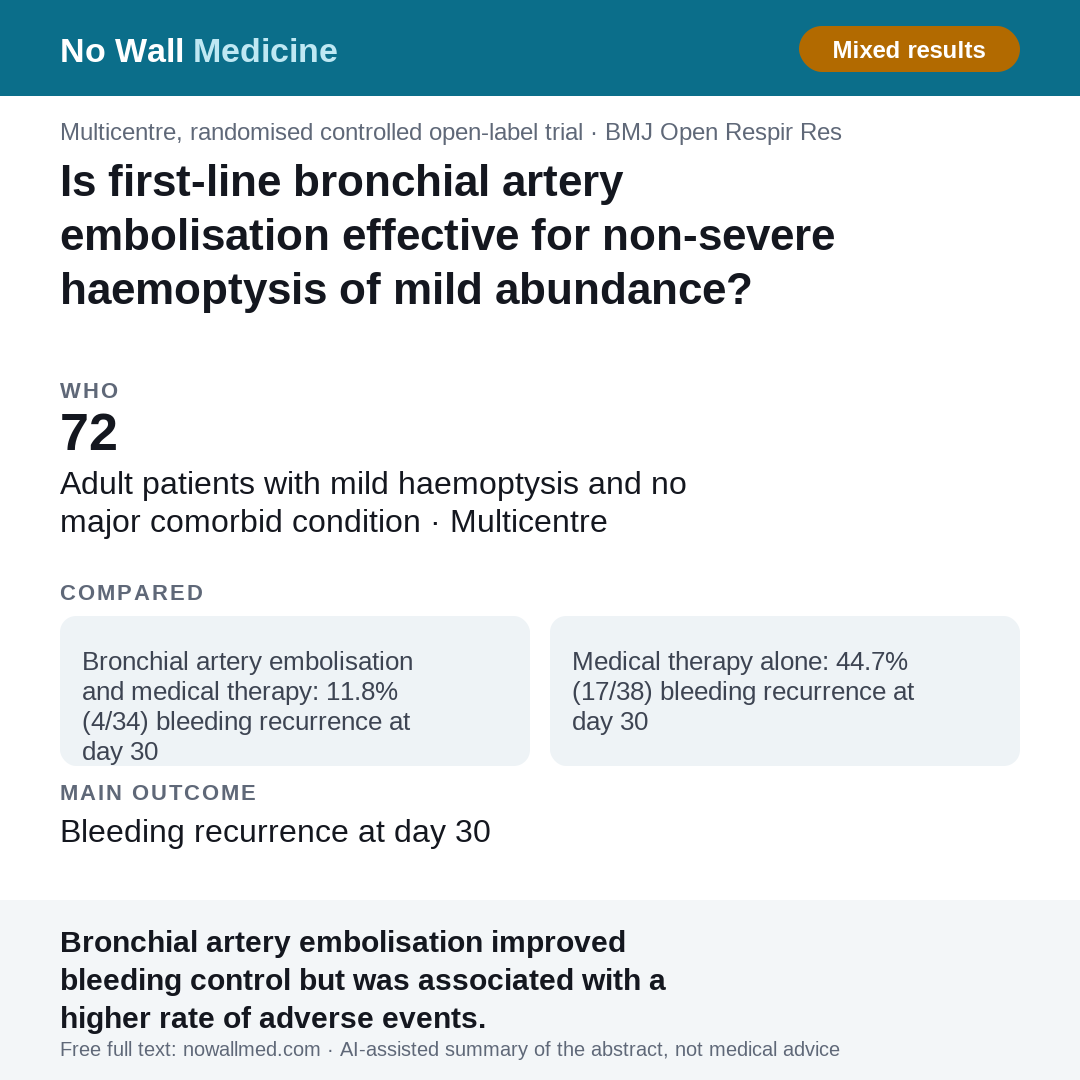
Clinical question: Is first-line bronchial artery embolisation effective for non-severe haemoptysis of mild abundance?
Key points
- Researchers studied 72 adult patients with mild coughing up of blood and randomly assigned them to receive either bronchial artery embolisation—a procedure to block bleeding vessels—plus medical therapy or medical therapy alone.
- Bleeding recurrence at 30 days occurred in 11.8% of the bronchial artery embolisation group compared to 44.7% in the medical therapy group.
- Four adverse events occurred during hospitalisation, all in the bronchial artery embolisation group, representing 11.8% of those patients compared to 0% in the medical therapy group.
Headline and key points written with AI from the paper’s abstract, with every number checked against it. Read the paper before relying on them.
Was this summary helpful?
Abstract
Background
Whereas first-line bronchial artery embolisation (BAE) is considered standard of care for the management of severe haemoptysis, it is unknown whether this approach is warranted for non-severe haemoptysis. Research question
To assess the efficacy on bleeding control and the safety of first-line BAE in non-severe haemoptysis of mild abundance. Study design and methods
This multicentre, randomised controlled open-label trial enrolled adult patients without major comorbid condition and having mild haemoptysis (onset <72 hours, 100-200 mL estimated bleeding amount), related to a systemic arterial mechanism. Patients were randomly assigned (1:1) to BAE associated with medical therapy or to medical therapy alone. Results
Bleeding recurrence at day 30 after randomisation (primary outcome) occurred in 4 (11.8%) of 34 patients in the BAE strategy and 17 (44.7%) of 38 patients in the medical strategy (difference -33%; 95% CI -13.8% to -52.1%, p=0.002). The 90-day bleeding recurrence-free survival rates were 91.2% (95% CI 75.1% to 97.1%) and 60.2% (95% CI 42.9% to 73.8%), respectively (HR=0.19, 95% CI 0.05 to 0.67, p=0.01). No death occurred during follow-up and no bleeding recurrence needed surgery.Four adverse events (one major with systemic emboli) occurred during hospitalisation, all in the BAE strategy (11.8% vs 0%; difference 11.8%, 95% CI 0.9 to 22.6, p=0.045); all eventually resolved. Conclusion
In non-severe haemoptysis of mild abundance, BAE associated with medical therapy had a superior efficacy for preventing bleeding recurrences at 30 and 90 days, as compared with medical therapy alone. However, it was associated with a higher rate of adverse events. Trial registration number
NCT01278199.
Abstract reproduced under the article’s CC BY NC licence.
Subject terms
Headline, design, result, key points, caveat and citation as plain text.
Cite this article
Fartoukh M, Demoule A, Sanchez O, et al. Randomised trial of first-line bronchial artery embolisation for non-severe haemoptysis of mild abundance. BMJ Open Respir Res. 2021. doi:10.1136/bmjresp-2021-000949
Spotted a mistake? Suggest a correction