Randomised trial of first-line bronchial artery embolisation for non-severe haemoptysis of mild abundance
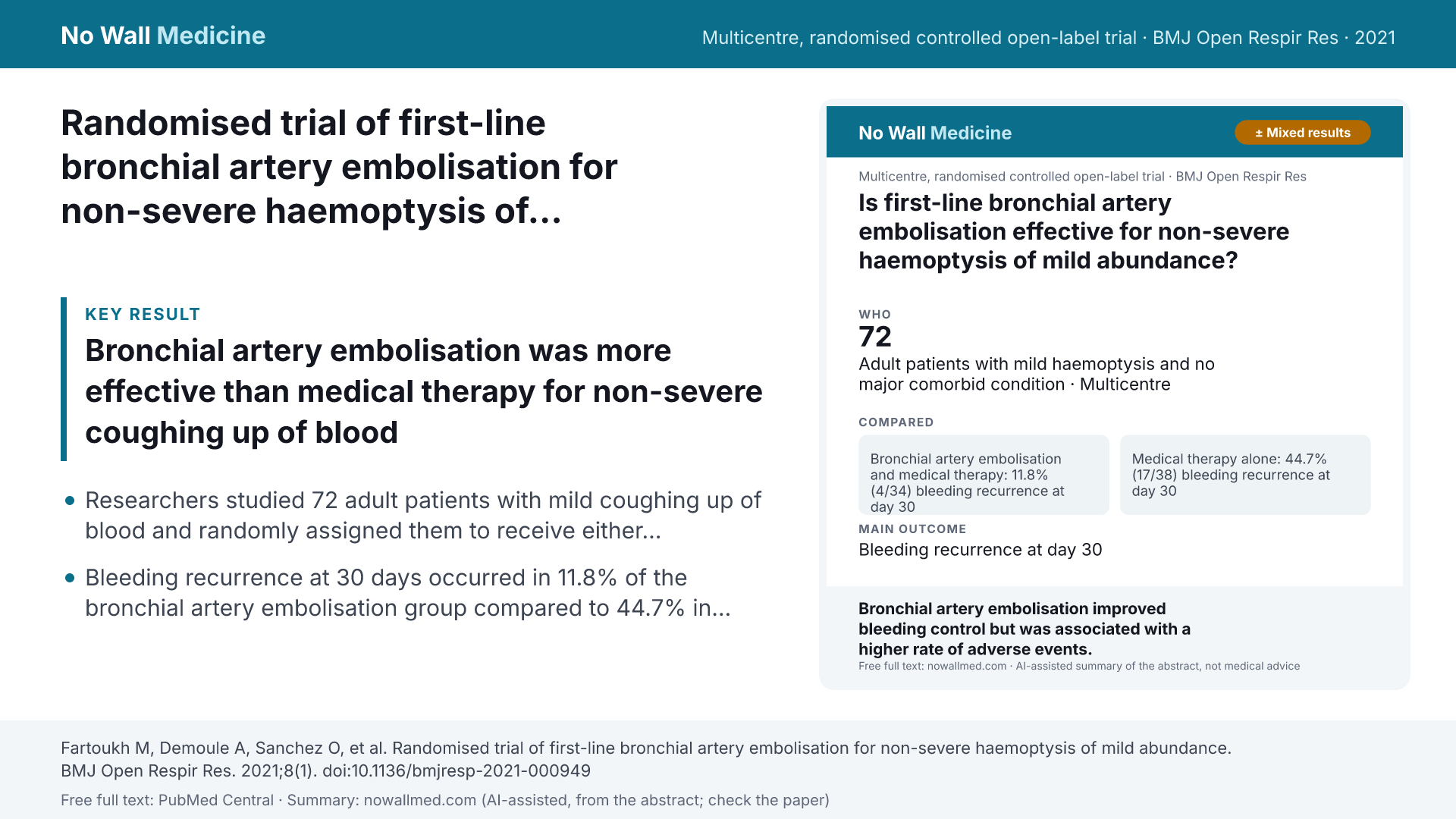
Key result: Bronchial artery embolisation was more effective than medical therapy for non-severe coughing up of blood
Multicentre, randomised controlled open-label trialMixed results
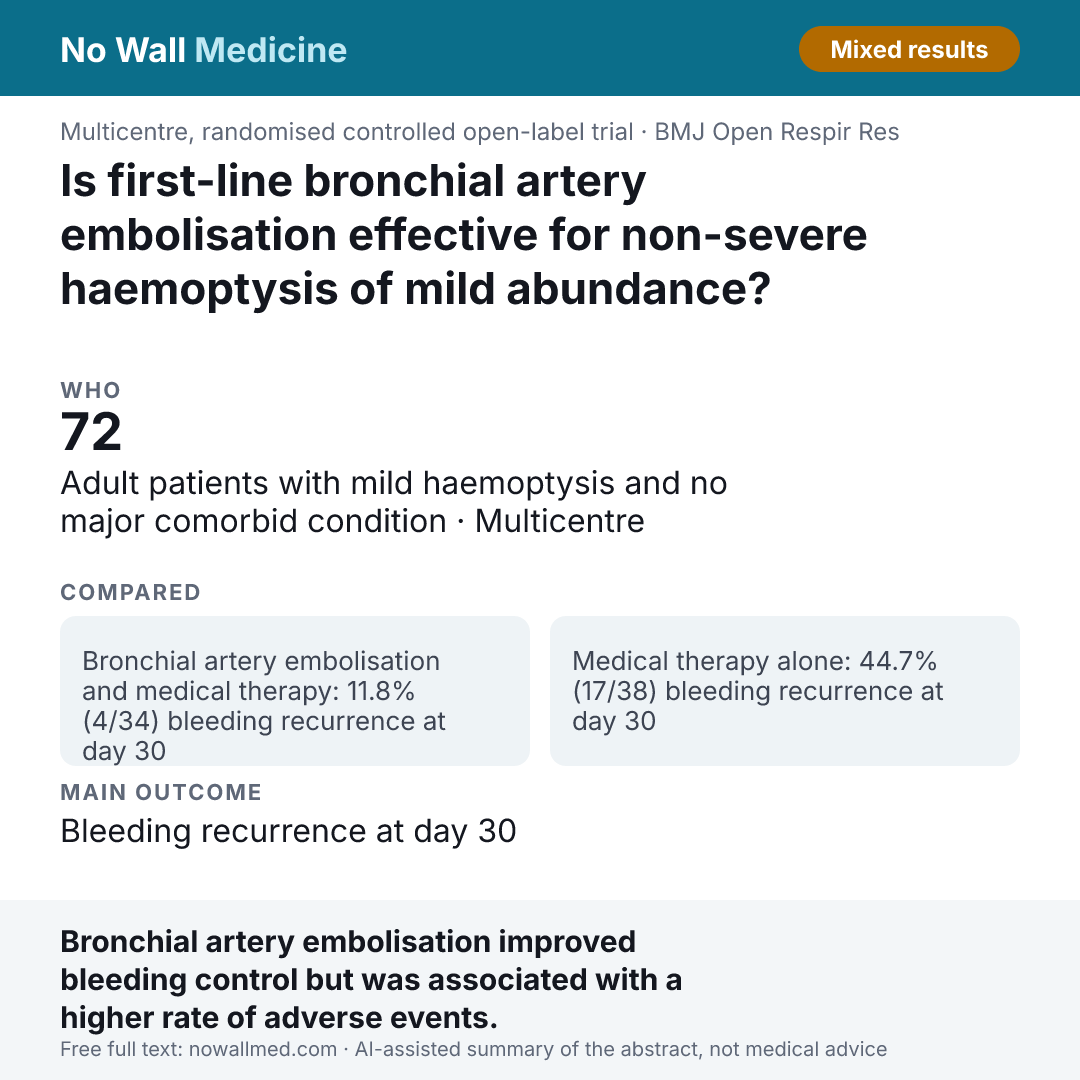
Is first-line bronchial artery embolisation effective for non-severe haemoptysis of mild abundance?
Who
72
Adult patients with mild haemoptysis and no major comorbid condition · Multicentre
Compared
Bronchial artery embolisation and medical therapy: 11.8% (4/34) bleeding recurrence at day 30
Medical therapy alone: 44.7% (17/38) bleeding recurrence at day 30
Main outcome
Bleeding recurrence at day 30
Result: difference -33% (95% CI -13.8% to -52.1%)
Bottom line: Bronchial artery embolisation improved bleeding control but was associated with a higher rate of adverse events.
BMJ Open Respir Res · 2021-06-05 · Save PNG
Key points
- Researchers studied 72 adult patients with mild coughing up of blood and randomly assigned them to receive either bronchial artery embolisation—a procedure to block bleeding vessels—plus medical therapy or medical therapy alone.
- Bleeding recurrence at 30 days occurred in 11.8% of the bronchial artery embolisation group compared to 44.7% in the medical therapy group.
- Four adverse events occurred during hospitalisation, all in the bronchial artery embolisation group, representing 11.8% of those patients compared to 0% in the medical therapy group.
Discussion prompts
- Would these patients look like yours? Who was left out?
- Is the main outcome one that matters to patients?
- Is the difference large enough to change what you do?
Cite: Fartoukh M, Demoule A, Sanchez O, et al. Randomised trial of first-line bronchial artery embolisation for non-severe haemoptysis of mild abundance. BMJ Open Respir Res. 2021;8(1). doi:10.1136/bmjresp-2021-000949
Free full text: PubMed Central · Summary and visual abstract: nowallmed.com/a/randomised-trial-of-first-line-bronchial-artery-embolisation-for-non-1wplko6/ (AI-assisted from the abstract; check the paper before relying on it).