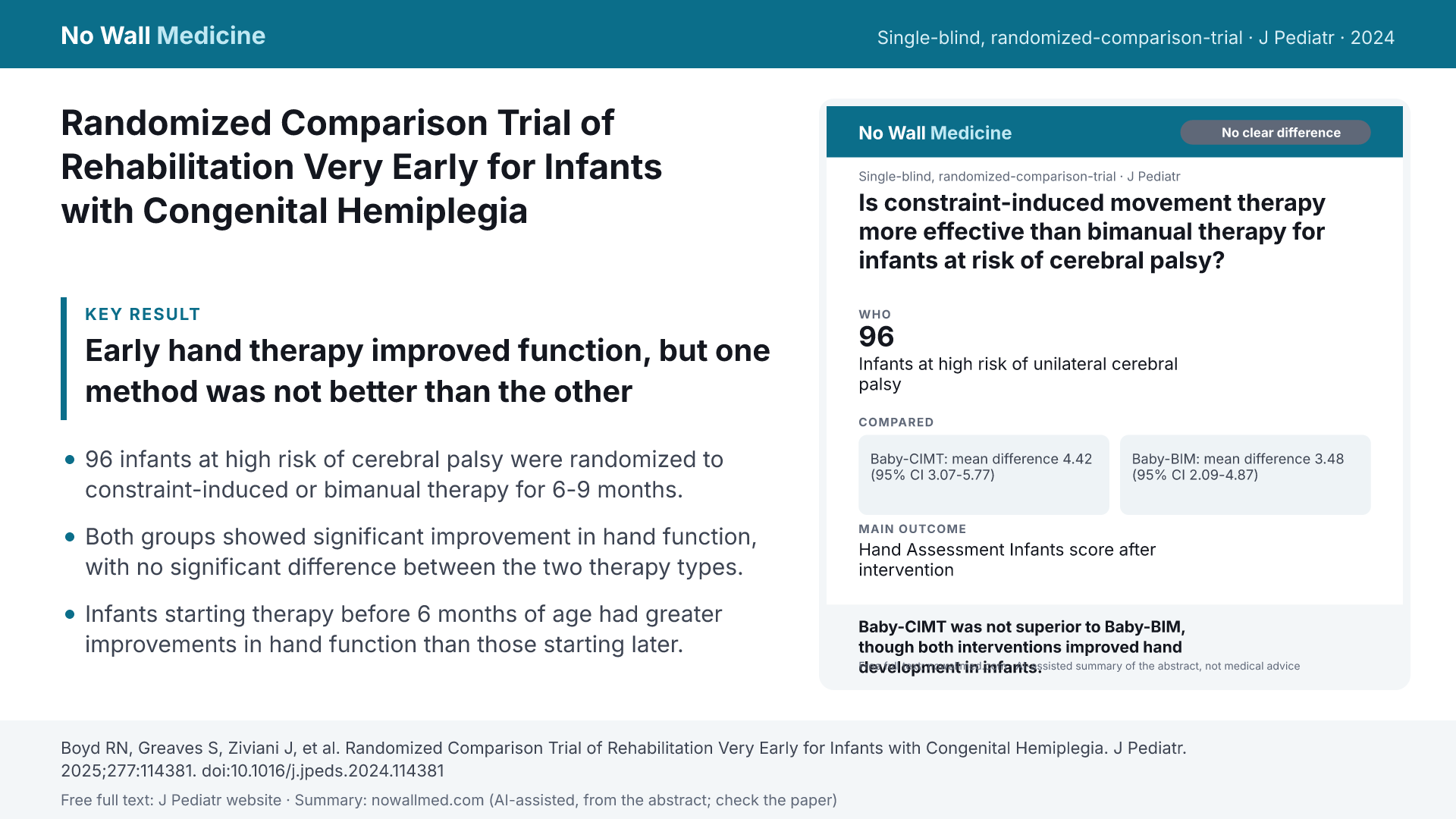
Early hand therapy improved function, but one method was not better than the other
Randomized Comparison Trial of Rehabilitation Very Early for Infants with Congenital Hemiplegia
Single-blind, randomized-comparison-trialNo clear difference
Is constraint-induced movement therapy more effective than bimanual therapy for infants at risk of cerebral palsy?
Who
96
Infants at high risk of unilateral cerebral palsy
Compared
Baby-CIMT: mean difference 4.42 (95% CI 3.07-5.77)
Baby-BIM: mean difference 3.48 (95% CI 2.09-4.87)
Main outcome
Hand Assessment Infants score after intervention
Result: mean difference 0.98 HAI units (95% CI 0.94-2.91)
Bottom line: Baby-CIMT was not superior to Baby-BIM, though both interventions improved hand development in infants.
J Pediatr · 2024-10-29 · Save PNG
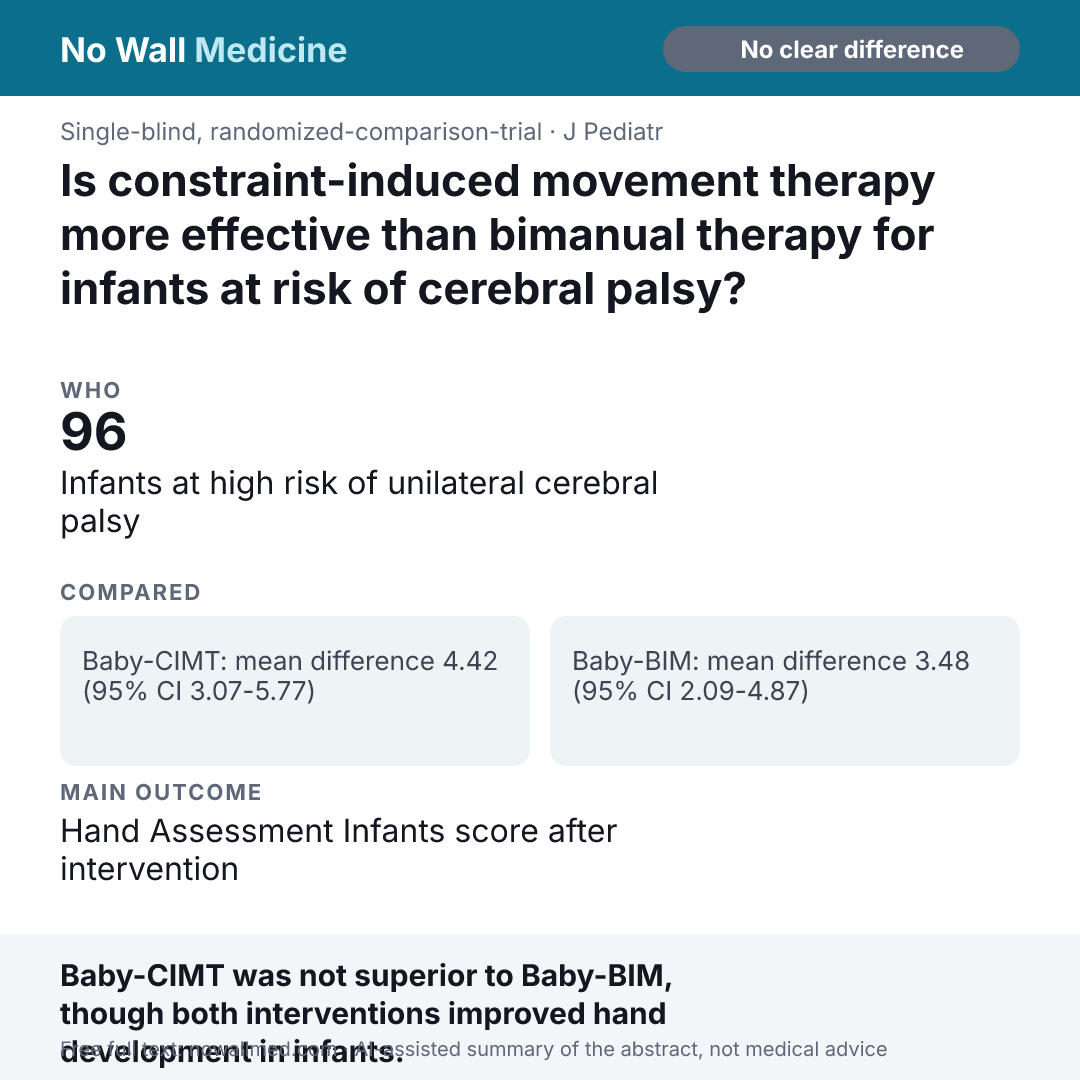
Clinical question: Is constraint-induced movement therapy more effective than bimanual therapy for infants at risk of cerebral palsy?
Key points
- 96 infants at high risk of cerebral palsy were randomized to constraint-induced or bimanual therapy for 6-9 months.
- Both groups showed significant improvement in hand function, with no significant difference between the two therapy types.
- Infants starting therapy before 6 months of age had greater improvements in hand function than those starting later.
Headline and key points written with AI from the paper’s abstract, with every number checked against it. Read the paper before relying on them.
Was this summary helpful?
Subject terms
Headline, design, result, key points, caveat and citation as plain text.
Cite this article
Boyd RN, Greaves S, Ziviani J, et al. Randomized Comparison Trial of Rehabilitation Very Early for Infants with Congenital Hemiplegia. J Pediatr. 2025;277:114381. doi:10.1016/j.jpeds.2024.114381
Spotted a mistake? Suggest a correction