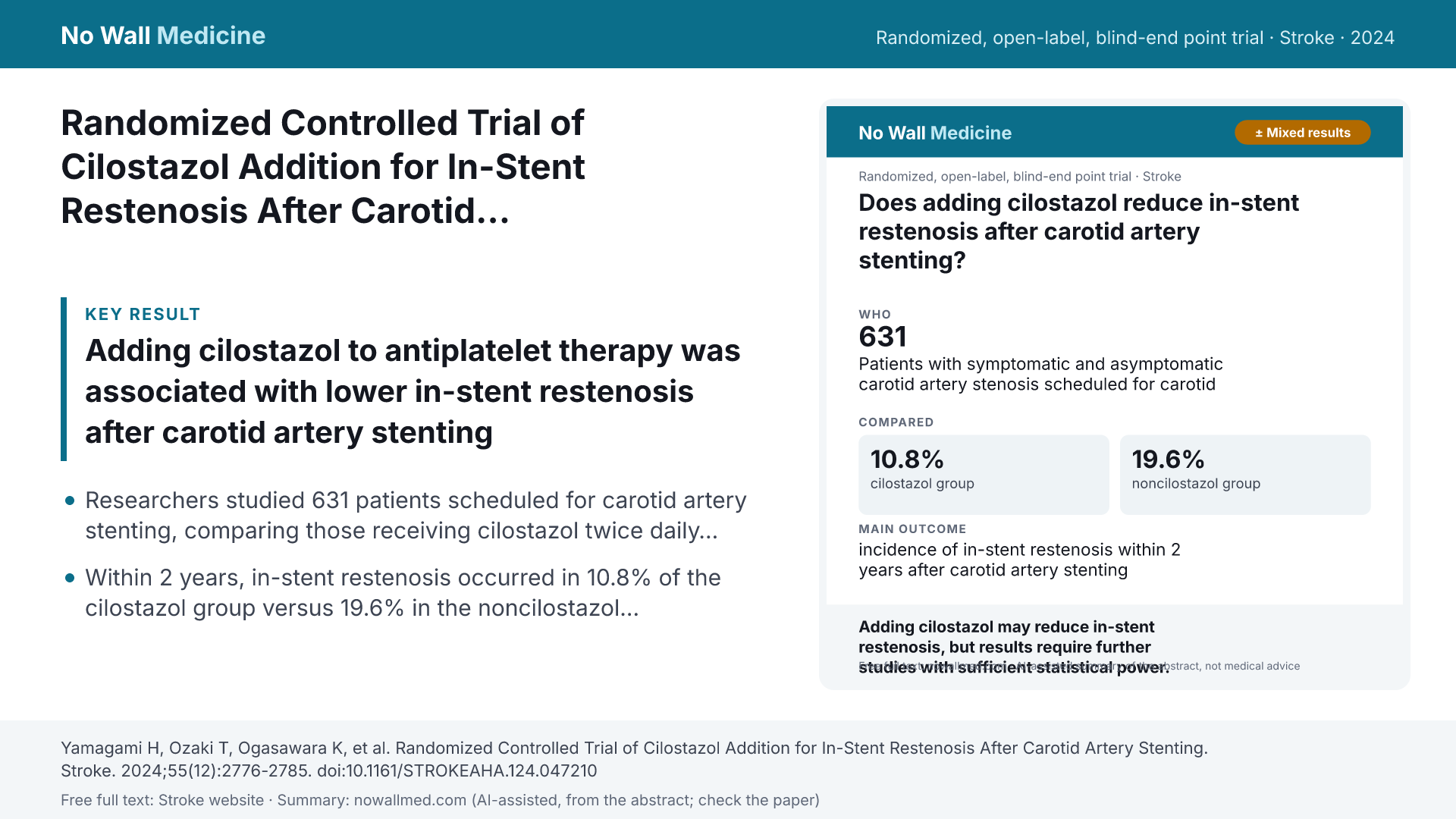
Adding cilostazol to antiplatelet therapy was associated with lower in-stent restenosis after carotid artery stenting
Randomized Controlled Trial of Cilostazol Addition for In-Stent Restenosis After Carotid Artery Stenting
Randomized, open-label, blind-end point trialMixed results
Does adding cilostazol reduce in-stent restenosis after carotid artery stenting?
Who
631
Patients with symptomatic and asymptomatic carotid artery stenosis scheduled for carotid artery stenting
Compared
10.8%cilostazol group
19.6%noncilostazol group
Main outcome
incidence of in-stent restenosis within 2 years after carotid artery stenting
Result: hazard ratio 0.64 (95% CI 0.41-1.0)
Bottom line: Adding cilostazol may reduce in-stent restenosis, but results require further studies with sufficient statistical power.
Stroke · 2024-11-25Download image
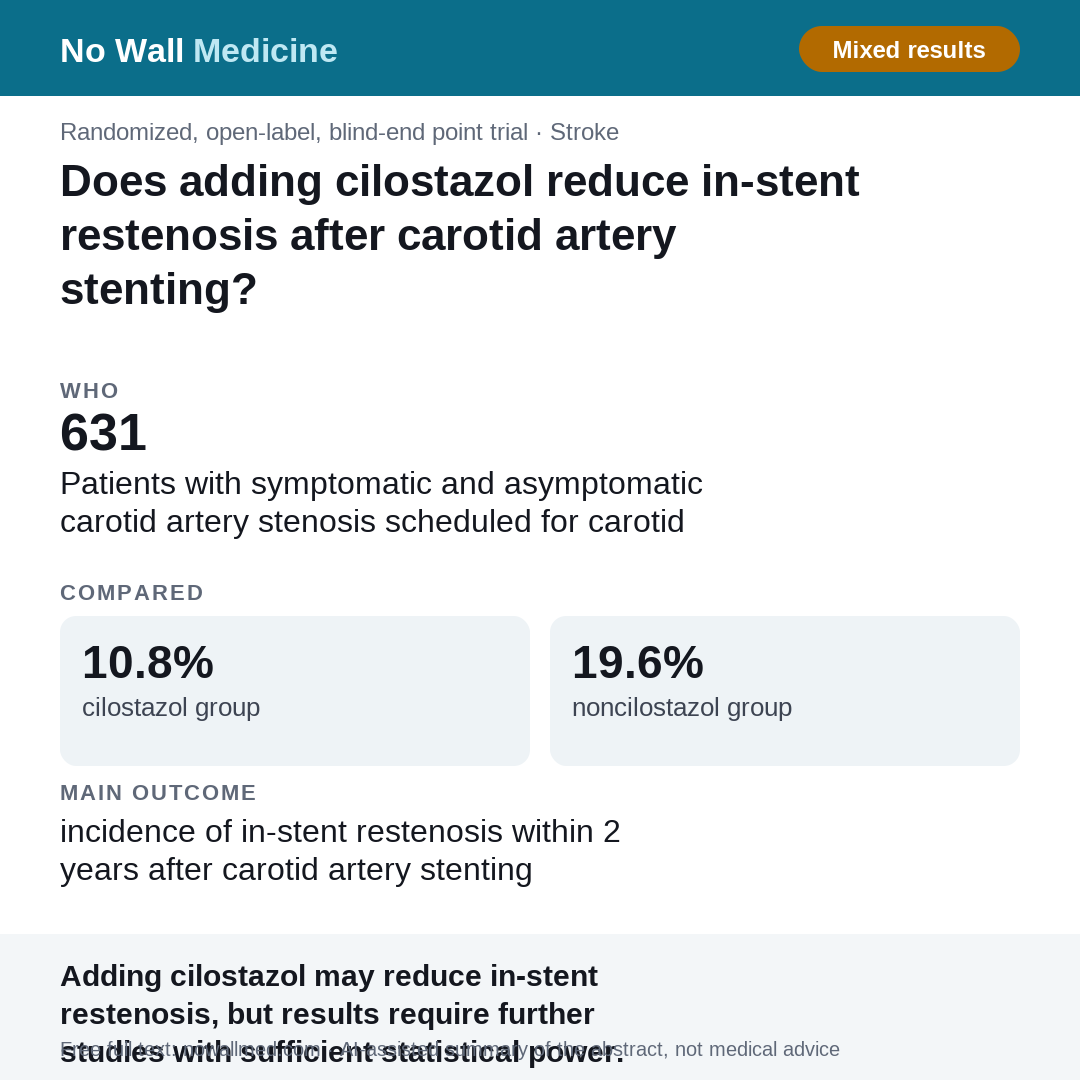
Clinical question: Does adding cilostazol reduce in-stent restenosis after carotid artery stenting?
Why it matters: It is unknown if adding cilostazol to other antiplatelet medications reduces the risk of in-stent restenosis, which is the re-narrowing of an artery after stenting.
Key points
- Researchers studied 631 patients scheduled for carotid artery stenting, comparing those receiving cilostazol twice daily with those who did not.
- Within 2 years, in-stent restenosis occurred in 10.8% of the cilostazol group versus 19.6% in the noncilostazol group, though this was not statistically significant (P=0.056).
- In an exploratory analysis, the incidence of in-stent restenosis after 30 days was 10.3% in the cilostazol group compared to 19.3% in the noncilostazol group (P=0.040).
Headline and key points written with AI from the paper’s abstract, with every number checked against it. Read the paper before relying on them.
Was this summary helpful?
Subject terms
Cite this article
Yamagami H, Ozaki T, Ogasawara K, et al. Randomized Controlled Trial of Cilostazol Addition for In-Stent Restenosis After Carotid Artery Stenting. Stroke. 2024. doi:10.1161/STROKEAHA.124.047210
Spotted a mistake? Suggest a correction