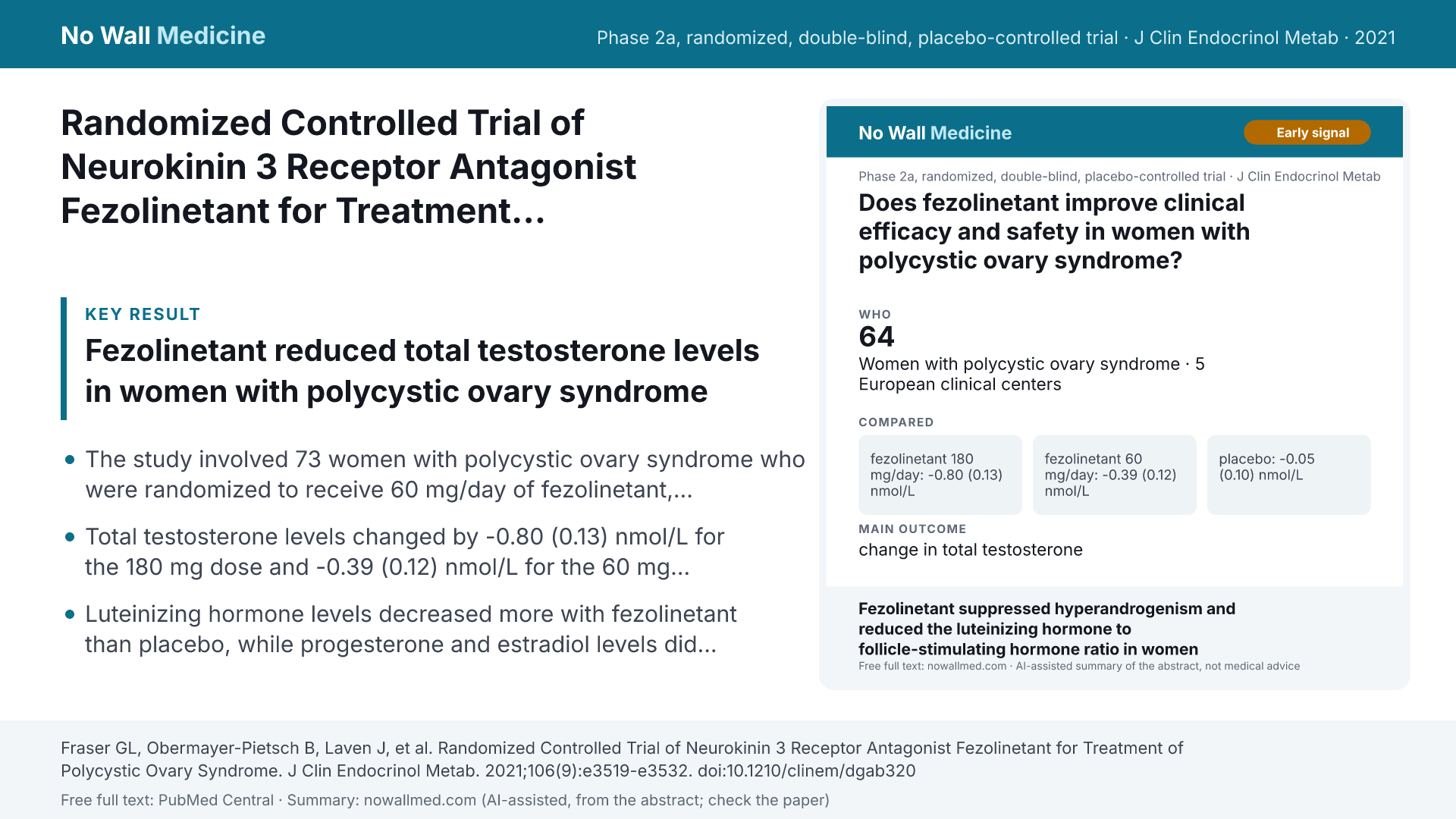
Randomized Controlled Trial of Neurokinin 3 Receptor Antagonist Fezolinetant for Treatment of Polycystic Ovary Syndrome
Key result: Fezolinetant reduced total testosterone levels in women with polycystic ovary syndrome
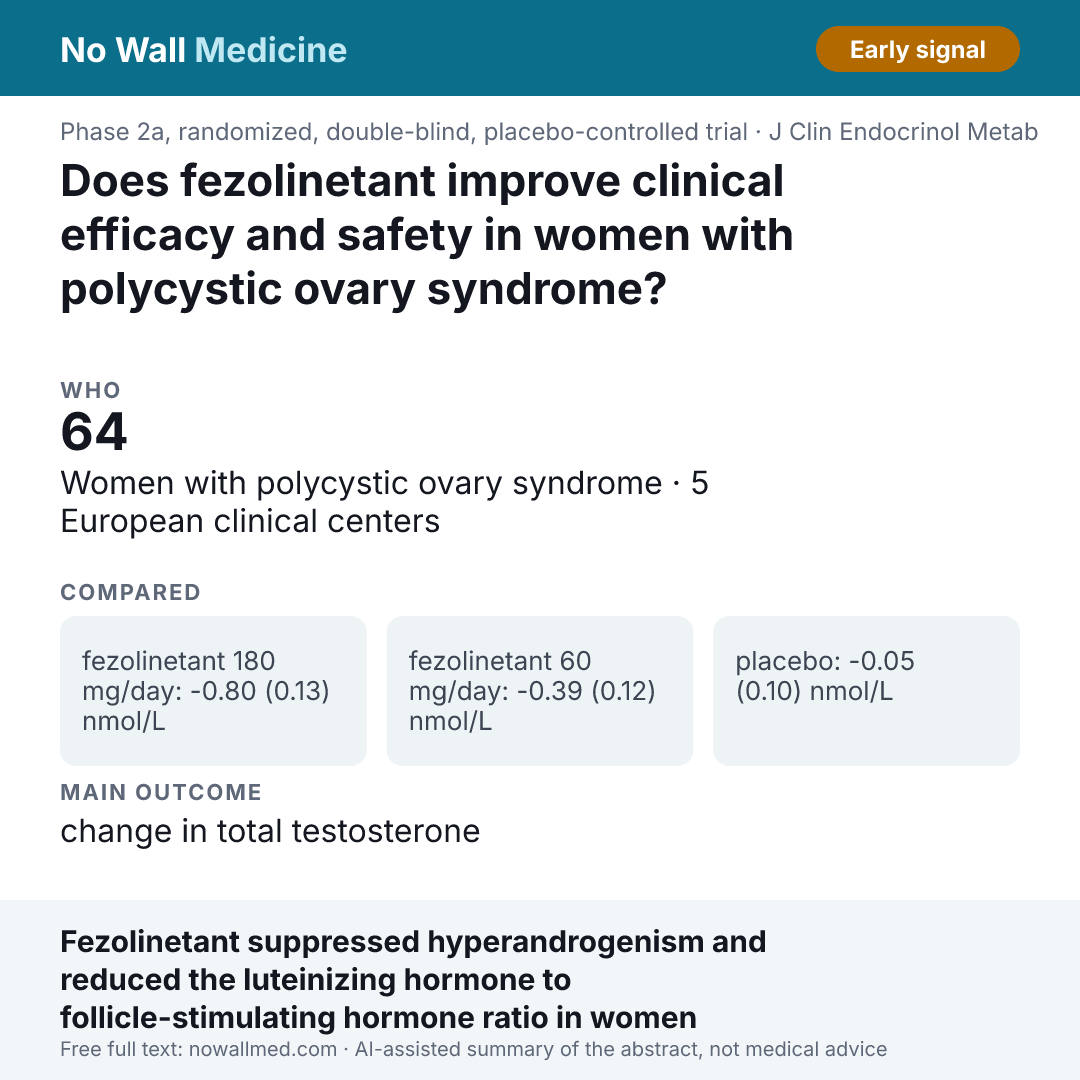
Phase 2a, randomized, double-blind, placebo-controlled trialEarly signal
Does fezolinetant improve clinical efficacy and safety in women with polycystic ovary syndrome?
Who
64
Women with polycystic ovary syndrome · 5 European clinical centers
Compared
fezolinetant 180 mg/day: -0.80 (0.13) nmol/L
fezolinetant 60 mg/day: -0.39 (0.12) nmol/L
placebo: -0.05 (0.10) nmol/L
Main outcome
change in total testosterone
Bottom line: Fezolinetant suppressed hyperandrogenism and reduced the luteinizing hormone to follicle-stimulating hormone ratio in women with polycystic ovary syndrome.
J Clin Endocrinol Metab · 2021-05-18 · Save PNG
Key points
- The study involved 73 women with polycystic ovary syndrome who were randomized to receive 60 mg/day of fezolinetant, 180 mg/day of fezolinetant, or a placebo for 12 weeks.
- Total testosterone levels changed by -0.80 (0.13) nmol/L for the 180 mg dose and -0.39 (0.12) nmol/L for the 60 mg dose compared to -0.05 (0.10) nmol/L for placebo.
- Luteinizing hormone levels decreased more with fezolinetant than placebo, while progesterone and estradiol levels did not change significantly.
Discussion prompts
- Would these patients look like yours? Who was left out?
- Is the main outcome one that matters to patients?
- Is the difference large enough to change what you do?
Cite: Fraser GL, Obermayer-Pietsch B, Laven J, et al. Randomized Controlled Trial of Neurokinin 3 Receptor Antagonist Fezolinetant for Treatment of Polycystic Ovary Syndrome. J Clin Endocrinol Metab. 2021;106(9):e3519-e3532. doi:10.1210/clinem/dgab320
Free full text: PubMed Central · Summary and visual abstract: nowallmed.com/a/randomized-controlled-trial-of-neurokinin-3-receptor-antagonist-12mphyh/ (AI-assisted from the abstract; check the paper before relying on it).