Randomized Controlled Trial of the Effects of High-Dose Ondansetron on Clinical Symptoms and Brain Connectivity in Obsessive-Compulsive and Tic Disorders
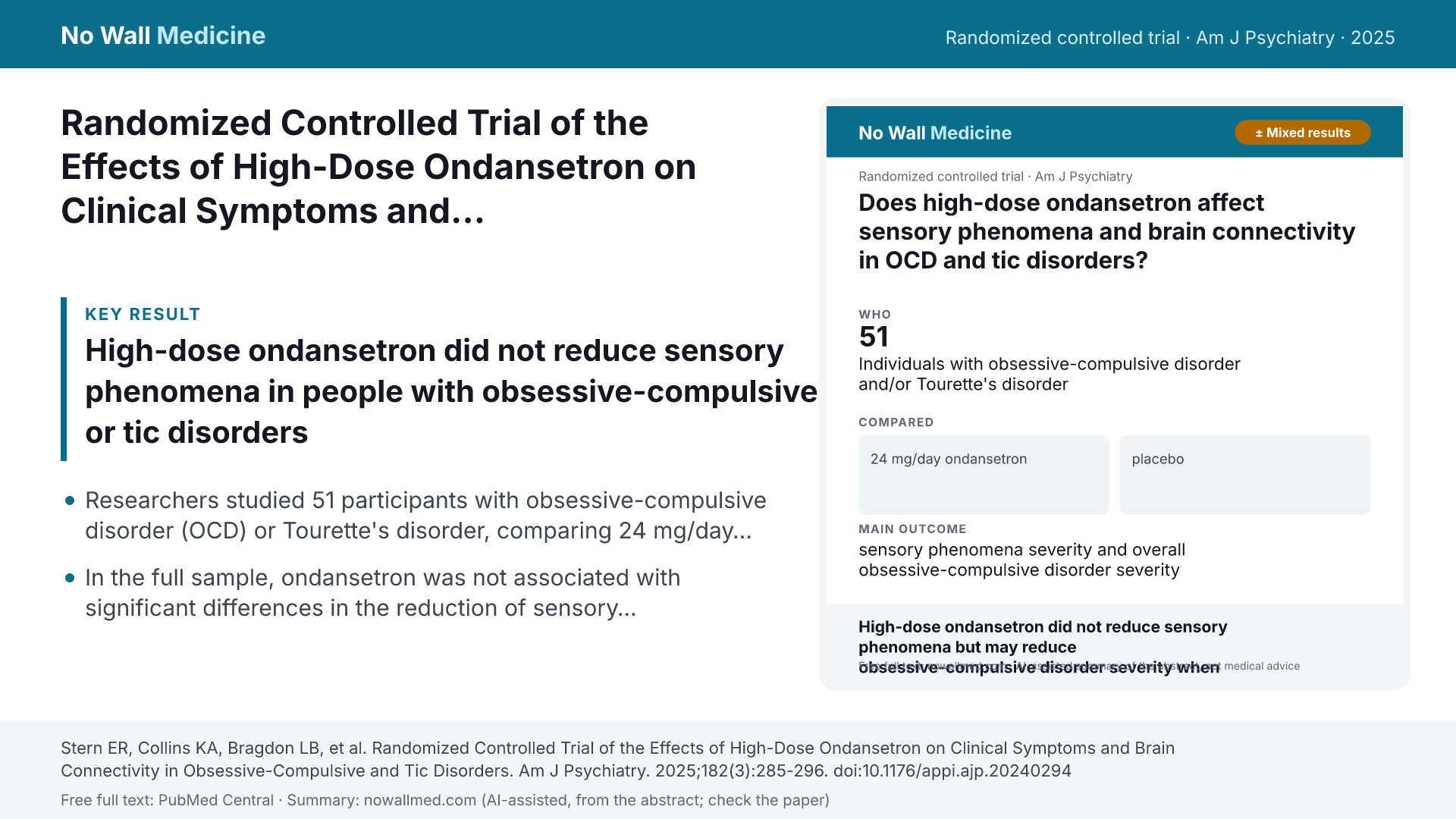
Key result: High-dose ondansetron did not reduce sensory phenomena in people with obsessive-compulsive or tic disorders
Key points
- Researchers studied 51 participants with obsessive-compulsive disorder (OCD) or Tourette's disorder, comparing 24 mg/day of ondansetron to a placebo over 4 weeks.
- In the full sample, ondansetron was not associated with significant differences in the reduction of sensory phenomena or overall OCD severity compared to placebo.
- In a subsample of participants with OCD taking serotonin reuptake inhibitors, ondansetron was associated with a significant decrease in overall OCD severity and global connectivity of the medial sensorimotor cortex.
Why it matters: Standard treatments do not well address the aversive sensory phenomena that drive repetitive behaviors in obsessive-compulsive and tic disorders.
Discussion prompts
- Would these patients look like yours? Who was left out?
- Is the main outcome one that matters to patients?
- Is the difference large enough to change what you do?
Cite: Stern ER, Collins KA, Bragdon LB, et al. Randomized Controlled Trial of the Effects of High-Dose Ondansetron on Clinical Symptoms and Brain Connectivity in Obsessive-Compulsive and Tic Disorders. Am J Psychiatry. 2025;182(3):285-296. doi:10.1176/appi.ajp.20240294
Free full text: PubMed Central · Summary and visual abstract: nowallmed.com/a/randomized-controlled-trial-of-the-effects-of-high-dose-ondansetron-i6on34/ (AI-assisted from the abstract; check the paper before relying on it).