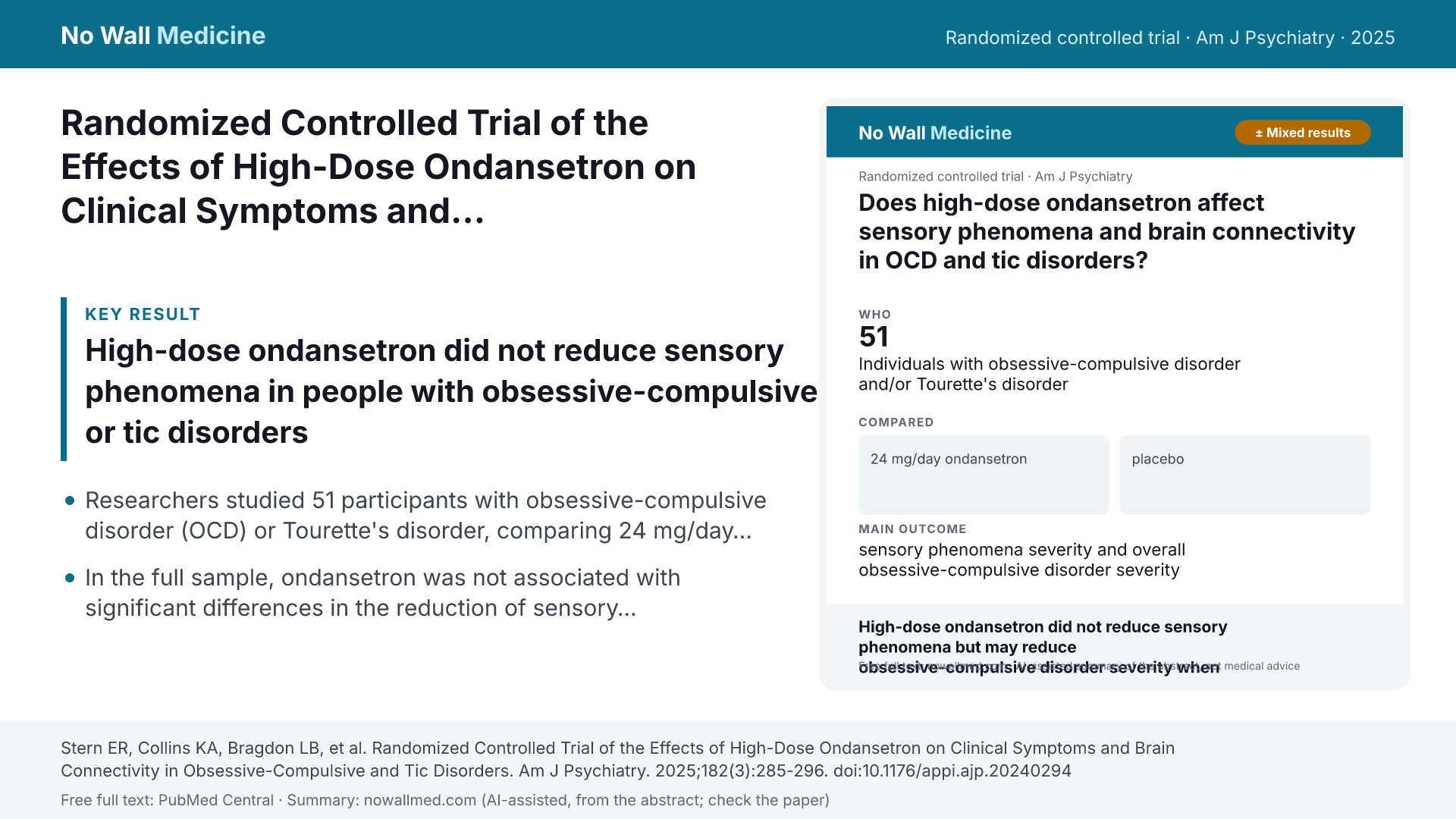
High-dose ondansetron did not reduce sensory phenomena in people with obsessive-compulsive or tic disorders
Randomized Controlled Trial of the Effects of High-Dose Ondansetron on Clinical Symptoms and Brain Connectivity in Obsessive-Compulsive and Tic Disorders
Randomized controlled trialMixed results
Does high-dose ondansetron affect sensory phenomena and brain connectivity in OCD and tic disorders?
Who
51
Individuals with obsessive-compulsive disorder and/or Tourette's disorder
Compared
24 mg/day ondansetron
placebo
Main outcome
sensory phenomena severity and overall obsessive-compulsive disorder severity
Bottom line: High-dose ondansetron did not reduce sensory phenomena but may reduce obsessive-compulsive disorder severity when augmenting serotonin reuptake inhibitors.
Am J Psychiatry · 2025-01-29Download image
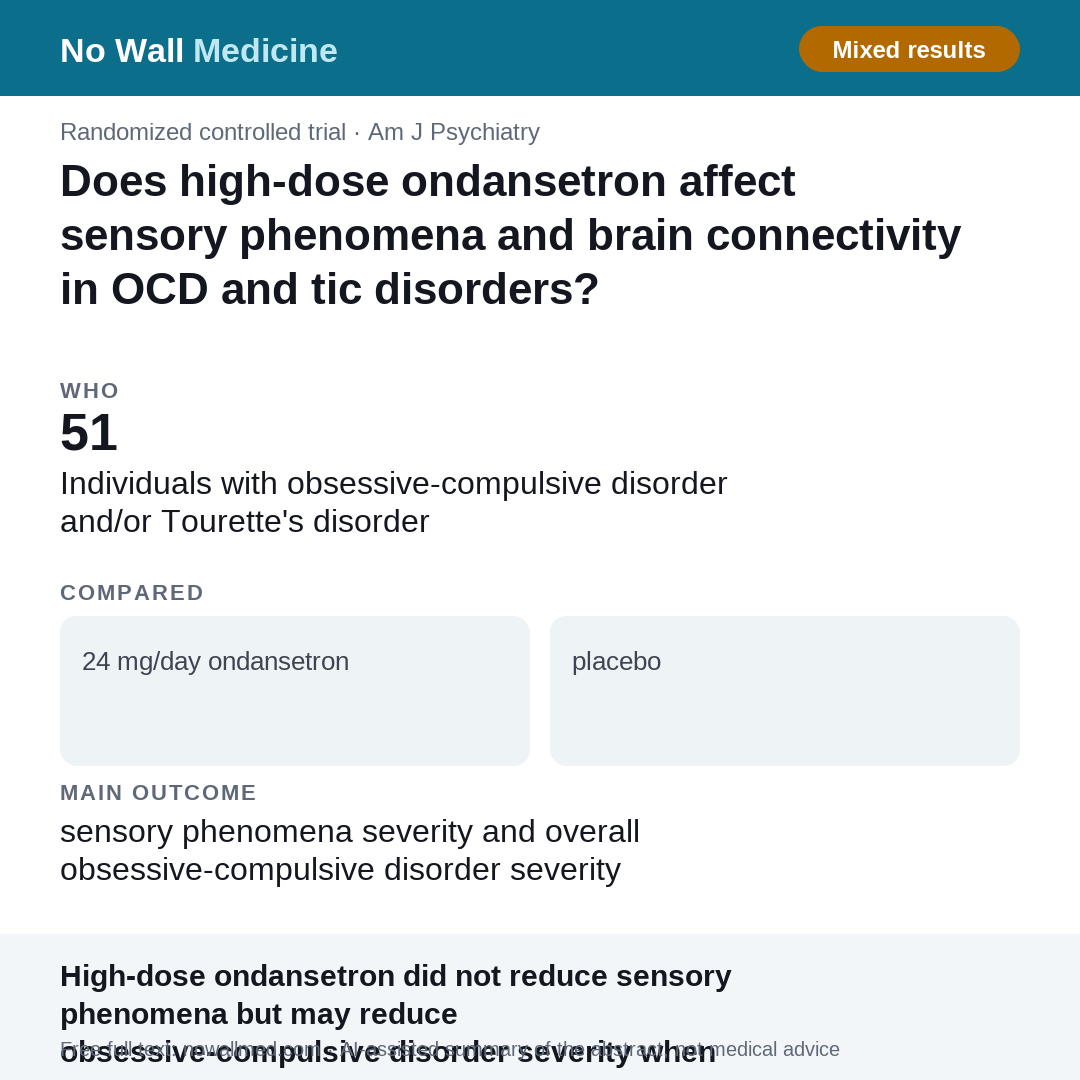
Clinical question: Does high-dose ondansetron affect sensory phenomena and brain connectivity in OCD and tic disorders?
Why it matters: Standard treatments do not well address the aversive sensory phenomena that drive repetitive behaviors in obsessive-compulsive and tic disorders.
Key points
- Researchers studied 51 participants with obsessive-compulsive disorder (OCD) or Tourette's disorder, comparing 24 mg/day of ondansetron to a placebo over 4 weeks.
- In the full sample, ondansetron was not associated with significant differences in the reduction of sensory phenomena or overall OCD severity compared to placebo.
- In a subsample of participants with OCD taking serotonin reuptake inhibitors, ondansetron was associated with a significant decrease in overall OCD severity and global connectivity of the medial sensorimotor cortex.
Headline and key points written with AI from the paper’s abstract, with every number checked against it. Read the paper before relying on them.
Was this summary helpful?
Subject terms
Headline, design, result, key points, caveat and citation as plain text.
Cite this article
Stern ER, Collins KA, Bragdon LB, et al. Randomized Controlled Trial of the Effects of High-Dose Ondansetron on Clinical Symptoms and Brain Connectivity in Obsessive-Compulsive and Tic Disorders. Am J Psychiatry. 2025. doi:10.1176/appi.ajp.20240294
Spotted a mistake? Suggest a correction