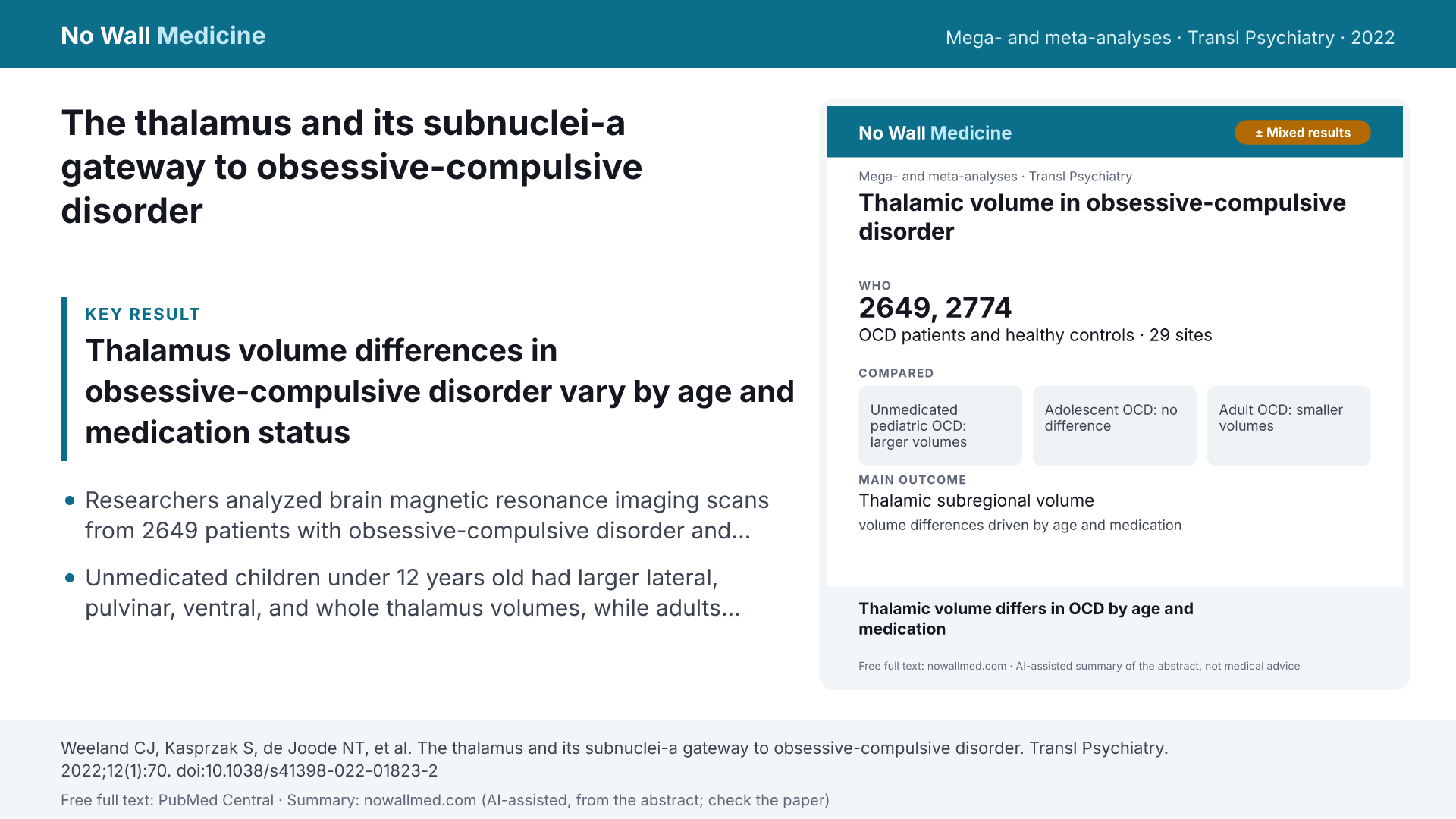
Thalamus volume differences in obsessive-compulsive disorder vary by age and medication status
The thalamus and its subnuclei-a gateway to obsessive-compulsive disorder
Psychiatry & Mental HealthAdult and pediatric
Mega- and meta-analysesMixed results
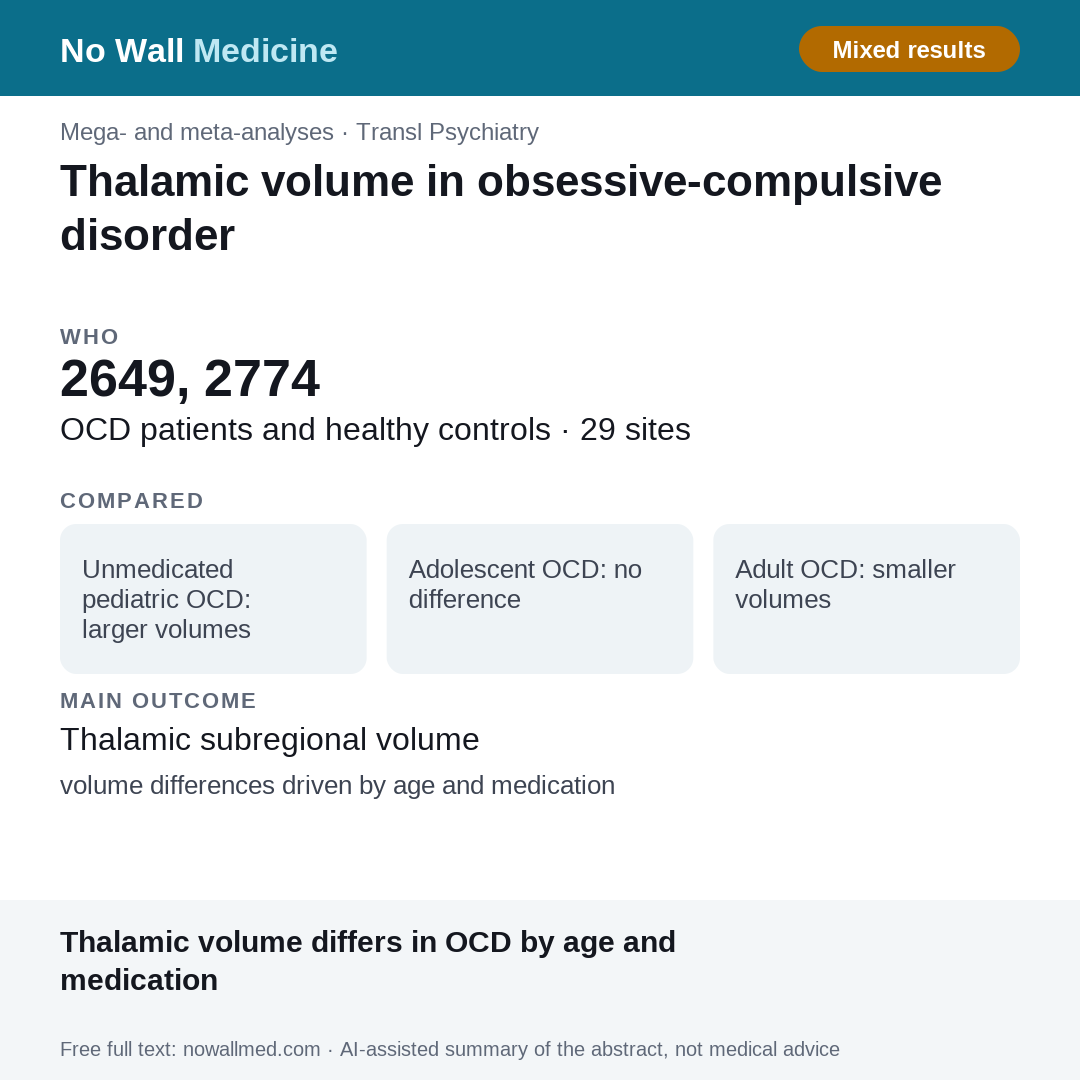
Thalamic volume in obsessive-compulsive disorder
Who
2649, 2774
OCD patients and healthy controls · 29 sites
Compared
Unmedicated pediatric OCD: larger volumes
Adolescent OCD: no difference
Adult OCD: smaller volumes
Main outcome
Thalamic subregional volume
Result: volume differences driven by age and medication
Bottom line: Thalamic volume differs in OCD by age and medication
Transl Psychiatry · 2022-02-21Download image
Why it matters: It was unknown how the volume of specific thalamic subregions changes across different age groups in people with obsessive-compulsive disorder.
Key points
- Researchers analyzed brain magnetic resonance imaging scans from 2649 patients with obsessive-compulsive disorder and 2774 healthy controls across 29 sites.
- Unmedicated children under 12 years old had larger lateral, pulvinar, ventral, and whole thalamus volumes, while adults had smaller volumes across all subregions.
- In adults, smaller thalamic volumes were associated with medication use and higher symptom severity.
Headline and key points written with AI from the paper’s abstract, with every number checked against it. Read the paper before relying on them.
Was this summary helpful?
Subject terms
Cite this article
Weeland CJ, Kasprzak S, de Joode NT, et al. The thalamus and its subnuclei-a gateway to obsessive-compulsive disorder. Transl Psychiatry. 2022. doi:10.1038/s41398-022-01823-2
Spotted a mistake? Suggest a correction