Weekly paclitaxel and bevacizumab showed longer progression-free survival than anetumab ravtansine and bevacizumab
Randomized Phase II Study of Bevacizumab with Weekly Anetumab Ravtansine or Weekly Paclitaxel in Platinum-Resistant/Refractory High-Grade Ovarian Cancer (NCI Trial)
Randomized trialHarm found
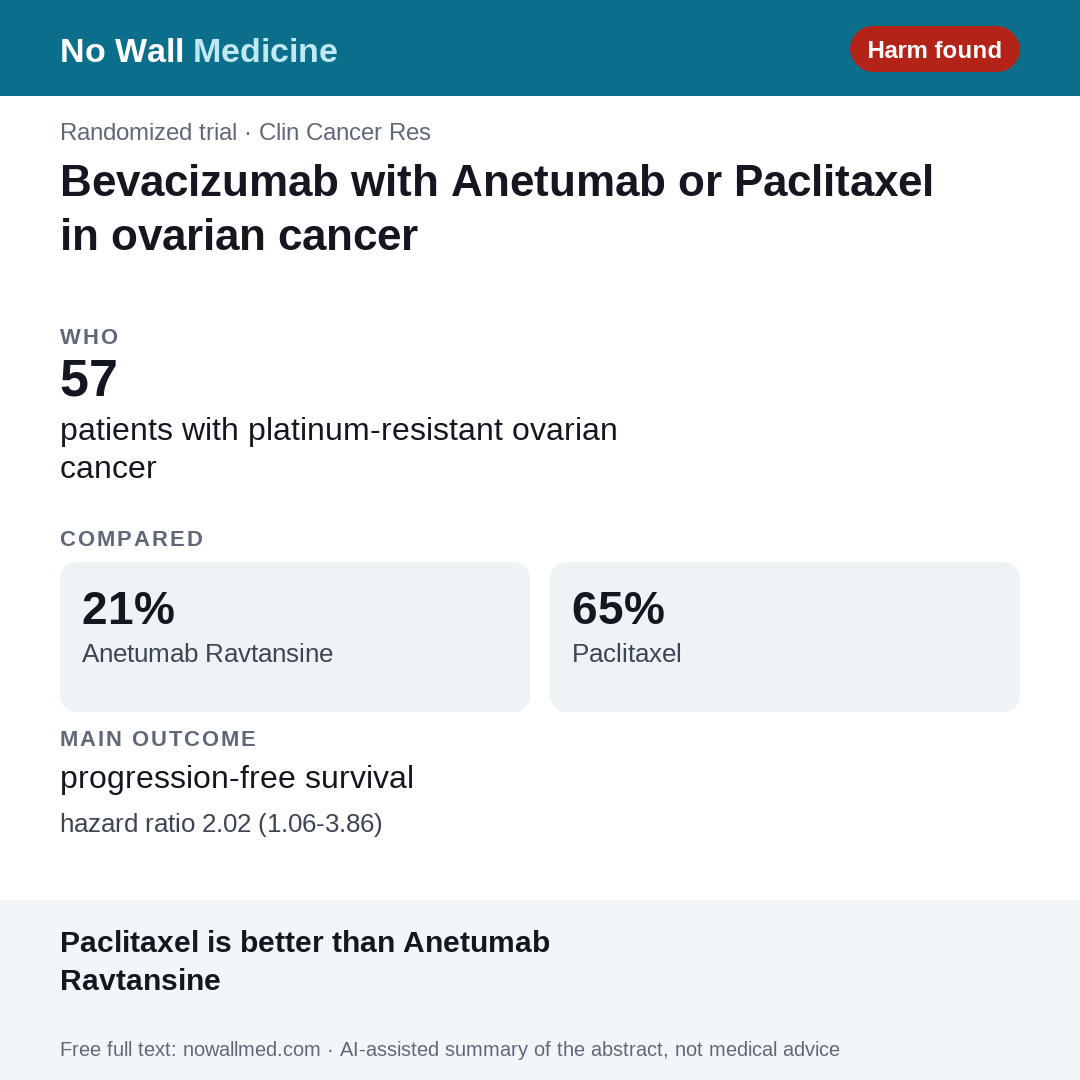
Bevacizumab with Anetumab or Paclitaxel in ovarian cancer
Who
57
patients with platinum-resistant ovarian cancer
Compared
21%Anetumab Ravtansine
65%Paclitaxel
Main outcome
progression-free survival
Result: hazard ratio 2.02 (1.06-3.86)
Bottom line: Paclitaxel is better than Anetumab Ravtansine
Clin Cancer Res · 2025-01-21Download image
Why it matters: It was unknown if combining anetumab ravtansine, an antibody-drug conjugate, with bevacizumab was more effective than the standard weekly paclitaxel and bevacizumab treatment for this cancer.
Key points
- Researchers randomized 57 patients with platinum-resistant or refractory high-grade ovarian cancer to receive either anetumab ravtansine with bevacizumab or weekly paclitaxel with bevacizumab.
- The median progression-free survival, which is the time until the disease worsens, was 5.3 months for the anetumab ravtansine group and 12.7 months for the paclitaxel group.
- The overall response rate was 21% with anetumab ravtansine and 65% with paclitaxel, while the most common severe side effects were anemia at 18% and neutropenia at 24%.
Headline and key points written with AI from the paper’s abstract, with every number checked against it. Read the paper before relying on them.
Was this summary helpful?
Subject terms
Cite this article
Alqaisi HA, Cohn DE, Chern JY, Duska LR, Jewell A, Corr BR. Randomized Phase II Study of Bevacizumab with Weekly Anetumab Ravtansine or Weekly Paclitaxel in Platinum-Resistant/Refractory High-Grade Ovarian Cancer (NCI Trial). Clin Cancer Res. 2025. doi:10.1158/1078-0432.CCR-24-3128
Spotted a mistake? Suggest a correction
Top studies every Monday
The week’s key trials and guidelines in your specialties, plus any topics you follow. By email, free.
Get the weekly digest