Magnetic stimulation therapy improved fecal incontinence symptoms compared to a sham treatment
Randomized Sham-Controlled Trial of Translumbosacral Neuromodulation Therapy for Fecal Incontinence
Multicenter, double-blind, randomized sham-controlled trialBenefit found
Is translumbosacral neuromodulation therapy effective for fecal incontinence?
Who
109
Patients with fecal incontinence having at least one leakage per week · Multicenter
Compared
2400 magnetic stimulations: 25 of 38 (65.8%) responders
3600 magnetic stimulations: 30 of 37 (81.1%) responders
Sham stimulations: 11 of 34 (32.4%) responders
Main outcome
At least 50% decrease in weekly fecal incontinence episodes
Result: odds ratio 3.91 (95% CI 1.48-10.91) for 2400 vs sham; odds ratio 8.53 (95% CI 2.96-27.47) for 3600 vs sham
Bottom line: Translumbosacral neuromodulation therapy with 2400 or 3600 pulses improved fecal incontinence and bowel symptoms compared to sham.
Gastroenterology · 2026-05-07Download image
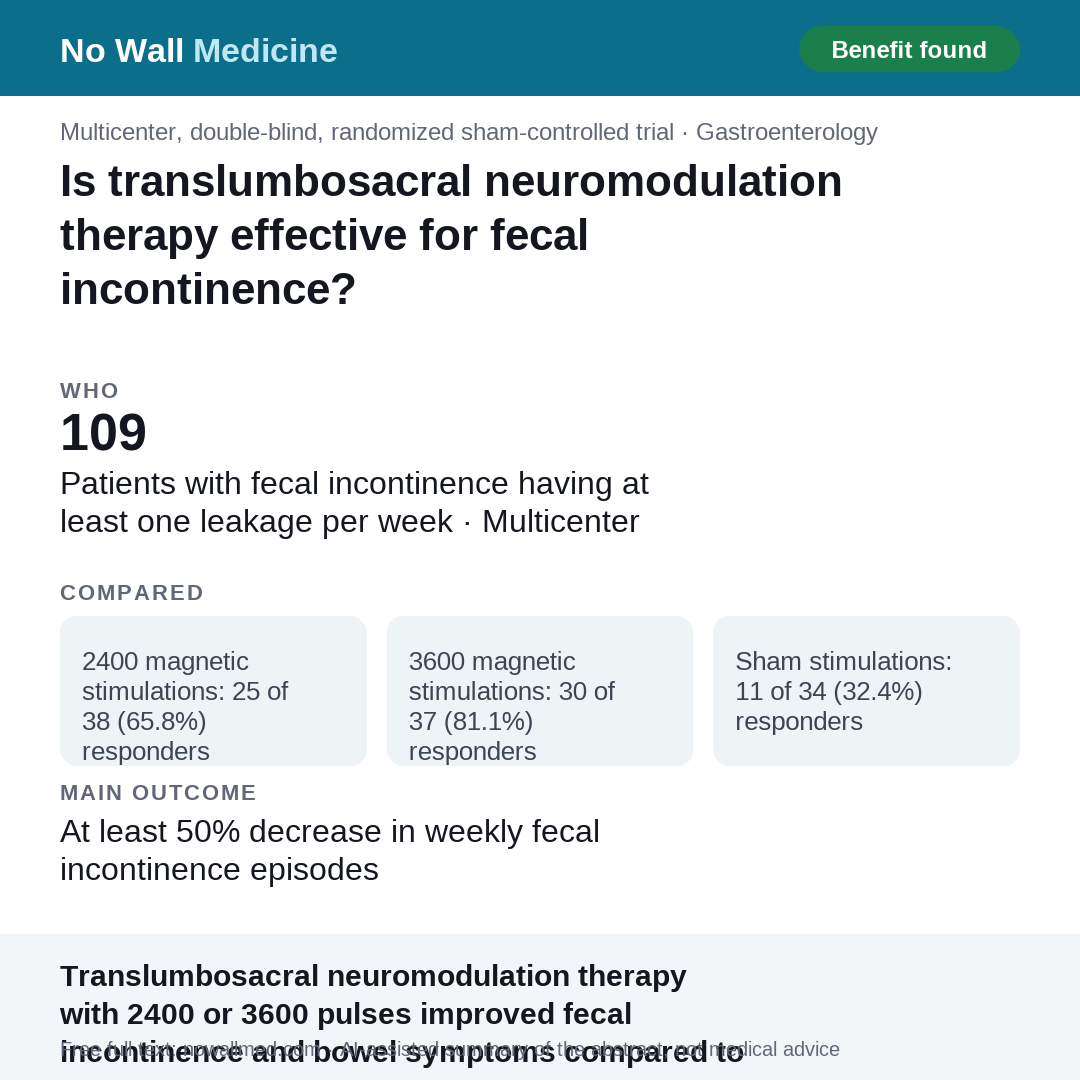
Clinical question: Is translumbosacral neuromodulation therapy effective for fecal incontinence?
Why it matters: Fecal incontinence is a complex disorder that currently lacks effective treatments that can modify the underlying disease.
Key points
- Researchers studied 109 patients with fecal incontinence who received either 2400 magnetic pulses, 3600 magnetic pulses, or sham stimulations over 6 weeks.
- The 2400 pulse group had 25 of 38 (65.8%) responders and the 3600 pulse group had 30 of 37 (81.1%) responders compared to 11 of 34 (32.4%) in the sham group.
- Patients receiving the magnetic stimulation showed significant improvements in fecal incontinence severity index scores and quality of life domains compared to the sham group.
Headline and key points written with AI from the paper’s abstract, with every number checked against it. Read the paper before relying on them.
Topics
Spotted a mistake? Suggest a correction