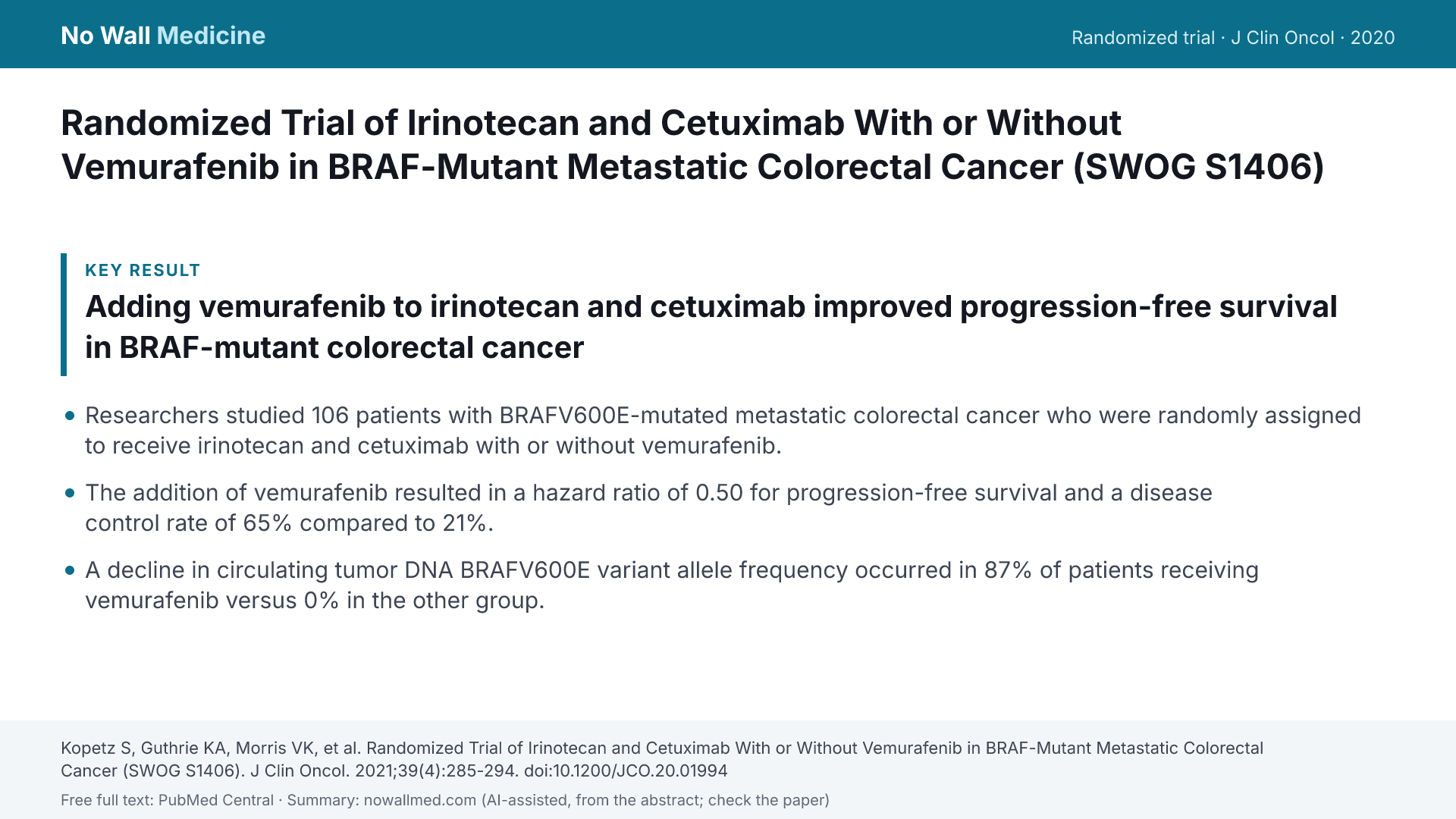
Randomized Trial of Irinotecan and Cetuximab With or Without Vemurafenib in BRAF-Mutant Metastatic Colorectal Cancer (SWOG S1406)
Key result: Adding vemurafenib to irinotecan and cetuximab improved progression-free survival in BRAF-mutant colorectal cancer
Key points
- Researchers studied 106 patients with BRAFV600E-mutated metastatic colorectal cancer who were randomly assigned to receive irinotecan and cetuximab with or without vemurafenib.
- The addition of vemurafenib resulted in a hazard ratio of 0.50 for progression-free survival and a disease control rate of 65% compared to 21%.
- A decline in circulating tumor DNA BRAFV600E variant allele frequency occurred in 87% of patients receiving vemurafenib versus 0% in the other group.
Why it matters: BRAFV600E mutations rarely respond to the BRAF inhibitor vemurafenib alone because blocking BRAF causes feedback upregulation of the epidermal growth factor receptor.
Discussion prompts
- Would these patients look like yours? Who was left out?
- Is the main outcome one that matters to patients?
- Is the difference large enough to change what you do?
Cite: Kopetz S, Guthrie KA, Morris VK, et al. Randomized Trial of Irinotecan and Cetuximab With or Without Vemurafenib in BRAF-Mutant Metastatic Colorectal Cancer (SWOG S1406). J Clin Oncol. 2021;39(4):285-294. doi:10.1200/JCO.20.01994
Free full text: PubMed Central · Summary and visual abstract: nowallmed.com/a/randomized-trial-of-irinotecan-and-cetuximab-with-or-without-t9futb/ (AI-assisted from the abstract; check the paper before relying on it).