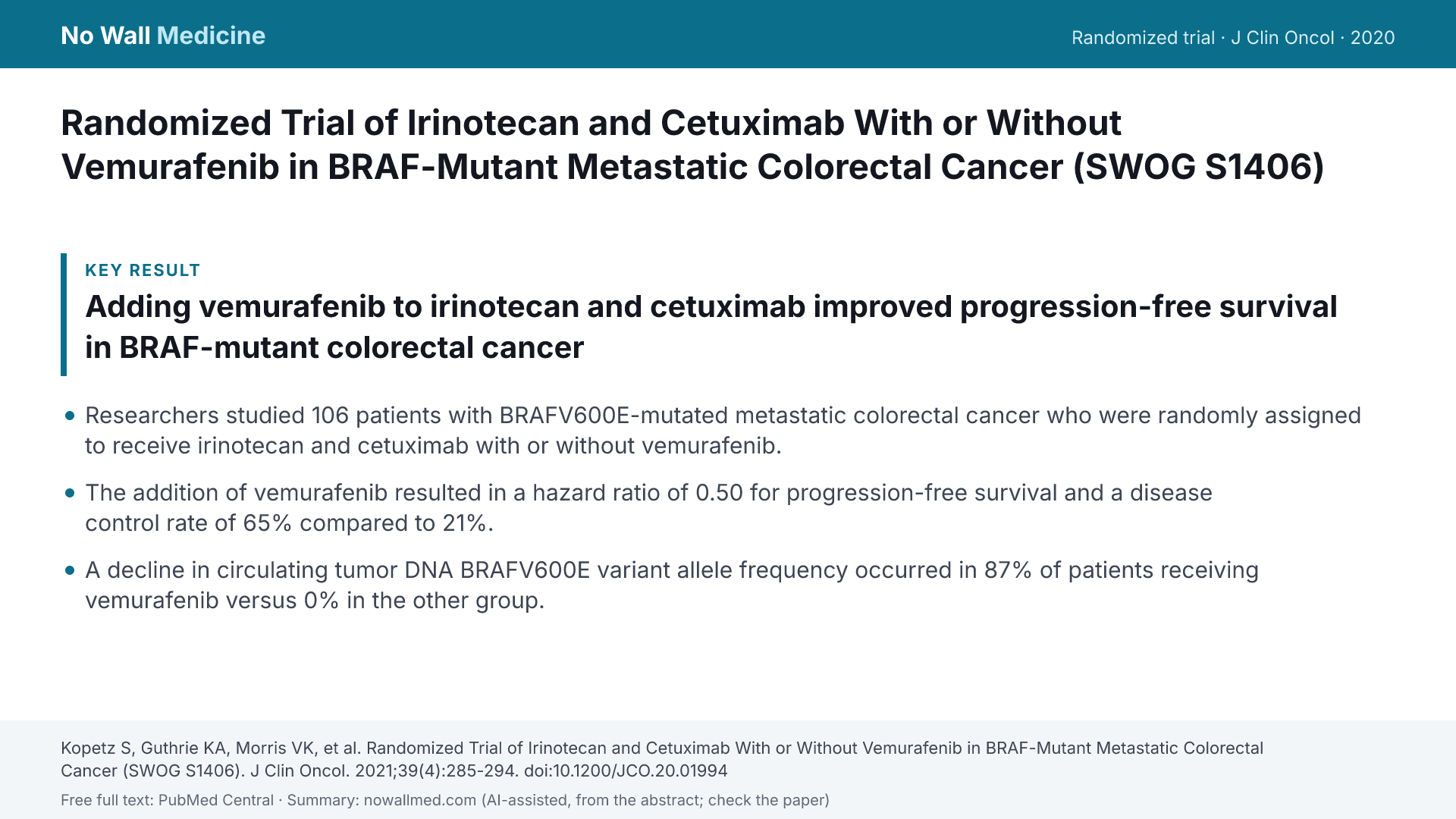
Adding vemurafenib to irinotecan and cetuximab improved progression-free survival in BRAF-mutant colorectal cancer
Randomized Trial of Irinotecan and Cetuximab With or Without Vemurafenib in BRAF-Mutant Metastatic Colorectal Cancer (SWOG S1406)
Why it matters: BRAFV600E mutations rarely respond to the BRAF inhibitor vemurafenib alone because blocking BRAF causes feedback upregulation of the epidermal growth factor receptor.
Key points
- Researchers studied 106 patients with BRAFV600E-mutated metastatic colorectal cancer who were randomly assigned to receive irinotecan and cetuximab with or without vemurafenib.
- The addition of vemurafenib resulted in a hazard ratio of 0.50 for progression-free survival and a disease control rate of 65% compared to 21%.
- A decline in circulating tumor DNA BRAFV600E variant allele frequency occurred in 87% of patients receiving vemurafenib versus 0% in the other group.
Headline and key points written with AI from the paper’s abstract, with every number checked against it. Read the paper before relying on them.
Was this summary helpful?
Subject terms
Cite this article
Kopetz S, Guthrie KA, Morris VK, et al. Randomized Trial of Irinotecan and Cetuximab With or Without Vemurafenib in BRAF-Mutant Metastatic Colorectal Cancer (SWOG S1406). J Clin Oncol. 2020. doi:10.1200/JCO.20.01994
Spotted a mistake? Suggest a correction