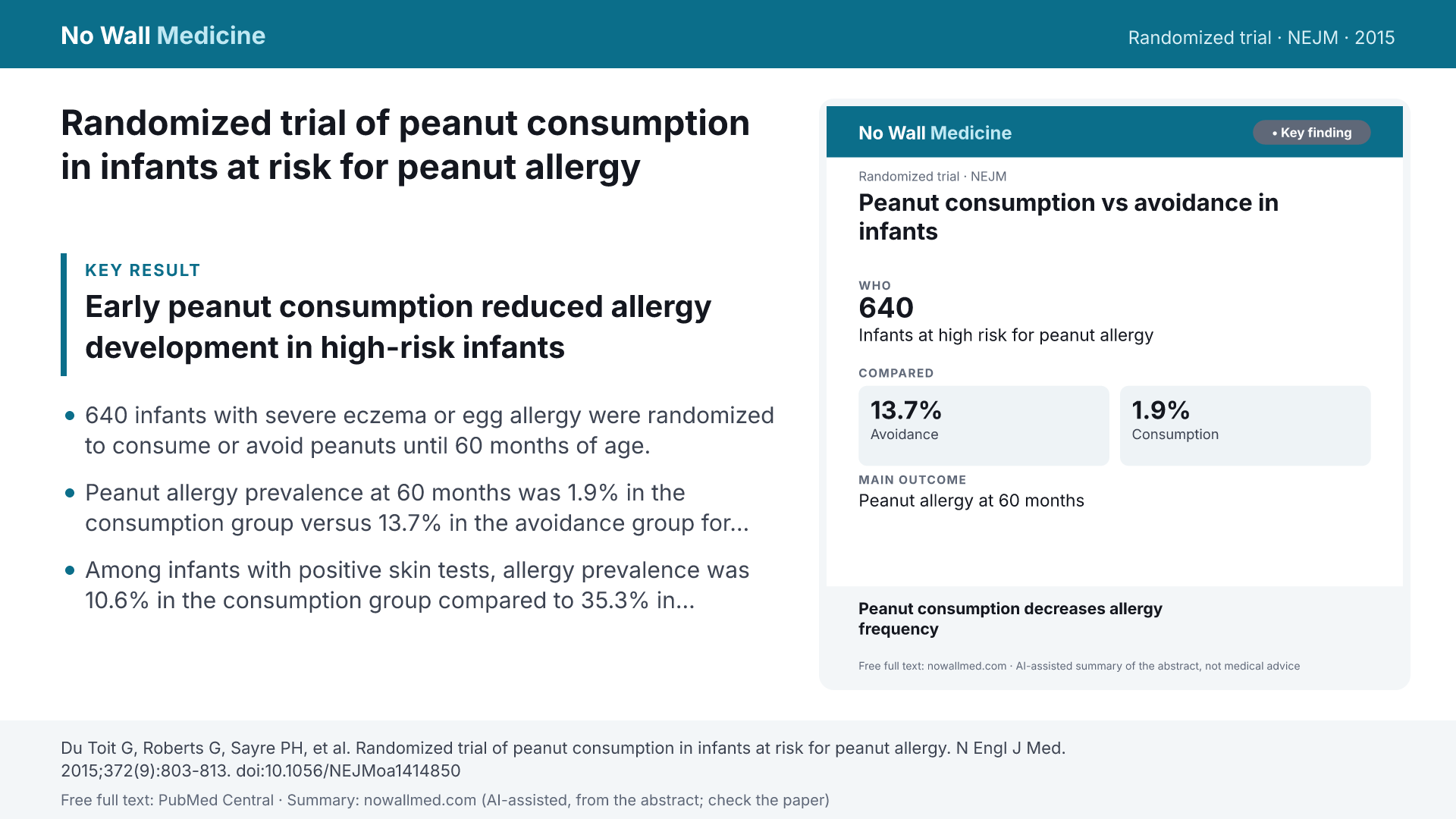
Early peanut consumption reduced allergy development in high-risk infants
Randomized trial of peanut consumption in infants at risk for peanut allergy
Randomized trialKey finding
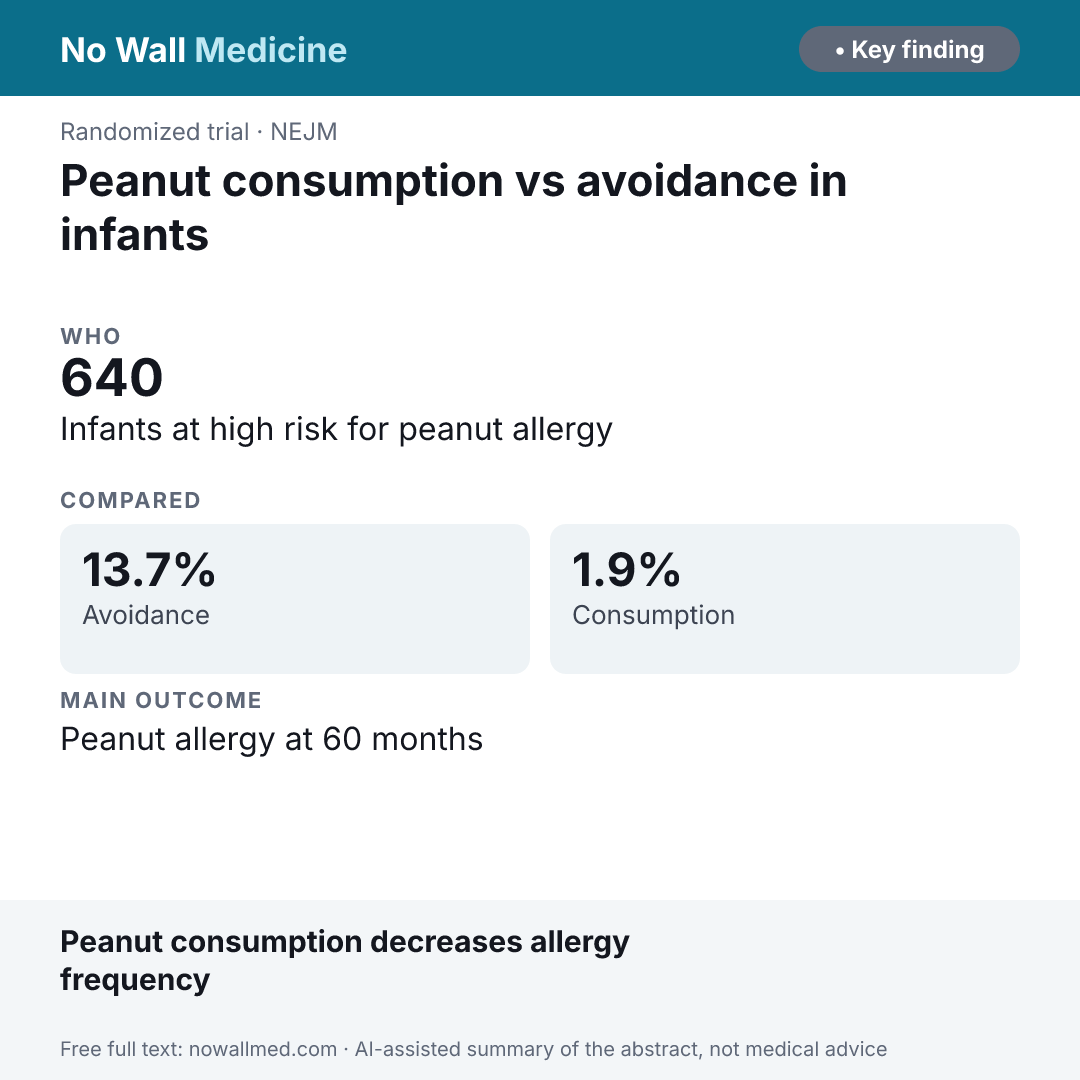
Peanut consumption vs avoidance in infants
Who
640
Infants at high risk for peanut allergy
Compared
13.7%Avoidance
1.9%Consumption
Main outcome
Peanut allergy at 60 months
Bottom line: Peanut consumption decreases allergy frequency
NEJM · 2015-02-23 · Funded by National Institute of Allergy · NCT00329784
Why it matters: Early peanut introduction in high-risk infants greatly reduced peanut allergy, reversing earlier avoidance advice.
Context written by the No Wall Medicine team.
Trial at a glance
Bottom line: Peanut consumption decreased peanut allergy frequency in high-risk children.
Clinical question
Does peanut consumption prevent allergy in infants?
Design
Randomized, open-label, controlled trial. United Kingdom, 1 site, 2006-2009
Who was studied
640 infants with severe eczema, egg allergy, or both
Key inclusion criteria
- severe eczema
- egg allergy
- at least 4 months and less than 11 months of age
Interventions
- consumption group: consume peanuts
- avoidance group: avoid peanuts
Primary outcome
peanut allergy at 60 months. 13.7% in avoidance group and 1.9% in consumption group (P<0.001)
Secondary outcomes
- immune responses: increases in levels of peanut-specific IgG4 antibody in consumption group
Harms
no significant difference in serious adverse events
Limitations reported by the authors
- failure to collect dust samples to validate consumption
Funding
National Institute of Allergy and Infectious Diseases and others
Written with AI from the full paper; every number was checked against it. Read the paper before relying on it.
Headline and visual abstract written with AI from the paper’s abstract, with every number checked against it. Read the paper before relying on them.
Was this summary helpful?
Subject terms
Cite this article
Du Toit G, Roberts G, Sayre PH, et al. Randomized trial of peanut consumption in infants at risk for peanut allergy. N Engl J Med. 2015;372(9):803-813. doi:10.1056/NEJMoa1414850
Spotted a mistake? Suggest a correction