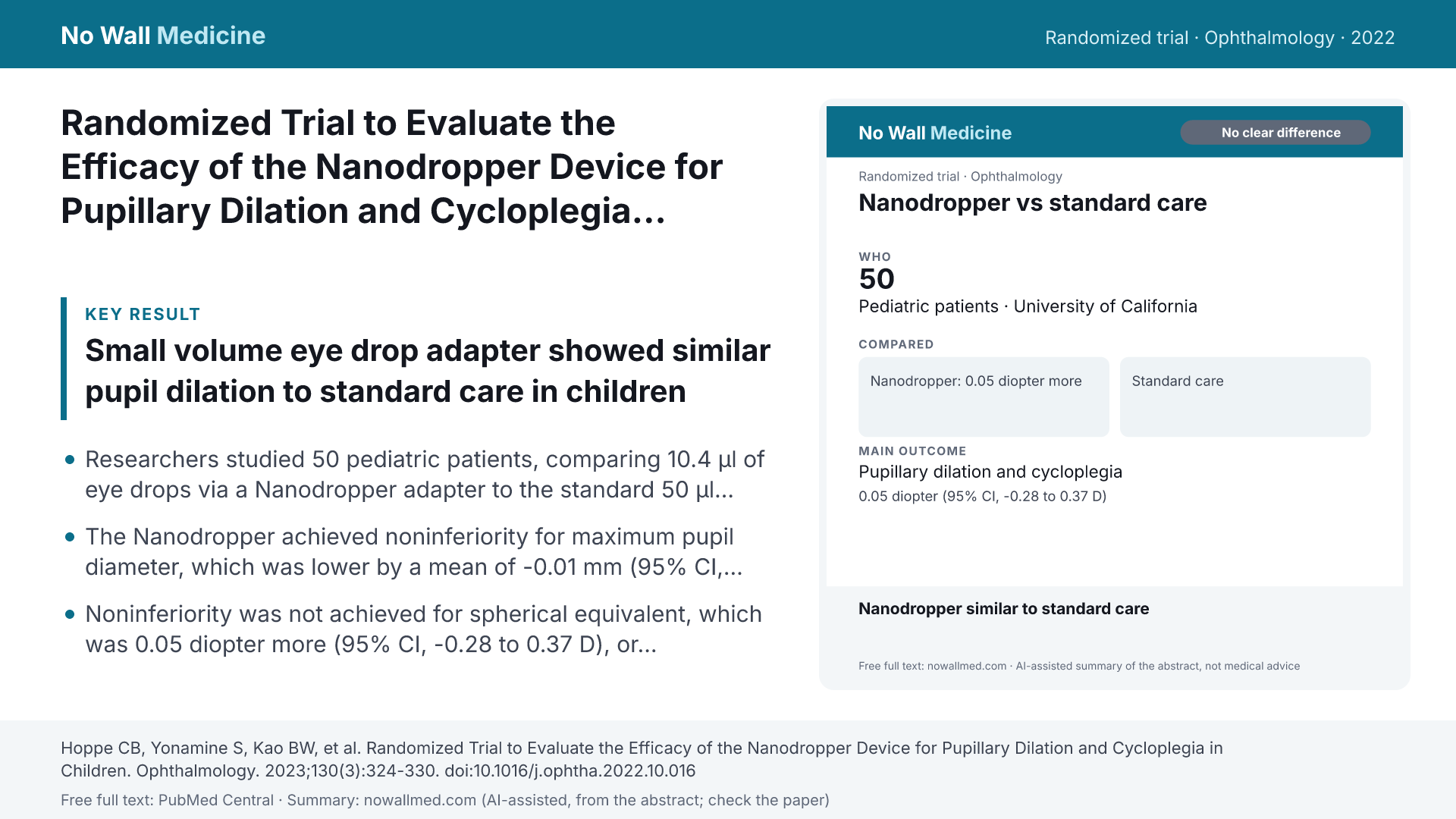
Small volume eye drop adapter showed similar pupil dilation to standard care in children
Randomized Trial to Evaluate the Efficacy of the Nanodropper Device for Pupillary Dilation and Cycloplegia in Children
Randomized trialNo clear difference
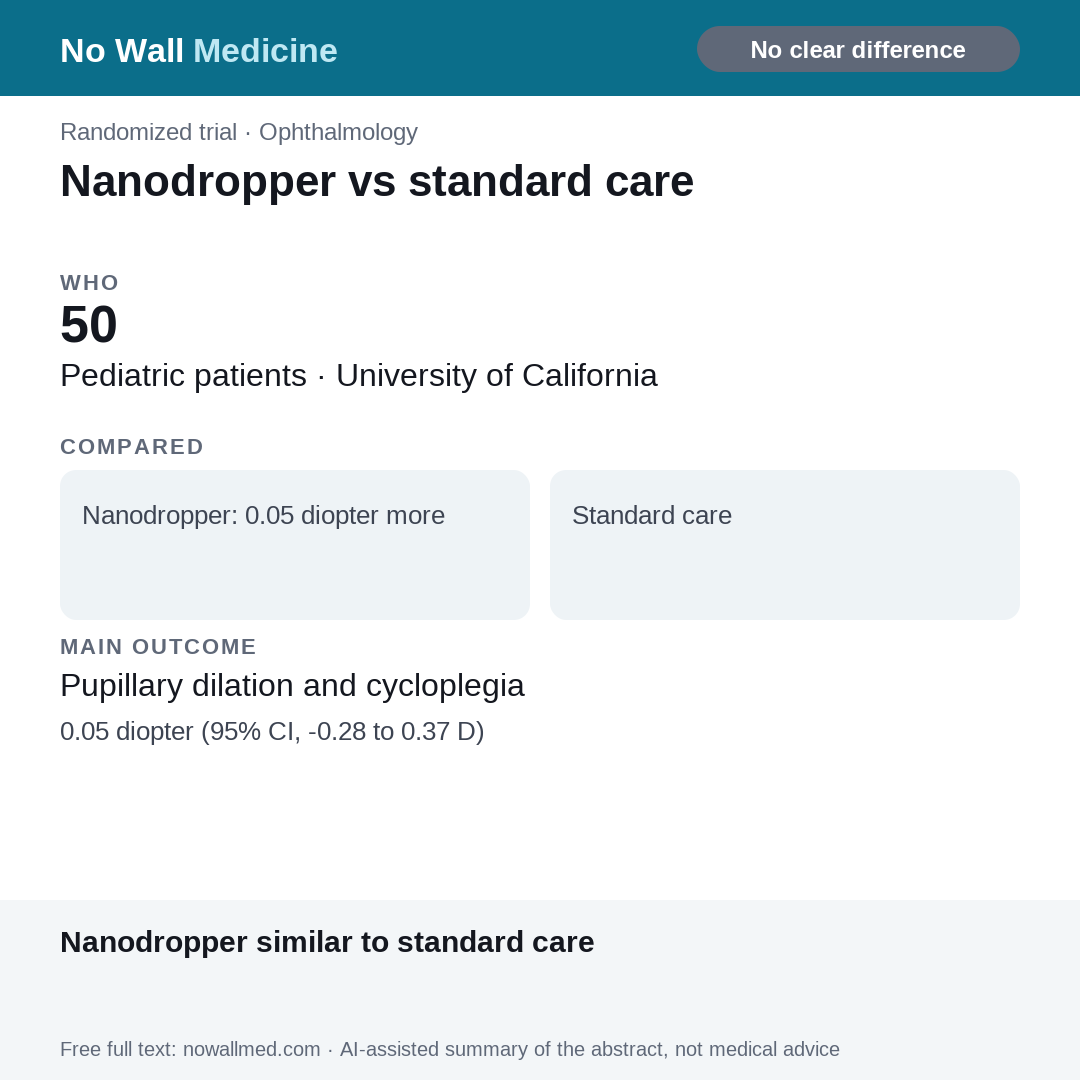
Nanodropper vs standard care
Who
50
Pediatric patients · University of California
Compared
Nanodropper: 0.05 diopter more
Standard care
Main outcome
Pupillary dilation and cycloplegia
Result: 0.05 diopter (95% CI, -0.28 to 0.37 D)
Bottom line: Nanodropper similar to standard care
Limitation: small differences not clinically significant
Ophthalmology · 2022-10-22Download image
Why it matters: It is unknown if using a small-volume eye drop adapter can maintain the same therapeutic effect for pupillary dilation and cycloplegia, which is the paralysis of the eye's focusing muscle, as standard larger doses.
Key points
- Researchers studied 50 pediatric patients, comparing 10.4 μl of eye drops via a Nanodropper adapter to the standard 50 μl dose in one eye of each child.
- The Nanodropper achieved noninferiority for maximum pupil diameter, which was lower by a mean of -0.01 mm (95% CI, -0.20 to -0.03).
- Noninferiority was not achieved for spherical equivalent, which was 0.05 diopter more (95% CI, -0.28 to 0.37 D), or pupil constriction percentage, which was 0.57 percentage points more (95% CI, -1.38 to 2.51 percentage points).
Headline and key points written with AI from the paper’s abstract, with every number checked against it. Read the paper before relying on them.
Was this summary helpful?
Subject terms
Cite this article
Hoppe CB, Yonamine S, Kao BW, Turner ML, Ou Y, Han Y. Randomized Trial to Evaluate the Efficacy of the Nanodropper Device for Pupillary Dilation and Cycloplegia in Children. Ophthalmology. 2022. doi:10.1016/j.ophtha.2022.10.016
Spotted a mistake? Suggest a correction