Randomized Trial to Evaluate the Efficacy of the Nanodropper Device for Pupillary Dilation and Cycloplegia in Children
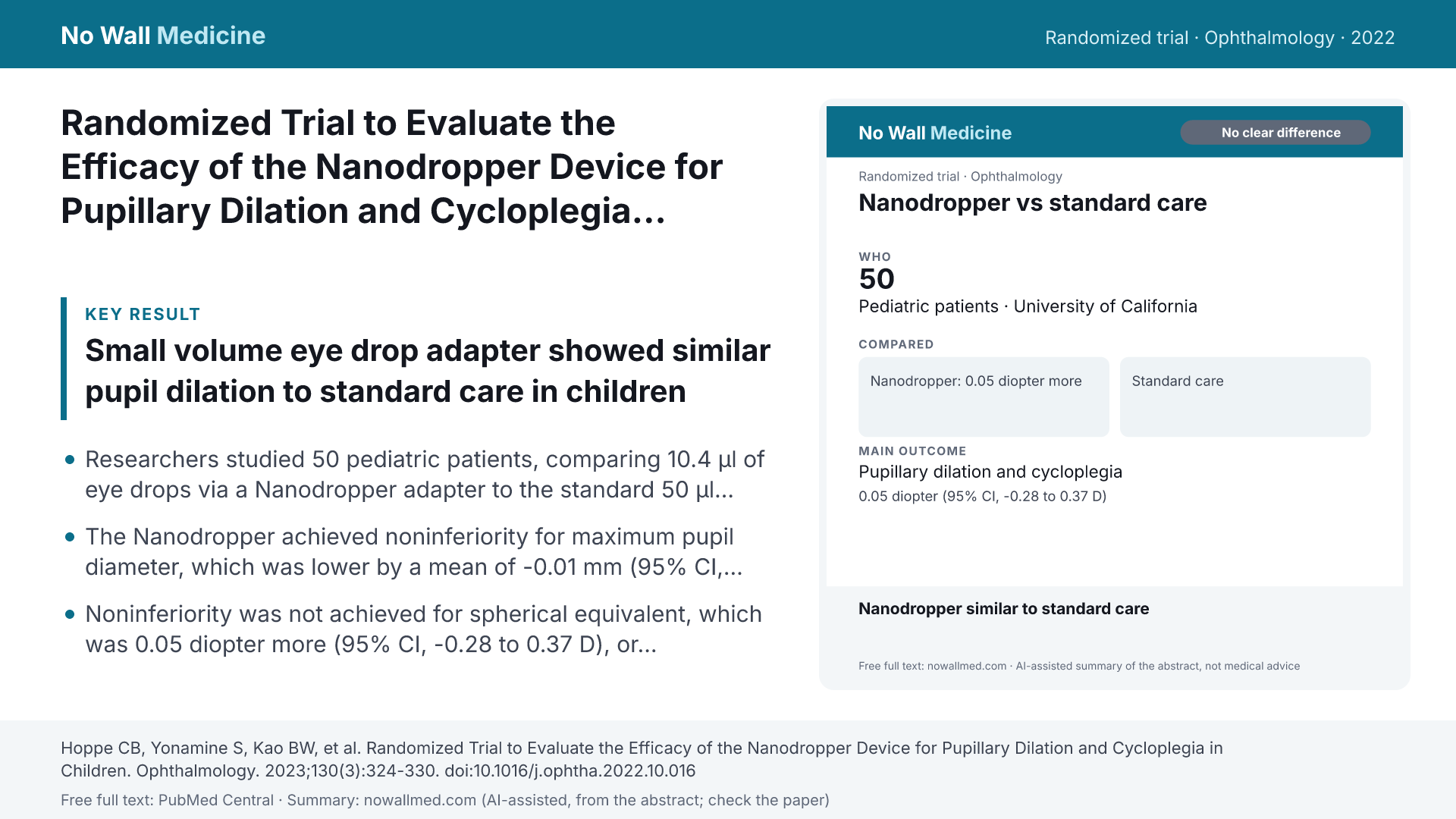
Key result: Small volume eye drop adapter showed similar pupil dilation to standard care in children
Randomized trialNo clear difference
Nanodropper vs standard care
Who
50
Pediatric patients · University of California
Compared
Nanodropper: 0.05 diopter more
Standard care
Main outcome
Pupillary dilation and cycloplegia
Result: 0.05 diopter (95% CI, -0.28 to 0.37 D)
Bottom line: Nanodropper similar to standard care
Limitation: small differences not clinically significant
Ophthalmology · 2022-10-22
Key points
- Researchers studied 50 pediatric patients, comparing 10.4 μl of eye drops via a Nanodropper adapter to the standard 50 μl dose in one eye of each child.
- The Nanodropper achieved noninferiority for maximum pupil diameter, which was lower by a mean of -0.01 mm (95% CI, -0.20 to -0.03).
- Noninferiority was not achieved for spherical equivalent, which was 0.05 diopter more (95% CI, -0.28 to 0.37 D), or pupil constriction percentage, which was 0.57 percentage points more (95% CI, -1.38 to 2.51 percentage points).
Discussion prompts
- Would these patients look like yours? Who was left out?
- Is the main outcome one that matters to patients?
- Is the difference large enough to change what you do?
Cite: Hoppe CB, Yonamine S, Kao BW, et al. Randomized Trial to Evaluate the Efficacy of the Nanodropper Device for Pupillary Dilation and Cycloplegia in Children. Ophthalmology. 2023;130(3):324-330. doi:10.1016/j.ophtha.2022.10.016
Free full text: PubMed Central · Summary and visual abstract: nowallmed.com/a/randomized-trial-to-evaluate-the-efficacy-of-the-nanodropper-device-1vuvguj/ (AI-assisted from the abstract; check the paper before relying on it).