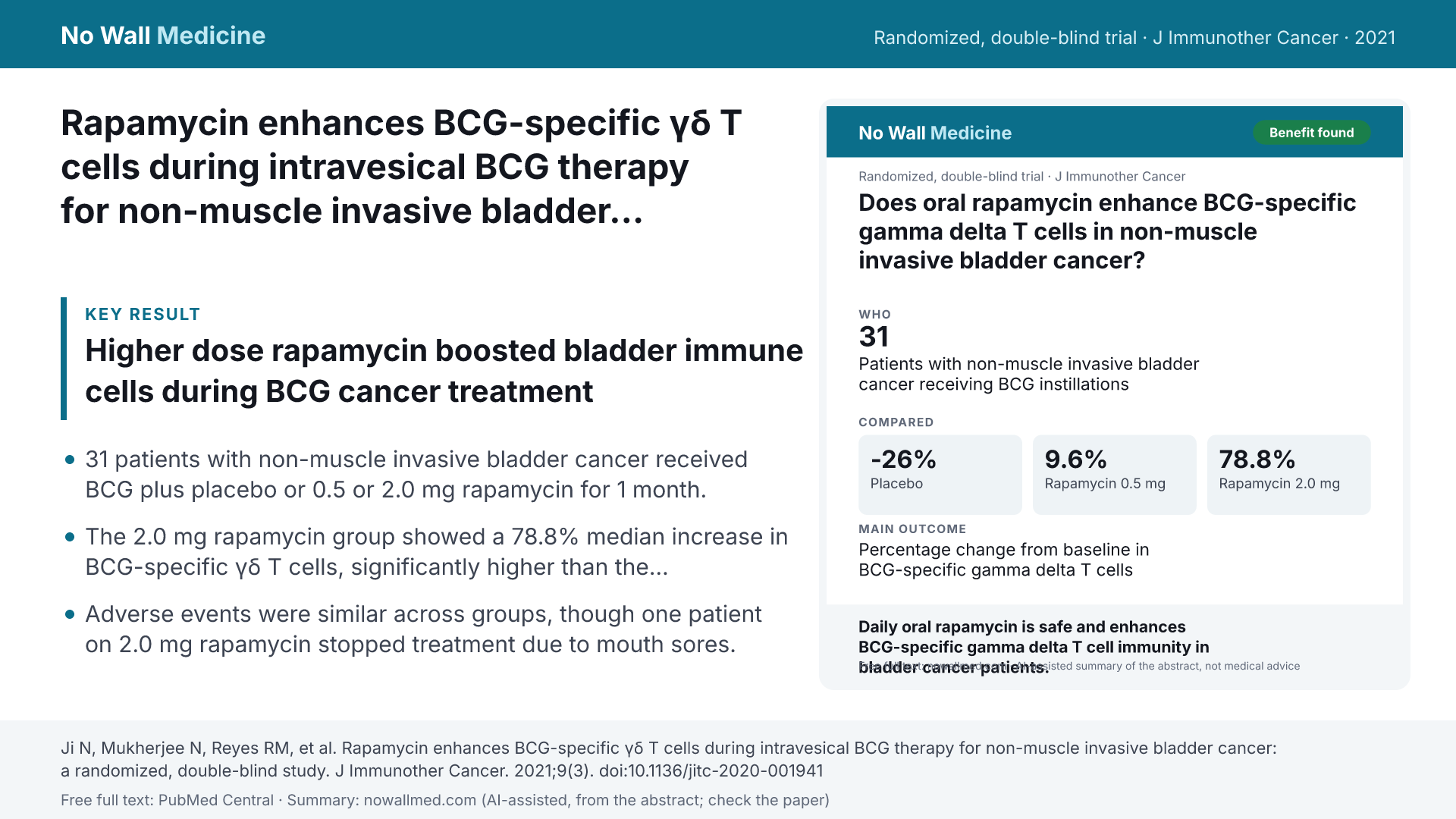
Higher dose rapamycin boosted bladder immune cells during BCG cancer treatment
Rapamycin enhances BCG-specific γδ T cells during intravesical BCG therapy for non-muscle invasive bladder cancer: a randomized, double-blind study
Randomized, double-blind trialBenefit found
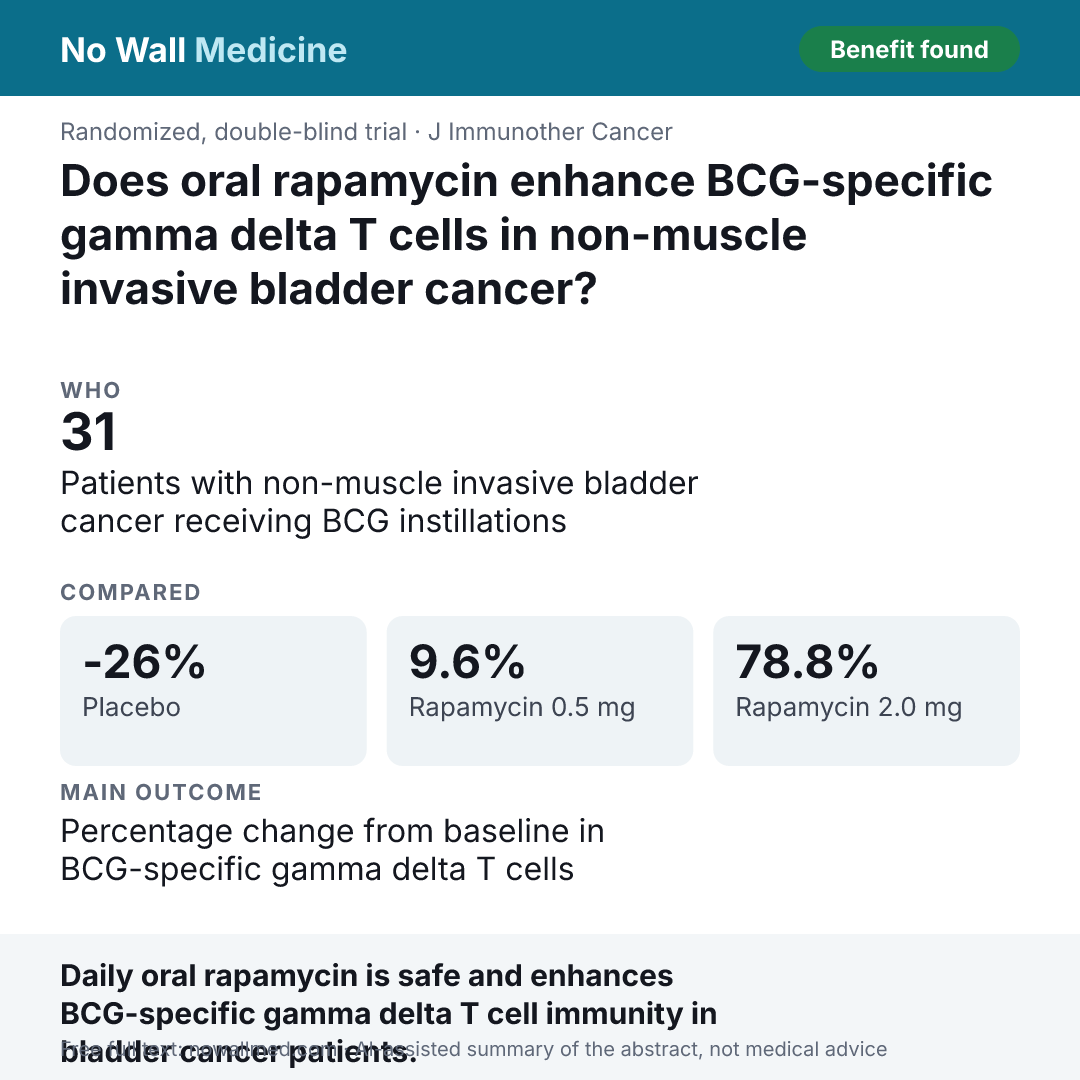
Does oral rapamycin enhance BCG-specific gamma delta T cells in non-muscle invasive bladder cancer?
Who
31
Patients with non-muscle invasive bladder cancer receiving BCG instillations
Compared
-26%Placebo (-51% to 24%)
9.6%Rapamycin 0.5 mg (-59% to 117%)
78.8%Rapamycin 2.0 mg (-31% to 115%)
Main outcome
Percentage change from baseline in BCG-specific gamma delta T cells
Bottom line: Daily oral rapamycin is safe and enhances BCG-specific gamma delta T cell immunity in bladder cancer patients.
J Immunother Cancer · 2021-03-03 · Save PNG
Clinical question: Does oral rapamycin enhance BCG-specific gamma delta T cells in non-muscle invasive bladder cancer?
Why it matters: Response rates to standard BCG therapy for bladder cancer remain unsatisfactory, and it was unknown if adding rapamycin could enhance the immune response.
Key points
- 31 patients with non-muscle invasive bladder cancer received BCG plus placebo or 0.5 or 2.0 mg rapamycin for 1 month.
- The 2.0 mg rapamycin group showed a 78.8% median increase in BCG-specific γδ T cells, significantly higher than the placebo group.
- Adverse events were similar across groups, though one patient on 2.0 mg rapamycin stopped treatment due to mouth sores.
Headline and key points written with AI from the paper’s abstract, with every number checked against it. Read the paper before relying on them.
Was this summary helpful?
Abstract
Background
Although intravesical BCG is the standard treatment of high-grade non-muscle invasive bladder cancer (NMIBC), response rates remain unsatisfactory. In preclinical models, rapamycin enhances BCG vaccine efficacy against tuberculosis and the killing capacity of γδ T cells, which are critical for BCG's antitumor effects. Here, we monitored immunity, safety, and tolerability of rapamycin combined with BCG in patients with NMIBC. Methods
A randomized double-blind trial of oral rapamycin (0.5 or 2.0 mg daily) versus placebo for 1 month was conducted in patients with NMIBC concurrently receiving 3 weekly BCG instillations (NCT02753309). The primary outcome was induction of BCG-specific γδ T cells, measured as a percentage change from baseline. Post-BCG urinary cytokines and immune cells were examined as surrogates for local immune response in the bladder. Secondary outcomes measured were adverse events (AEs) and tolerability using validated patient-reported questionnaires. Results
Thirty-one patients were randomized (11 placebo, 8 rapamycin 2.0 mg, and 12 rapamycin 0.5 mg). AEs were similar across groups and most were grade 1-2. One (12.5%) patient randomized to 2.0 mg rapamycin was taken off treatment due to stomatitis. No significant differences in urinary symptoms, bowel function, or bother were observed between groups. The median (IQR) percentage change in BCG-specific γδ T cells from baseline per group was as follows: -26% (-51% to 24%) for placebo, 9.6% (-59% to 117%) for rapamycin 0.5 mg (versus placebo, p=0.18), and 78.8% (-31% to 115%) for rapamycin 2.0 mg (versus placebo, p=0.03). BCG-induced cytokines showed a progressive increase in IL-8 (p=0.02) and TNF-α (p=0.04) over time for patients on rapamycin 2.0 mg, whereas patients receiving placebo had no significant change in urinary cytokines. Compared with placebo, patients receiving 2.0 mg rapamycin had increased urinary γδ T cells at the first week of BCG (p=0.02). Conclusions
Four weeks of 0.5 and 2.0 mg oral rapamycin daily is safe and tolerable in combination with BCG for patients with NMIBC. Rapamycin enhances BCG-specific γδ T cell immunity and boosts urinary cytokines during BCG treatment. Further study is needed to determine long-term rapamycin safety, tolerability and effects on BCG efficacy.
Abstract reproduced under the article’s CC BY NC licence.
Subject terms
Headline, design, result, key points, caveat and citation as plain text.
Cite this article
Ji N, Mukherjee N, Reyes RM, et al. Rapamycin enhances BCG-specific γδ T cells during intravesical BCG therapy for non-muscle invasive bladder cancer: a randomized, double-blind study. J Immunother Cancer. 2021. doi:10.1136/jitc-2020-001941
Spotted a mistake? Suggest a correction