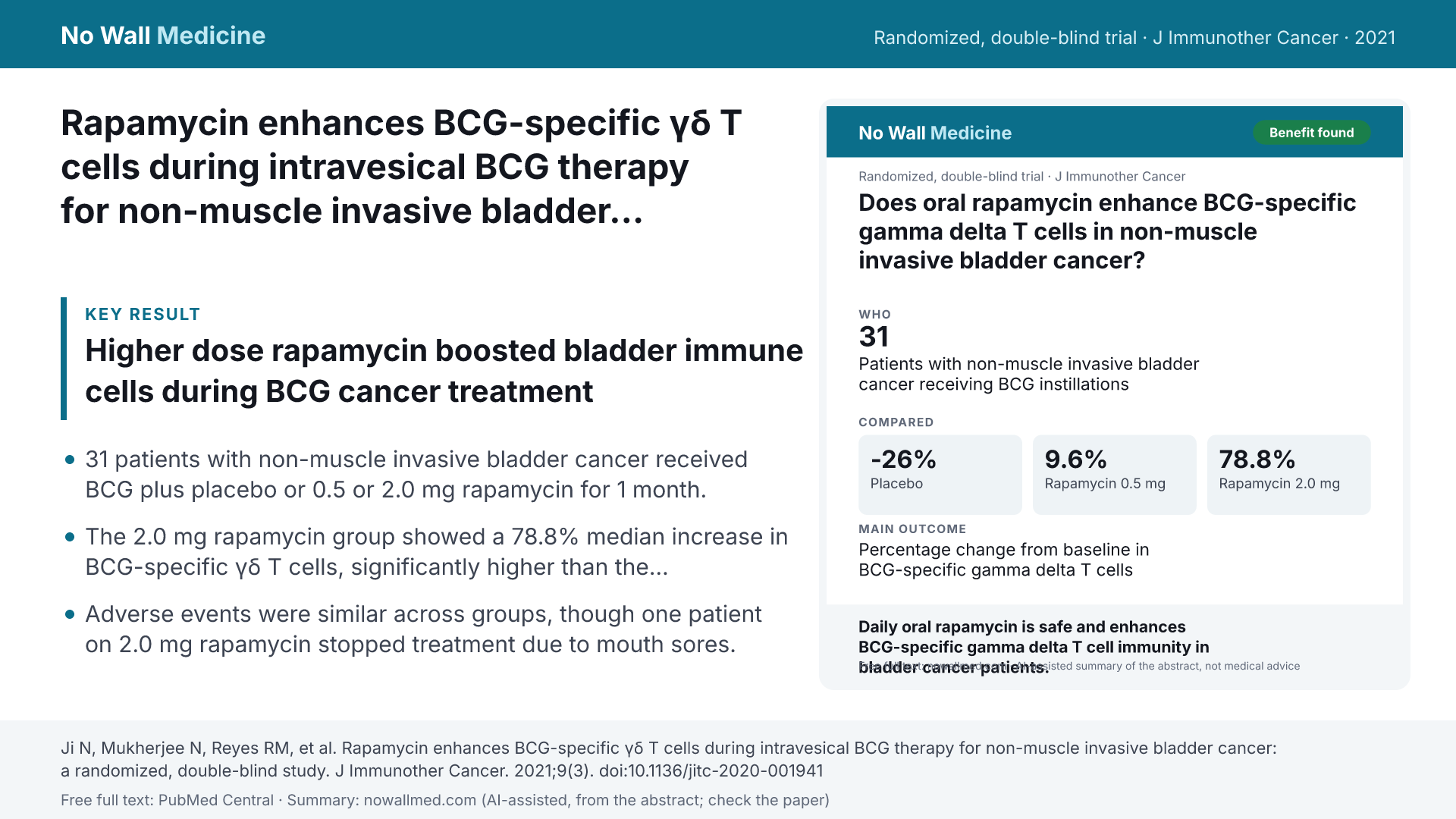
Rapamycin enhances BCG-specific γδ T cells during intravesical BCG therapy for non-muscle invasive bladder cancer: a randomized, double-blind study
Key result: Higher dose rapamycin boosted bladder immune cells during BCG cancer treatment
Randomized, double-blind trialBenefit found
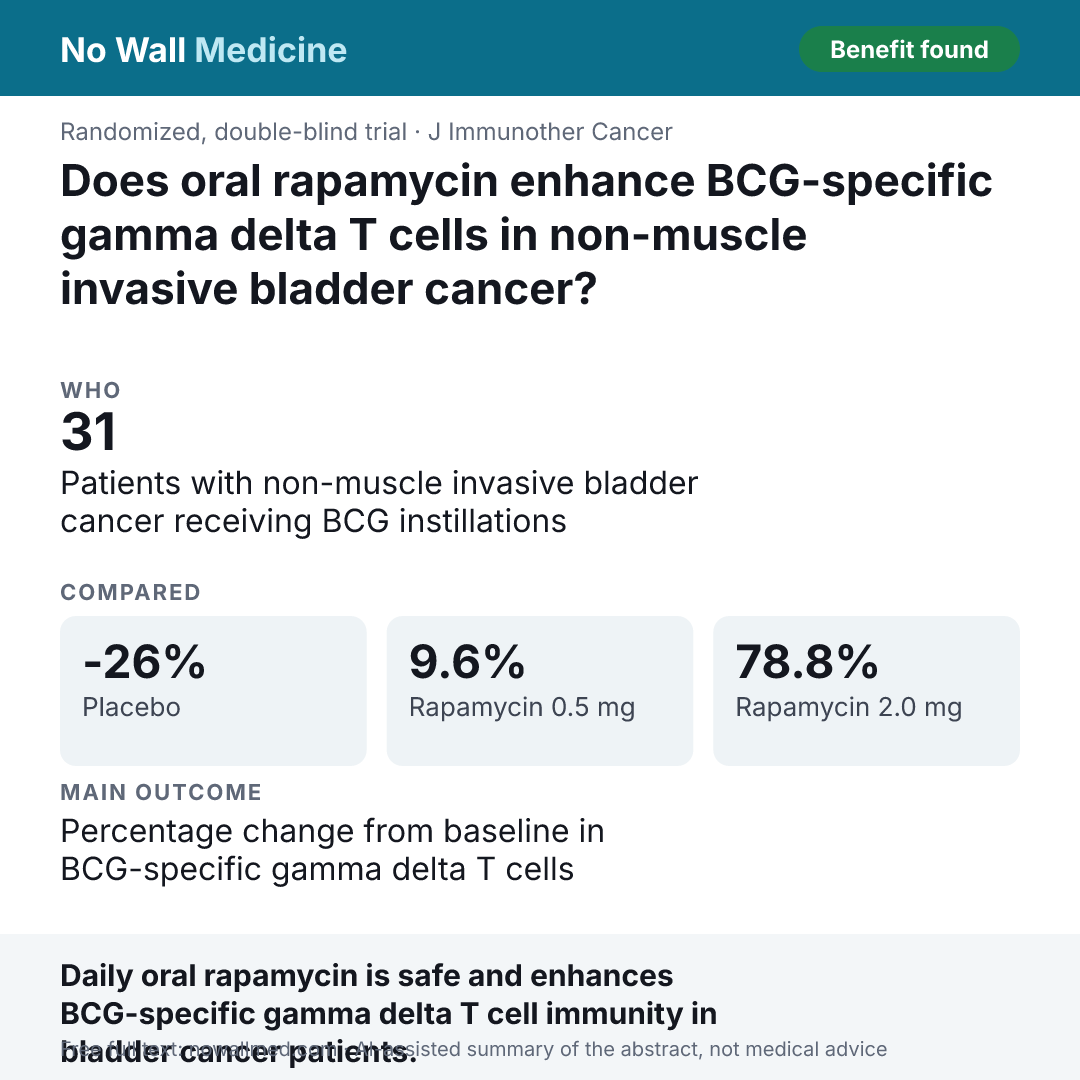
Does oral rapamycin enhance BCG-specific gamma delta T cells in non-muscle invasive bladder cancer?
Who
31
Patients with non-muscle invasive bladder cancer receiving BCG instillations
Compared
-26%Placebo (-51% to 24%)
9.6%Rapamycin 0.5 mg (-59% to 117%)
78.8%Rapamycin 2.0 mg (-31% to 115%)
Main outcome
Percentage change from baseline in BCG-specific gamma delta T cells
Bottom line: Daily oral rapamycin is safe and enhances BCG-specific gamma delta T cell immunity in bladder cancer patients.
J Immunother Cancer · 2021-03-03 · Save PNG
Key points
- 31 patients with non-muscle invasive bladder cancer received BCG plus placebo or 0.5 or 2.0 mg rapamycin for 1 month.
- The 2.0 mg rapamycin group showed a 78.8% median increase in BCG-specific γδ T cells, significantly higher than the placebo group.
- Adverse events were similar across groups, though one patient on 2.0 mg rapamycin stopped treatment due to mouth sores.
Why it matters: Response rates to standard BCG therapy for bladder cancer remain unsatisfactory, and it was unknown if adding rapamycin could enhance the immune response.
Discussion prompts
- Would these patients look like yours? Who was left out?
- Is the main outcome one that matters to patients?
- Is the difference large enough to change what you do?
Cite: Ji N, Mukherjee N, Reyes RM, et al. Rapamycin enhances BCG-specific γδ T cells during intravesical BCG therapy for non-muscle invasive bladder cancer: a randomized, double-blind study. J Immunother Cancer. 2021. doi:10.1136/jitc-2020-001941
Free full text: PubMed Central · Summary and visual abstract: nowallmed.com/a/rapamycin-enhances-bcg-specific-t-cells-during-intravesical-bcg-vdlvvh/ (AI-assisted from the abstract; check the paper before relying on it).