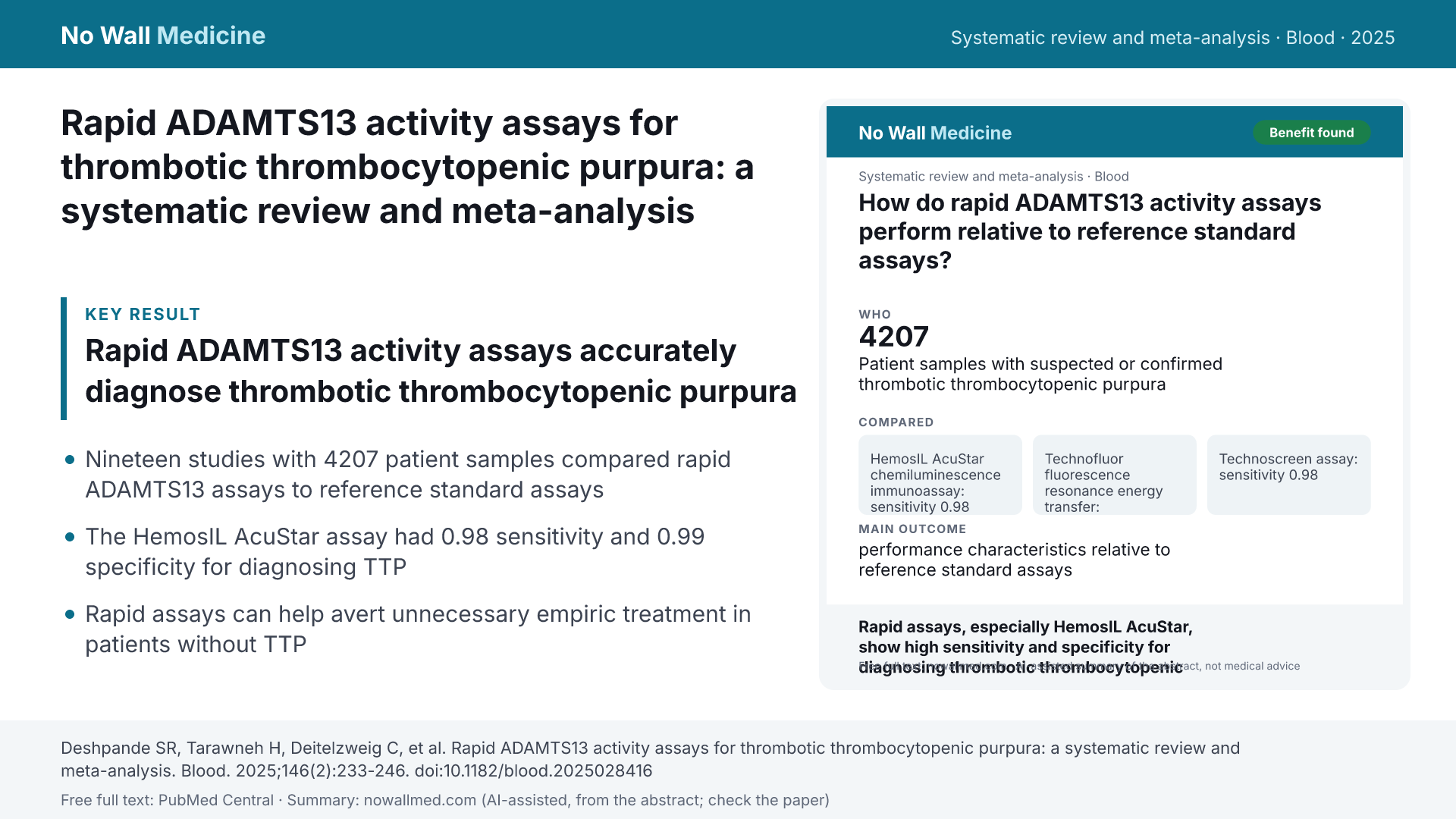
Rapid ADAMTS13 activity assays accurately diagnose thrombotic thrombocytopenic purpura
Rapid ADAMTS13 activity assays for thrombotic thrombocytopenic purpura: a systematic review and meta-analysis
Systematic review and meta-analysisBenefit found
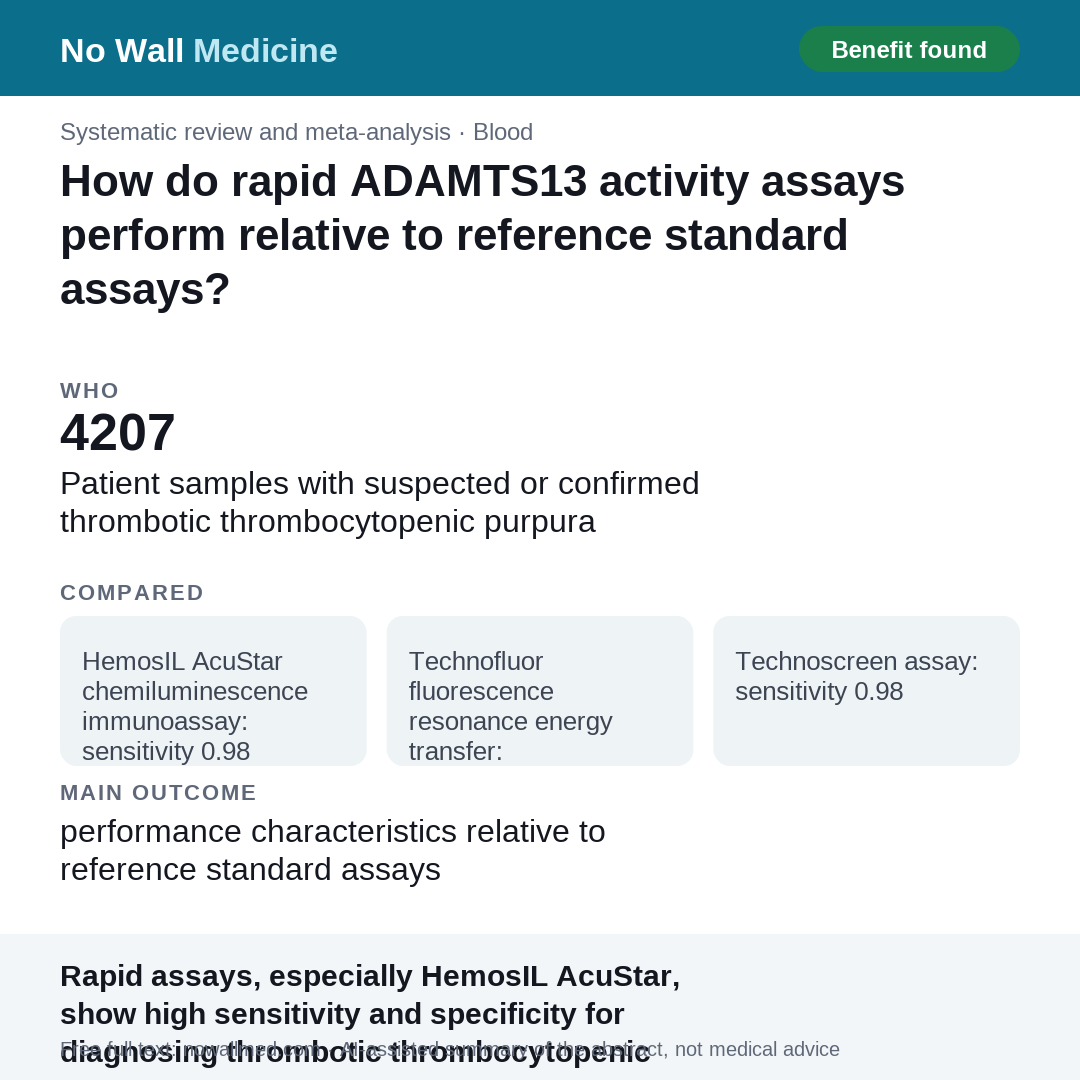
How do rapid ADAMTS13 activity assays perform relative to reference standard assays?
Who
4207
Patient samples with suspected or confirmed thrombotic thrombocytopenic purpura
Compared
HemosIL AcuStar chemiluminescence immunoassay: sensitivity 0.98
Technofluor fluorescence resonance energy transfer: sensitivity 0.93
Technoscreen assay: sensitivity 0.98
Main outcome
performance characteristics relative to reference standard assays
Bottom line: Rapid assays, especially HemosIL AcuStar, show high sensitivity and specificity for diagnosing thrombotic thrombocytopenic purpura.
Blood · 2025-04-21Download image
Clinical question: How do rapid ADAMTS13 activity assays perform relative to reference standard assays?
Why it matters: Reference standard assays have long turnaround times, leading to empiric treatment of many non-TTP patients
Key points
- Nineteen studies with 4207 patient samples compared rapid ADAMTS13 assays to reference standard assays.
- The HemosIL AcuStar assay had 0.98 sensitivity and 0.99 specificity for diagnosing TTP.
- Rapid assays can help avert unnecessary empiric treatment in patients without TTP.
Headline and key points written with AI from the paper’s abstract, with every number checked against it. Read the paper before relying on them.
Was this summary helpful?
Abstract
Thrombotic thrombocytopenic purpura (TTP) is a rare, potentially fatal thrombotic microangiopathy caused by severe ADAMTS13 (a disintegrin and metalloproteinase with thrombospondin motif 13) deficiency. Prompt treatment improves survival; however, reference standard enzyme-linked immunosorbent assay and FRETS-VWF73 ADAMTS13 activity assays have long turnaround times (TATs) that necessitate empiric treatment of many patients who ultimately are found not to have TTP. Rapid assays with analytical TATs <1 hour have recently become available. We conducted a systematic review and meta-analysis of the performance characteristics of rapid assays relative to reference standard assays for ADAMTS13 activity for patients with suspected or confirmed TTP. Nineteen studies representing 3 rapid ADAMTS13 assays and 4207 patient samples were included. The HemosIL AcuStar chemiluminescence immunoassay (CLIA) demonstrated high sensitivity (0.98; 95% confidence interval [CI], 0.94-1.00), specificity (0.99; 95% CI, 0.97-1.00), and positive (PPV) (0.96; 95% CI, 0.90-0.98) and negative predictive values (NPV) (0.99; 95% CI, 0.99-1.00). The Technofluor fluorescence resonance energy transfer (FRET) and Technoscreen assays had sensitivity of 0.93 (95% CI, 0.86-0.96) and 0.98 (95% CI, 0.42-1.00), specificity of 0.98 (95% CI, 0.95-0.99) and 0.87 (95% CI, 0.76-0.94), PPV of 0.97 (95% CI, 0.85-1.00) and 0.71 (95% CI, 0.59-0.80), and NPV of 0.96 (95% CI, 0.93-0.98) and 0.99 (95% CI, 0.72-1.00), respectively. The proportion of discrepant results (relative to reference standard assays) was 0.04 (95% CI, 0.03-0.05) for HemosIL AcuStar, 0.04 (95% CI, 0.02-0.06) for Technofluor FRET, and 0.11 (95% CI, 0.07-0.16) for the Technoscreen assay. With rapid TAT and high sensitivity, the HemosIL AcuStar CLIA seems able to reliably avert empiric plasma exchange, corticosteroids, and caplacizumab in patients without TTP.
Abstract reproduced under the article’s CC BY NC ND licence.
Subject terms
Cite this article
Deshpande SR, Tarawneh H, Deitelzweig C, Tong J, Zhou T, Chen Y. Rapid ADAMTS13 activity assays for thrombotic thrombocytopenic purpura: a systematic review and meta-analysis. Blood. 2025. doi:10.1182/blood.2025028416
Spotted a mistake? Suggest a correction
Top studies every Monday
The week’s key trials and guidelines in your specialties, plus any topics you follow. By email, free.
Get the weekly digest