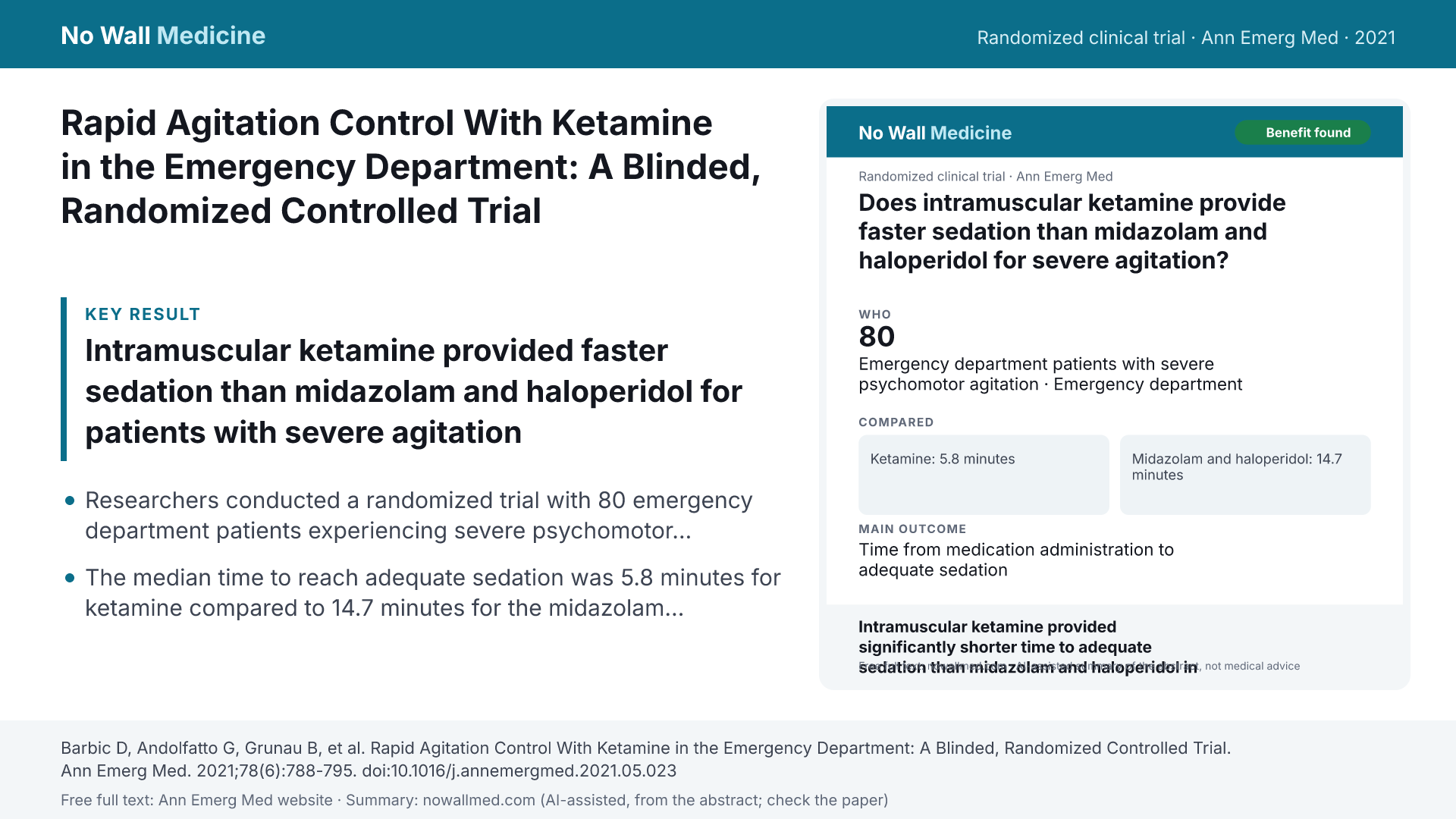
Intramuscular ketamine provided faster sedation than midazolam and haloperidol for patients with severe agitation
Rapid Agitation Control With Ketamine in the Emergency Department: A Blinded, Randomized Controlled Trial
Randomized clinical trialBenefit found
Does intramuscular ketamine provide faster sedation than midazolam and haloperidol for severe agitation?
Who
80
Emergency department patients with severe psychomotor agitation · Emergency department
Compared
Ketamine: 5.8 minutes
Midazolam and haloperidol: 14.7 minutes
Main outcome
Time from medication administration to adequate sedation
Result: hazard ratio 2.43 (95% CI 1.43 to 4.12)
Bottom line: Intramuscular ketamine provided significantly shorter time to adequate sedation than midazolam and haloperidol in agitated patients.
Ann Emerg Med · 2021-08-02 · Save PNG
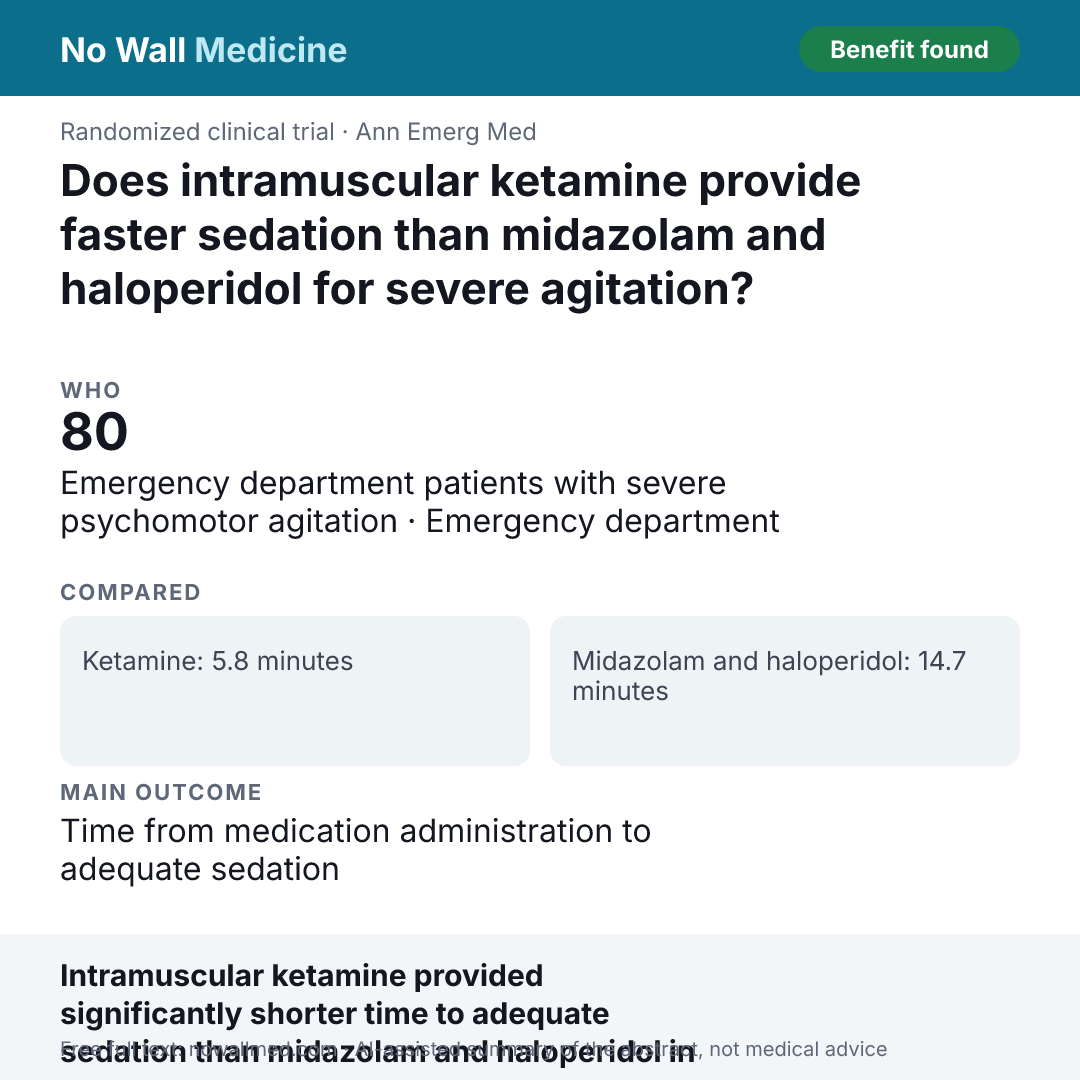
Clinical question: Does intramuscular ketamine provide faster sedation than midazolam and haloperidol for severe agitation?
Key points
- Researchers conducted a randomized trial with 80 emergency department patients experiencing severe psychomotor agitation, comparing ketamine to a combination of midazolam and haloperidol.
- The median time to reach adequate sedation was 5.8 minutes for ketamine compared to 14.7 minutes for the midazolam and haloperidol group.
- Serious adverse events occurred in 12.5% of the ketamine group and 5.0% of the midazolam and haloperidol group.
Headline and key points written with AI from the paper’s abstract, with every number checked against it. Read the paper before relying on them.
Was this summary helpful?
Subject terms
Headline, design, result, key points, caveat and citation as plain text.
Cite this article
Barbic D, Andolfatto G, Grunau B, et al. Rapid Agitation Control With Ketamine in the Emergency Department: A Blinded, Randomized Controlled Trial. Ann Emerg Med. 2021. doi:10.1016/j.annemergmed.2021.05.023
Spotted a mistake? Suggest a correction