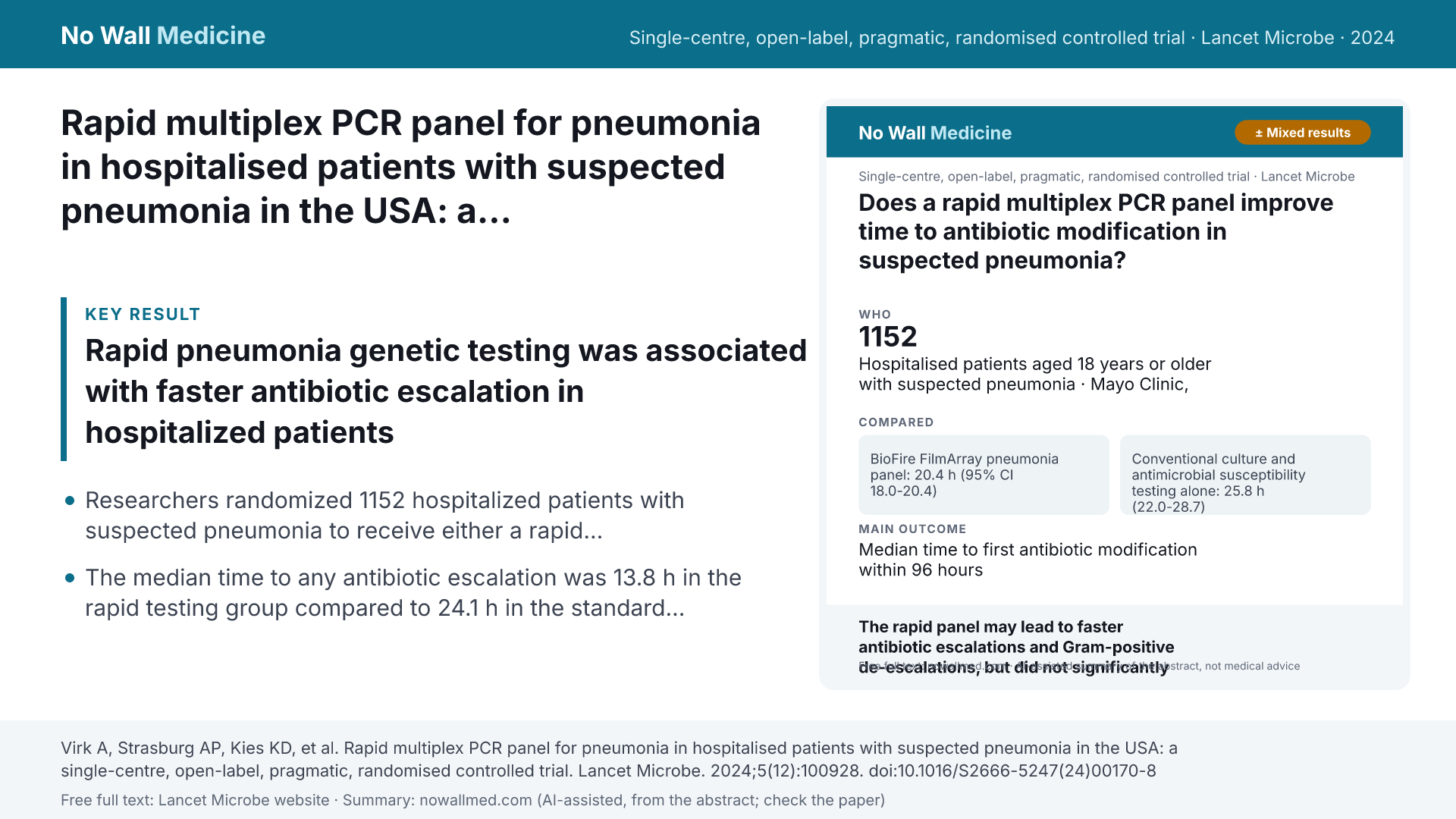
Rapid multiplex PCR panel for pneumonia in hospitalised patients with suspected pneumonia in the USA: a single-centre, open-label, pragmatic, randomised controlled trial
Key result: Rapid pneumonia genetic testing was associated with faster antibiotic escalation in hospitalized patients
Key points
- Researchers randomized 1152 hospitalized patients with suspected pneumonia to receive either a rapid multiplex polymerase chain reaction (PCR) panel or standard culture and susceptibility testing.
- The median time to any antibiotic escalation was 13.8 h in the rapid testing group compared to 24.1 h in the standard care group.
- The median time to the first antibiotic modification of any kind did not show a statistically significant difference between the two groups (20.4 h versus 25.8 h).
Why it matters: The clinical utility of rapid multiplex respiratory specimen polymerase chain reaction (PCR) panels for pneumonia in hospitalized patients is undefined.
Discussion prompts
- Would these patients look like yours? Who was left out?
- Is the main outcome one that matters to patients?
- Is the difference large enough to change what you do?
Cite: Virk A, Strasburg AP, Kies KD, et al. Rapid multiplex PCR panel for pneumonia in hospitalised patients with suspected pneumonia in the USA: a single-centre, open-label, pragmatic, randomised controlled trial. Lancet Microbe. 2024;5(12):100928. doi:10.1016/S2666-5247(24)00170-8
Free full text: Lancet Microbe website · Summary and visual abstract: nowallmed.com/a/rapid-multiplex-pcr-panel-for-pneumonia-in-hospitalised-patients-with-imosvn/ (AI-assisted from the abstract; check the paper before relying on it).