Trial design evaluates if mitiperstat improves symptoms and exercise capacity in heart failure patients
Rationale and design of ENDEAVOR: A sequential phase 2b-3 randomized clinical trial to evaluate the effect of myeloperoxidase inhibition on symptoms and exercise capacity in heart failure with preserved or mildly reduced ejection fraction
Sequential phase 2b-3 randomized clinical trialUnclear result
Does mitiperstat improve symptoms and exercise capacity in heart failure patients?
Who
Patients with heart failure and ejection fraction >40%
Compared
Mitiperstat 2.5 mg, 5 mg or placebo
Mitiperstat or placebo
Main outcome
6-minute walk distance and Kansas City Cardiomyopathy Questionnaire total symptom score
Bottom line: ENDEAVOR is a study designed to evaluate if myeloperoxidase inhibition improves heart failure symptoms and exercise capacity.
Eur J Heart Fail · 2023-08-22Download image
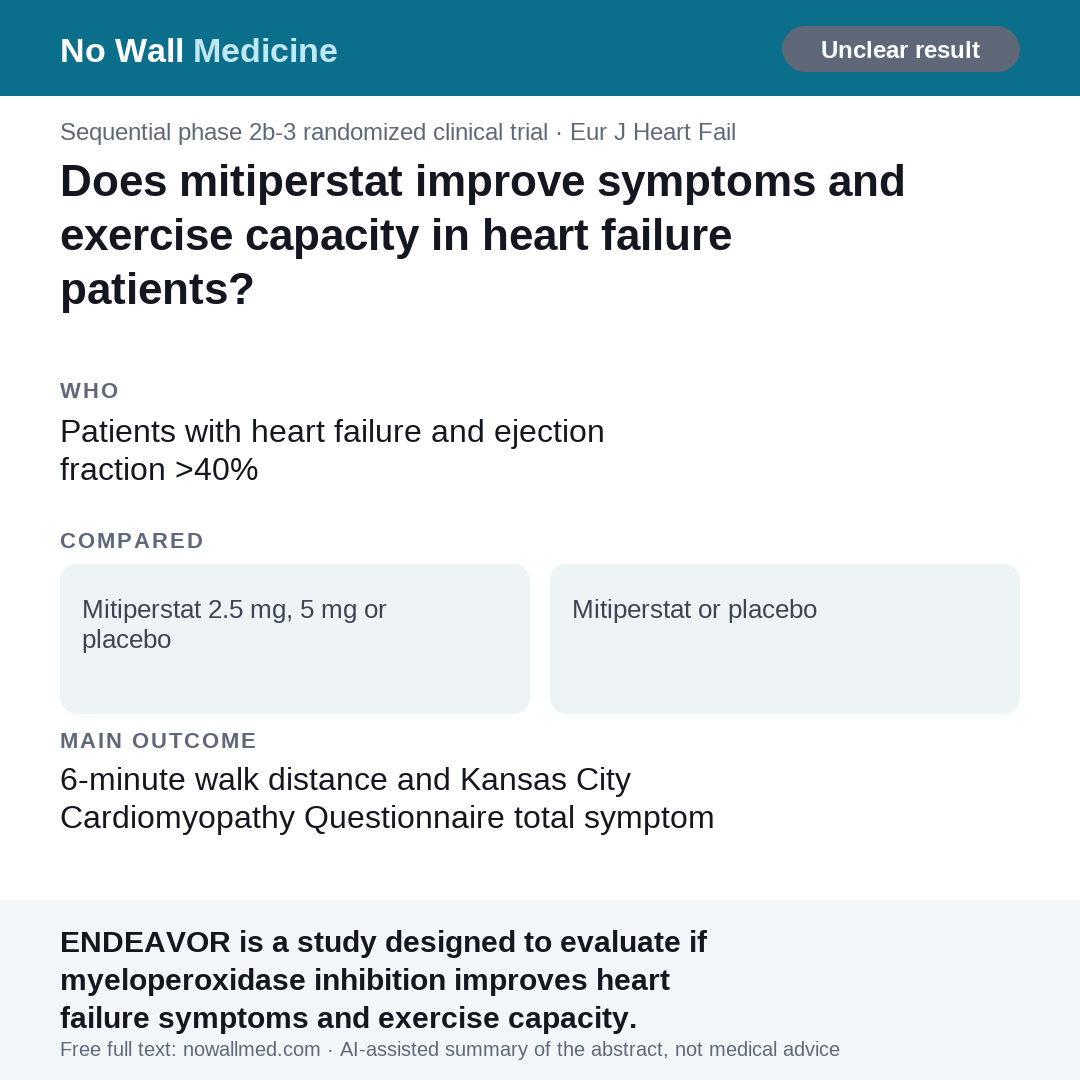
Clinical question: Does mitiperstat improve symptoms and exercise capacity in heart failure patients?
Why it matters: No effective therapies currently target systemic inflammation, which may be a mechanism underlying heart failure with preserved or mildly reduced ejection fraction.
Key points
- The ENDEAVOR trial will involve approximately 660 patients in phase 2b receiving mitiperstat or placebo and approximately 820 patients in phase 3 receiving mitiperstat or placebo.
- Researchers are measuring changes in the 6-minute walk distance and the Kansas City Cardiomyopathy Questionnaire total symptom score over 48 weeks.
- The study aims to detect placebo-adjusted improvements of 21 m in walking distance and 6.0 points in symptom scores.
Headline and key points written with AI from the paper’s abstract, with every number checked against it. Read the paper before relying on them.
Topics
Cite this article
Lund LH, Lam CSP, Pizzato PE, Gabrielsen A, Michaëlsson E, Nelander K. Rationale and design of ENDEAVOR: A sequential phase 2b-3 randomized clinical trial to evaluate the effect of myeloperoxidase inhibition on symptoms and exercise capacity in heart failure with preserved or mildly reduced ejection fraction. Eur J Heart Fail. 2023. doi:10.1002/ejhf.2977
Spotted a mistake? Suggest a correction
Top studies every Monday
The week’s key trials and guidelines in your specialties, plus any topics you follow. By email, free.
Get the weekly digest