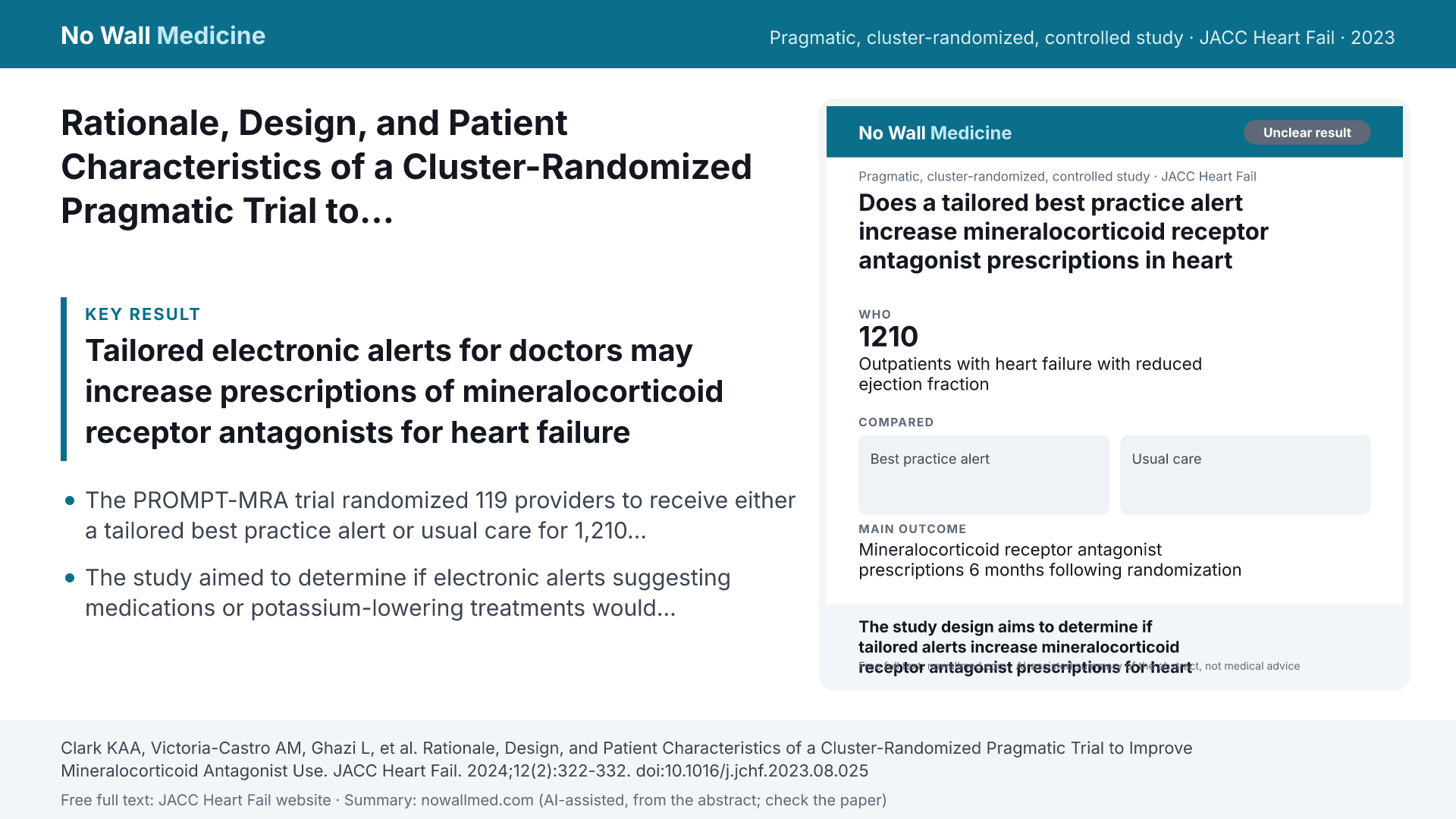
Tailored electronic alerts for doctors may increase prescriptions of mineralocorticoid receptor antagonists for heart failure
Rationale, Design, and Patient Characteristics of a Cluster-Randomized Pragmatic Trial to Improve Mineralocorticoid Antagonist Use
Pragmatic, cluster-randomized, controlled studyUnclear result
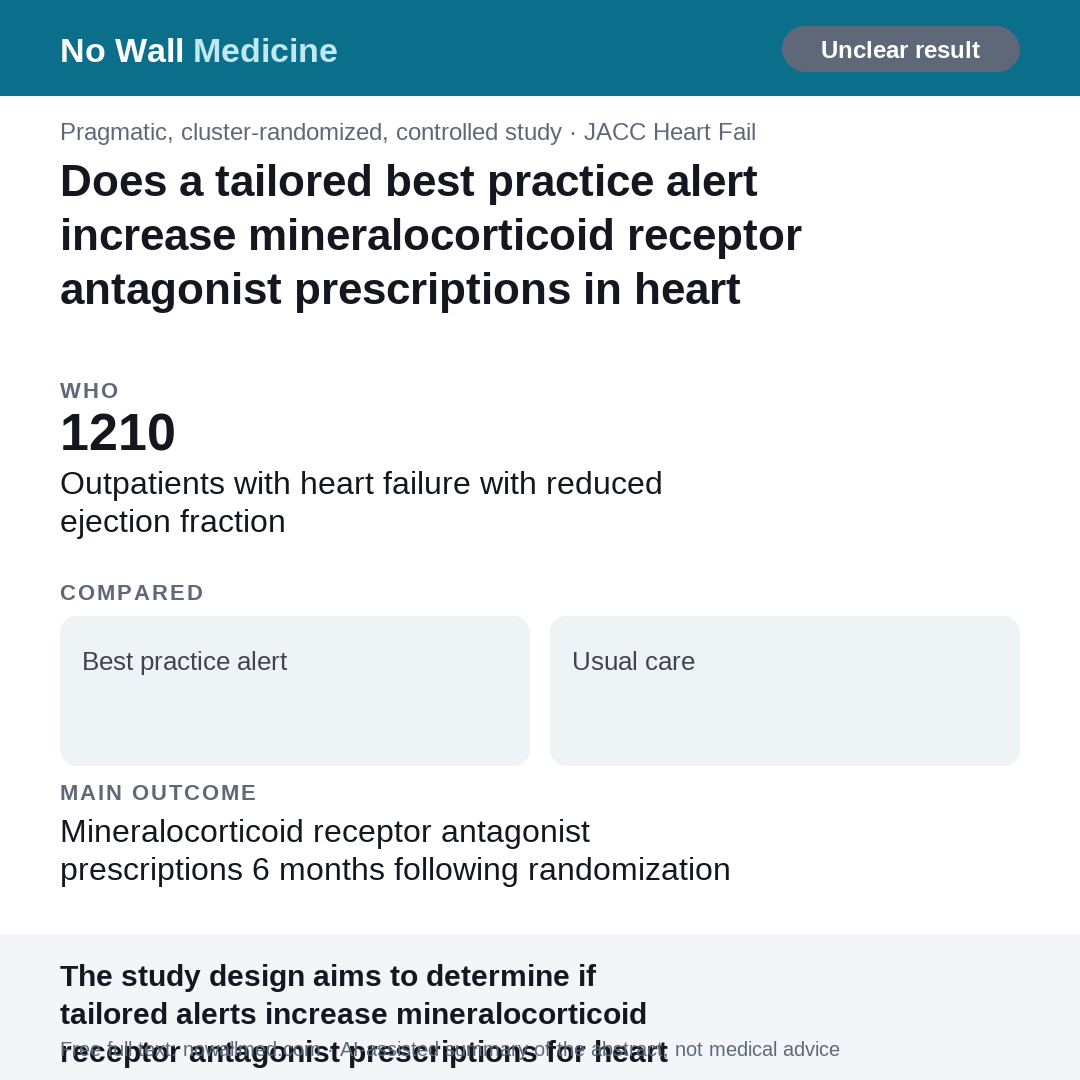
Does a tailored best practice alert increase mineralocorticoid receptor antagonist prescriptions in heart failure patients?
Who
1210
Outpatients with heart failure with reduced ejection fraction
Compared
Best practice alert
Usual care
Main outcome
Mineralocorticoid receptor antagonist prescriptions 6 months following randomization
Bottom line: The study design aims to determine if tailored alerts increase mineralocorticoid receptor antagonist prescriptions for heart failure patients.
JACC Heart Fail · 2023-11-08Download image
Clinical question: Does a tailored best practice alert increase mineralocorticoid receptor antagonist prescriptions in heart failure patients?
Why it matters: Mineralocorticoid receptor antagonists remain underused in clinical practice despite strong guideline recommendations for patients with heart failure with reduced ejection fraction.
Key points
- The PROMPT-MRA trial randomized 119 providers to receive either a tailored best practice alert or usual care for 1,210 patients with heart failure with reduced ejection fraction.
- The study aimed to determine if electronic alerts suggesting medications or potassium-lowering treatments would increase prescriptions of mineralocorticoid receptor antagonists within 6 months of randomization.
- Secondary outcomes measured in the trial included the incidence of hyperkalemia, use of novel potassium binders, heart failure hospitalizations, and mortality.
Headline and key points written with AI from the paper’s abstract, with every number checked against it. Read the paper before relying on them.
Was this summary helpful?
Subject terms
Cite this article
Clark KAA, Victoria-Castro AM, Ghazi L, Yamamoto Y, Coronel-Moreno C, Kadhim BA. Rationale, Design, and Patient Characteristics of a Cluster-Randomized Pragmatic Trial to Improve Mineralocorticoid Antagonist Use. JACC Heart Fail. 2023. doi:10.1016/j.jchf.2023.08.025
Spotted a mistake? Suggest a correction
Top studies every Monday
The week’s key trials and guidelines in your specialties, plus any topics you follow. By email, free.
Get the weekly digest