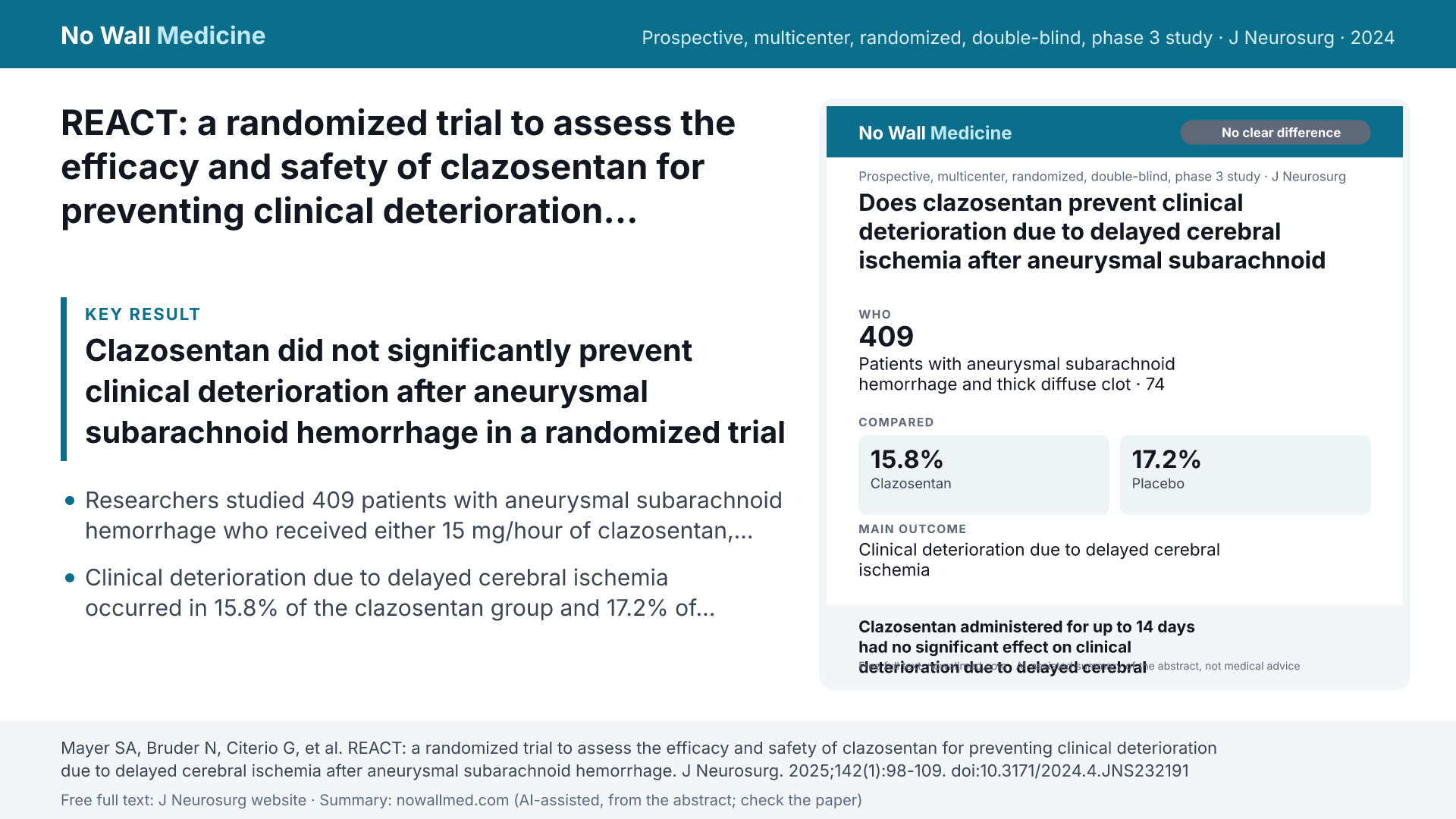
REACT: a randomized trial to assess the efficacy and safety of clazosentan for preventing clinical deterioration due to delayed cerebral ischemia after aneurysmal subarachnoid hemorrhage
Key result: Clazosentan did not significantly prevent clinical deterioration after aneurysmal subarachnoid hemorrhage in a randomized trial
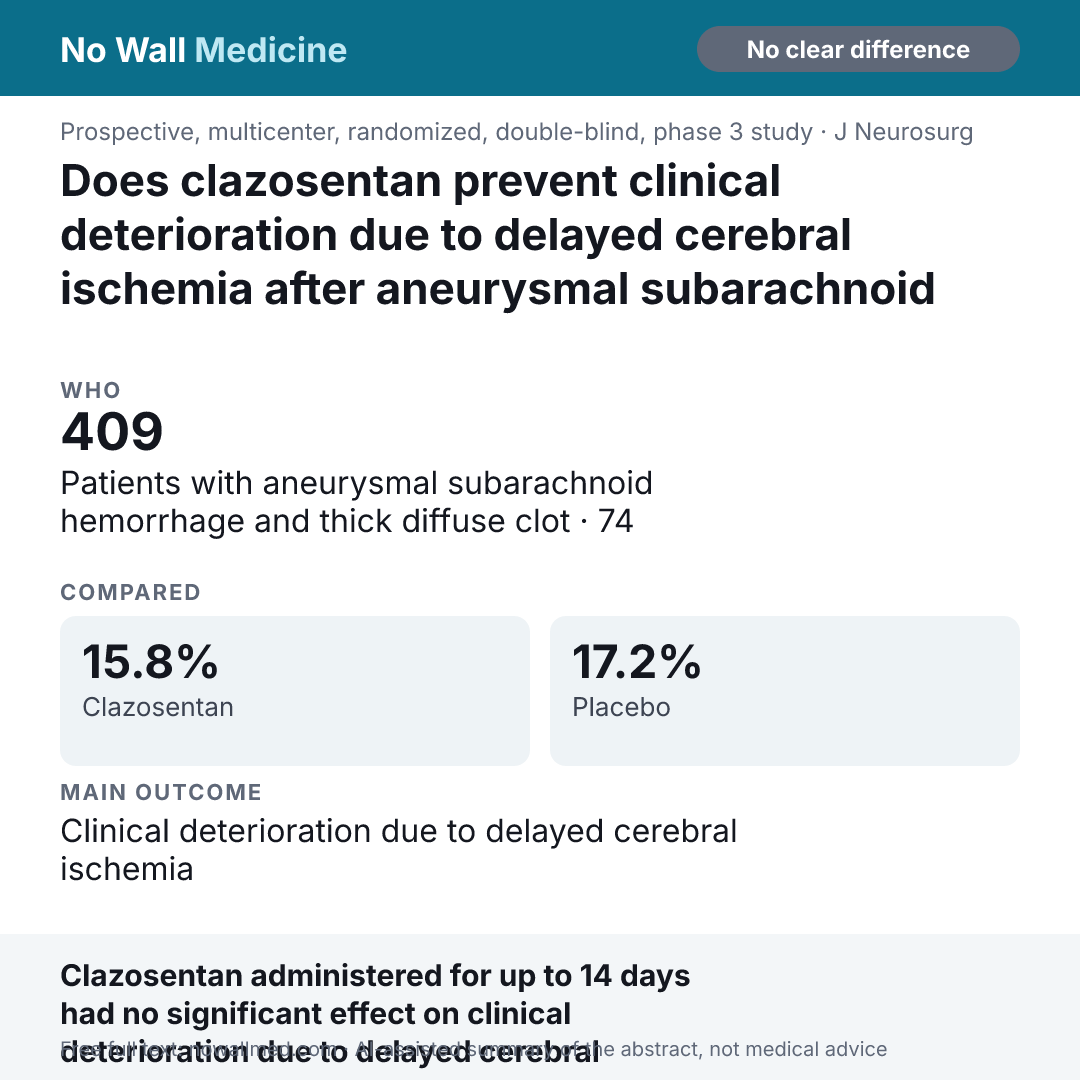
Prospective, multicenter, randomized, double-blind, phase 3 studyNo clear difference
Does clazosentan prevent clinical deterioration due to delayed cerebral ischemia after aneurysmal subarachnoid hemorrhage?
Who
409
Patients with aneurysmal subarachnoid hemorrhage and thick diffuse clot · 74 international sites
Compared
15.8%Clazosentan (32/202)
17.2%Placebo (35/204)
Main outcome
Clinical deterioration due to delayed cerebral ischemia
Result: relative risk reduction 7.2%, 95% CI -42.6% to 39.6%
Bottom line: Clazosentan administered for up to 14 days had no significant effect on clinical deterioration due to delayed cerebral ischemia.
J Neurosurg · 2024-08-09 · Save PNG
Key points
- Researchers studied 409 patients with aneurysmal subarachnoid hemorrhage who received either 15 mg/hour of clazosentan, an endothelin receptor antagonist, or a placebo.
- Clinical deterioration due to delayed cerebral ischemia occurred in 15.8% of the clazosentan group and 17.2% of the placebo group, which was not a statistically significant difference.
- Clinically relevant cerebral infarction occurred in 7.4% of the clazosentan group compared to 11.3% in the placebo group, though this difference was also not statistically significant.
Discussion prompts
- Would these patients look like yours? Who was left out?
- Is the main outcome one that matters to patients?
- Is the difference large enough to change what you do?
Cite: Mayer SA, Bruder N, Citerio G, et al. REACT: a randomized trial to assess the efficacy and safety of clazosentan for preventing clinical deterioration due to delayed cerebral ischemia after aneurysmal subarachnoid hemorrhage. J Neurosurg. 2025;142(1):98-109. doi:10.3171/2024.4.JNS232191
Free full text: J Neurosurg website · Summary and visual abstract: nowallmed.com/a/react-a-randomized-trial-to-assess-the-efficacy-and-safety-of-1331awq/ (AI-assisted from the abstract; check the paper before relying on it).